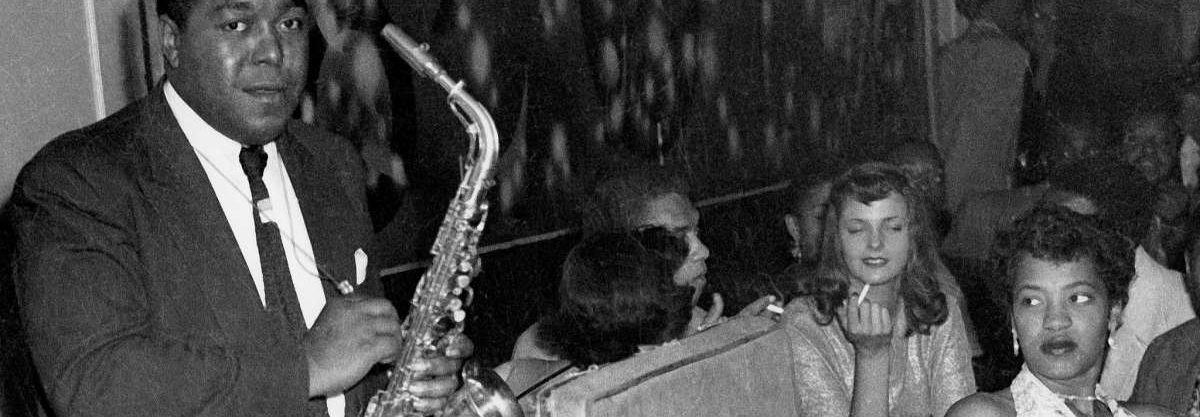

Parkeology 007: So There
Bird never talked about music, except one time I heard him arguing with a classical musician friend of mine. He told the cat that you can do anything with chords. I disagreed, told him that you couldn’t play D natural in the fifth bar of a B-flat blues. He said you could. One night later on at Birdland, I heard Lester Young do it. Bird was there when it happened and he just looked over at me with that “I told you so” look that he would lay on you when he had proved you wrong. – Miles Davis
One thing I like about this quote is Miles’s reference to Bird’s “I told you so look.” It reflects the level of intimacy they developed, despite their contentious relationship. It also implies that Bird had proved him wrong on more than one occasion.
I also like the image of Bird and Miles sitting around Birdland listening to Lester. It suggests that Lester was still a source of inspiration to them, at a time (early 50s) when jazz critics were writing him off.
But it’s not entirely clear what Miles is referring to. Was Bird arguing that you can make any note work over any chord? So it seems, since Miles refutes it by saying you can’t play the major 7th over a dominant 7th chord.
We will travel back to Lester’s Basie years to hear him do just that, in the fifth bar of a 12 bar blues. This is the only example I’m aware of on a blues, but there must be others. It comes from a live version of Pound Cake, broadcast from the Famous Door in 1938 (Savory Collection, complete track below).
Lester uses the major seventh in the fifth bar of both choruses. (In other words, he doesn’t flat the 3rd of the I chord.)
Lester’s final recording session with Basie (11/19/40) included an arrangement of Broadway (complete track below). It’s not a blues, but the A section goes to IV dominant 7 in bars three and four. In the last A of his solo on Take 1, Lester milks the major 7th for all it’s worth (using the minor 7th as an approach note).
If Bird believed any note could work over any chord, he didn’t go out of his way to prove it. His lines often imply chord substitutions that are out of key, up or down a half step, or a tritone away, but they are always diatonic within themselves. This isn’t the same as using specific non-diatonic notes that conflict with the chord, as Lester does.
I only know of one example where Bird deliberately uses a very non-diatonic note. In bar 9 of Embraceable You, from Bird at St. Nick’s, he plays the major 3rd (F#) on top of D minor chord (complete track below).
Then again, there’s Bird on 52nd Street, but that album is an alternate universe all its own. Dean Benedetti recorded Bird at the Onyx Club in July 1948, using paper-based tape, which gives these recordings a surreal (if you want to be charitable) sound quality. More to the point, they capture Bird’s all-time strangest playing, filled with dissonant notes and oddities of every sort. It’s fun to speculate as to why this might be, but not at the moment, so we will proceed straight to Out Of Nowhere (#223) (complete track below).
We join Bird in the last half of his second and final chorus. He paraphrases the melody, and when he arrives at the F natural, he holds it for almost three bars. This is fine on the Eb7, but when the chord changes back to Gmaj7, it becomes the flat 7. Then, as the key is changing to A minor, Bird deliberately plays a jarring C#. He lets go of it just as the I chord arrives, playing the major 3rd on a minor chord by sleight of hand.
Bird proved other musicians wrong all the time, by playing ideas so startling that they couldn’t believe their ears. Teddy Reig, Savoy’s ursine A&R man, speaks to this:
He’d play things and all the guys like John Lewis, Miles, Dizzy, would run to the piano to check out the harmonic progressions to determine whether he was crazy or right. And he was always right! He’d turn away and laugh.
If, however, you want to hear Bird play major 7ths over dominant 7th chords, cast down your buckets where you are. He does it consistently in the first three bars of the blues form.
Perhaps (Savoy 9/24/48) provides one of the clearest examples. The melody employs the major 7th twice in the first two bars. By all appearances, Bird considers the I chord to be Cmaj7. This is just as true of his solo (complete track below).
But I framed this in a misleading way. John Lewis is also treating it as Cmaj7, so there’s no actual conflict. This touches on a much broader subject, i.e. the evolution of the blues form, about which I know next to nothing. But it seems to me it was a lot more flexible back then.
I mean, it’s not like Bird didn’t know how to play the blues.
Here are the complete tracks of Pound Cake, Broadway, Embraceable You, Perhaps, and Out Of Nowhere.
 Charlie Parker 2020 - A Bird Centennial Blog