
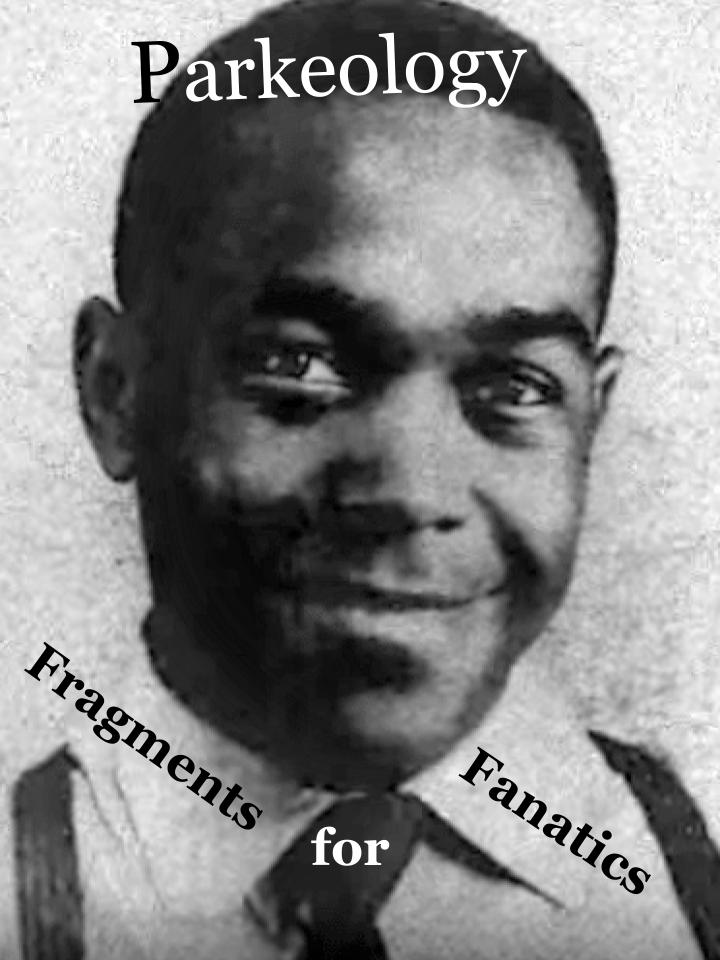
Parkeology 008: Blow Me Down
Charlie had a very nice disposition, kind of happy-go-lucky. During that time they had the comic strip Popeye. Charlie used to imitate Popeye’s deep toned voice, and he used to make that deep tone on his horn. – Ernest Daniels
Bird loved movies from an early age. The first Popeye cartoon was released in 1933, when Bird was thirteen, and it’s likely he saw many Popeye shorts as a teenager. Both the comic strip and the cartoons were wildly popular in their day.
The Popeye theme song became one of Bird’s quotes, as did the Sailor’s Hornpipe, which is used in the cartoon’s opening credits.
I only know of one Hornpipe example, found in the trio version of Cherokee, (Bird, guitar, inaudible drums), generally dated 1943. Bird breaks into a jig on the bridge, bars 43 & 44.
You might expect to find Popeye quotes in other early recordings, as well, but that’s not the case.
Bird used quotes sparingly in the first half of his career (1940–1946), particularly in the recording studio, but also in live performances. For example, quotes are few in the JATP concert from January 1946, the Finale Club broadcasts from March 1946, and even the very extensive Dean Benedetti recordings from March 1947. Furthermore, when Bird did quote, he was inclined to borrow from other jazz soloists, not from popular song.
All that began to change when Bird returned to New York in April 1947, and by the end of the decade he was quoting everything from Pop Goes The Weasel to The Rite Of Spring.
So the first Popeye quote (as far as I can determine) was documented on March 31st, 1948, at the Three Deuces. Bird quotes it during All The Things You Are, leading into the bridge of his second chorus.
Another Popeye quote pops up out of nowhere in Out Of Nowhere, recorded at Birdland on 2/14/50. Bird busts out the spinach in the second half of the out-chorus.
Note that both quotes are in concert G major. This hints at a much larger topic: Bird’s ideas are usually specific to the key he’s in. In other words, he plays most of his common phrases in the same key every time. Consider this reflexive motif, always played in concert F major. (All five excerpts come from the Royal Roost broadcasts.)
I believe Bird relied a lot on muscle memory, but no time for that now.
One of Bird’s most ubiquitous quotes is The Kerry Dance, by John McCormack. Here’s an excerpt, sung by the composer in 1936.
As far as I can tell, this quote makes its debut on or about July 6th, 1948, at the Onyx Club. Bird quotes it on Out Of Nowhere, in bars 19 & 20 of his first chorus. The tune is in G major and so is the quote.
It next appears at the Royal Roost, in the early hours of New Year’s Day, 1949. Bird uses it to close his solo on Ornithology. Again, both song and quote are in G major.
It then makes an appearance at Carnegie Hall, on Christmas Eve, 1949. Bird uses it on All The Things You Are, in his second bridge. The tune is in Ab major, but it goes to G major in the bridge, which puts the quote in G major again.
Bird uses it to comic effect at Massey Hall (5/25/53), again in G major, again in the bridge of All The Things You Are. You can hear Dizzy crack up.
At this point, you might conclude that Bird always quotes Kerry Dance in G major.
Not so fast. Back to the Royal Roost (12/12/48). Bird quotes Kerry Dance on Out Of Nowhere again, but he does so up a half step, in A-flat major, over bars 3 & 4 (Bbm7 / Eb7). The result is a musical pun. The last note of the quote is the seventh scale degree. In the key of A-flat, that’s a G. Bird times it so that the G arrives just as the chord changes back to Gmaj7, making it sound as the root.
So you can’t claim that Bird always quotes Kerry Dance in G major. And yet transposing ideas up a half step was common practice back then. You could make the case, if you don’t mind some eye rolling, that he always quotes Kerry Dance in G major, except when he moves it up to A-flat.
What about Popeye? In both instances, Bird quotes it in G major. Is it safe to claim he always played that in the same key?
No. Back to Carnegie Hall and All The Things You Are. Bird quotes Popeye in the last A of his second chorus, and it’s definitely not in G. Like it or not, though, he plays it up a half step in A-flat! How much eye rolling are you willing to endure?
I will conclude by throwing myself under the bus. I conveniently forgot to mention that Bird quotes Kerry Dance in the recording studio, in the key of F major. The tune is Ah-Leu-Cha (Savoy 9/18/48), and he inserts it right after the piano solo, when he starts the fours.
So that makes three different keys for Kerry Dance, G major, Ab major, and F major. That still doesn’t stop me from arguing that Bird always plays it in G major, except when he doesn’t.
I yam what I yam.
 Charlie Parker 2020 - A Bird Centennial Blog
Bird Lives.
LikeLike