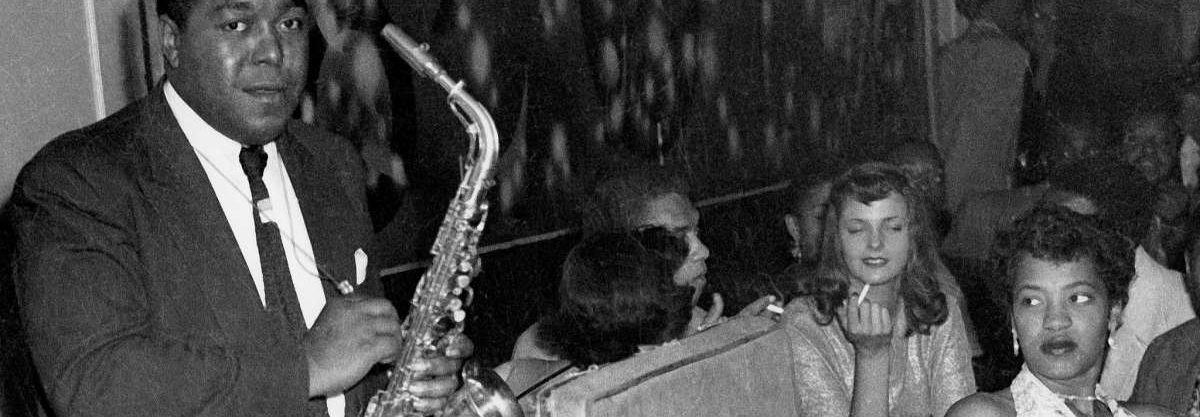

Parkeology 017: Growl Talk
There are all kinds of anecdotes and stories about Bird, but he was really a shy, humble person. He was thoughtful and considerate of other people, and you can hear that in his playing, the great beauty in his playing. There was some anger–we all get angry–and you can hear the anger in his playing when he felt that way. I think he, more than most of us… you can hear his feelings when you listen to him, because he was so proficient that he could get out anything he felt. – Red Rodney
I can’t point to any Bird solos that convey anger to me, but many have an aggressive edge, possibly related to his use of amphetamines. (One witness said hearing Bird perform live was like having knives thrown at you.) On the other hand, there are many solos that convey to me absolute serenity, possibly related to Bird’s use of narcotics.
Any discussion of Bird’s growls and the emotions they express will be subjective, but I’m going to make the case for one particular emotion: chagrin.
First things first. The growling sound on saxophone is produced in the throat, by humming while moving air through the horn. This isn’t as easy as it sounds, but anyone can master it, and some have made careers out of it. In the Swing Era, the technique was associated with Ben Webster in particular.
Bird expresses a variety of emotions through growls, but they’re also his response when he’s unhappy with the way things are going in the moment.
Exhibit A comes from the Royal Roost on January 22, 1949. The tune is “Scrapple From The Apple,” and in the fifth bar of his first A, Bird is the victim of a stuck low C-sharp key. (All notes are named in E-flat.) He’s coming down the D major scale, intending to end on low C-sharp, but a low C sounds instead, a conspicuous clam. Bird drops out for a moment to pry open his C-sharp key, and returns with a growl that’s clearly prompted by this malfunction (track slowed down for clarity).
This got me thinking about Bird’s growls in general, and further listening revealed a surprising fact: he doesn’t growl at all during his tenure with Jay McShann (1940 through 1942). By late 1943, though, he’s growling left and right on the Charles White discs (all four tracks below).
Another surprising fact turns the tables again: Bird almost never growls on the Dial and Savoy recordings (1945 through 1948). This must have been a conscious choice, related, perhaps, to his restriction on quotes in the studio during this period.
I’ve chosen “Body And Soul” from the Charles White discs because Bird growls frequently throughout, more so than on the other three tunes. It seems counterintuitive that he would growl so much on a ballad, but I suspect his intimate acquaintance with the chord changes fired him up, along with the double time section. In truth, this outing is pretty much a romp.
So here are twenty “Body And Soul” growls. In my opinion, none of these falls into the “chagrin” category. I’m inclined to go with exuberance all the way (track slowed down for clarity).
Make of it what you will, Bird’s only growls on the Dial recordings also happen on ballads. The clearest example is the famous Take A of “Embraceable You,” from October 28, 1947. Bird growls twice, a multi-note growl from 0:49 to 0:53, then a single growl at 1:41, on the last note of the phrase. Here are both excerpts:
If you go through other Dial and Savoy tracks with a fine tooth comb, you can find subtle growls here and there, but if “Body And Soul” is your baseline, they don’t even count.
Back to chagrin, and this time Bird’s horn is working fine. The tune is “Cheryl,” March 5, 1949, Royal Roost. It’s an example of Bird realizing he’s about to repeat himself (intolerable) and ditching in mid-phrase. He starts his solo with this motif:
Then, when he reaches the top of his third chorus, he begins to repeat it and awkwardly pulls the plug:
It doesn’t rate a growl, though, unlike the next example.
This comes from the midnight Carnegie Hall performance with strings, on September 16, 1950. The tune is Gerry Mulligan’s “Rocker.” Bird begins to repeat a phrase he’d played just two bars before, forcing him to ditch. This must have been doubly annoying, and he growls at the start of the next phrase. The two excerpts go first, then the full nine-bar section (track slowed down for clarity):
Sometimes a growl can be a comment on an entire solo, as happens on “Salt Peanuts,” from the legendary May 15, 1945 date for Guild. I don’t think Bird was happy with his performance, and I believe the growl at the end expresses his displeasure.
First, he fumbles coming out of the improvised bridge. Although he handles this with astonishing poise, it still counts as a mistake:
There’s more trouble in the solo itself. His first phrase ends badly:
There are two blemishes in a row on the bridge: another bad phrase ending and then a squeal:
Even the phrase ending just before the growl isn’t entirely successful:
We’ll never know why Bird’s growls came and went. He was no doubt aware of this technique during his apprenticeship period. At the very least, he was well acquainted with Ellington’s “Cotton Tail,” recorded and released in May 1940. Ben Webster growls throughout his famous 64-bar solo.
Here’s Bird on tenor in 1943, backing up Billy Eckstine (on trumpet) as he solos over “I Got Rhythm.” (Try to ignore the other nameless tenor player.) Bird uses “Cotton Tail” as a background riff and quotes the bridge from the saxophone soli. As the recording sputters to an end, he recreates Webster’s sound, growl and all, with uncanny accuracy:
The Charles White disks may represent a high water mark for growling, but examples can be found on live recordings throughout Bird’s career, and he permits growling in the studio during his final Mercury (Verve) period.
Despite the above, chagrin is seldom the emotion involved. Bird wasn’t trying to evoke simple, everyday emotions. He was talking about ideas and experiences, as he explained in a 1953 radio interview with John Fitch, a well-meaning square with a knack for asking unanswerable questions. Here, he asks Bird how his conception will evolve in the future. Bird replies:
That’s hard to tell, too, John. See, your ideas change as you grow older. Most people fail to realize that most of the things they hear, either coming out of a man’s horn ad lib, or else things that are written, original things, I mean, they’re just experiences. The way you feel, the beauty of the weather, the nice look of a mountain, maybe a nice fresh cool breath of air. All those things. You can never tell what you’ll be thinking tomorrow.
Talk about angry!!!
* * * * *
Here are all four selections from the Charles White discs: “Cherokee,” “My Heart Tells Me,” “I Found A New Baby,” and “Body And Soul.”
 Charlie Parker 2020 - A Bird Centennial Blog