
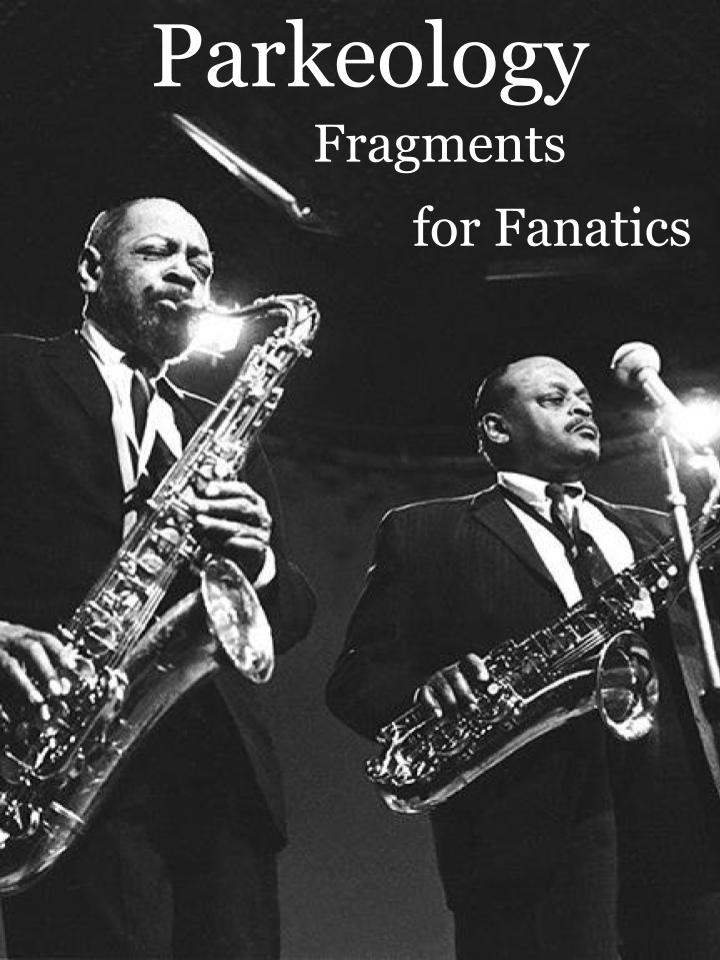
Parkeology 020: One Guesses
I got word that time that I could be in a jam session with Bird and Diz, and I walked two miles carrying my bass without gloves in ten below zero weather to the Ritz Hotel. It was a fine session. I remember a fellow named Red Cross taped the session. – Oscar Pettiford
Pettiford is referring to the jam session on February 15, 1943, where Bird plays tenor instead of alto. Bird switched to tenor when he joined the Earl Hines Orchestra in December 1942, and I’m trying to make the case that he was influenced by Ben Webster’s chromatic motifs at this crucial juncture. As noted in Parkeology 018, when I say chromatic motifs, I’m talking about consecutive half steps in a melodic line.
The Redcross recording “Three Guesses” is a mess. Pettiford isn’t playing, the presence of a second tenor player creates a lot of murk, and the guitarist is unclear on the very idea of form.
In a way, though, this is its strength. It seems unlikely that Bird had high expectations for this particular “I Got Rhythm” jam, which appears to have put him in a lackadaisical mood. The first minute and a half is so aimless that even Remi Bolduc didn’t transcribe it. And yet, of all the Redcross recordings, it offers the clearest proof of Ben Webster‘s influence.
Near the beginning of “Three Guesses,” after the two-horn noodling has passed, Bird mimics Webster for 45 seconds straight, from :42 to 1:27. These phrases aren’t quotes, which makes them hard to link to specific Webster solos. Here’s the 45 second stretch:
At 1:28, Bird drops his Webster impression and reverts to his own vocabulary. This is where Bolduc begins his transcription:
We must now address the elephant in the room: Hawk. On the surface, Webster and Coleman Hawkins sound very much alike. Their differences are as subtle as they are profound. The result is a musical Rorschach test that applies equally to Bird’s mimicry. One discernable difference between the two is that Webster employs growls much more frequently, often as tone color, whereas Hawkins generally reserves growls for the climax of a phrase.
To my ears, Bird is growling throughout this stretch in the Webster style. Those who believe he’s imitating Hawkins here are welcome to disagree. My argument has one thing going for it, though. A chromatic motif from Webster’s “Cotton Tail” solo became a fundamental building block in Bird’s vocabulary (Parkeology 018), thus a direct Webster influence has been established.
It would be easy to go off in all directions here, so I will focus on two excerpts that can be traced directly to Webster.
This chromatic motif is very similar to a Webster phrase in “Big Eight Blues” (I have transposed Bird’s excerpt to match Webster’s key):
The following three-note motif can be traced to both Webster and Hawkins:
Hawkins uses a three-note motif in the opening phrase in his famous 1939 “Body And Soul:”
Nevertheless, I think Bird is closer in spirit to Webster. Here’s an excerpt from Webster’s “I Surrender Dear,” matched with Bird’s three-note motif (I have again transposed Bird’s excerpt to match Webster’s key):
During these 45 seconds, we can hear Bird experimenting with other chromatic motifs inspired by Webster. This passage has the aura of a direct quote, but I’ve yet to locate anything like it:
The absence of quotes isn’t surprising, since Bird is copying Webster’s feel, not his ideas. He’s trying to unearth underlying principles in order to generate ideas of his own.
A prime example of this is the “Cherokee” recording made at Monroe’s Uptown House (1942, exact date unknown). I’m certain that Bird got the idea for this sequence from Webster’s “Cotton Tail” solo (note the growls):
The above suggests that Bird had absorbed the lessons of “Cotton Tail” before the switch to tenor. Furthermore, he uses Webster’s chromatic motif on “Yardin’ With Yard,” from the same “Three Guesses” date. Here’s the motif in question, first Webster, then Bird (both slowed down for clarity):
So by February 1943, Webster’s chromatic motif had already become a building block in Bird’s vocabulary. After that, though, there’s a big gap. We have no significant recordings until the Efferge Ware date (June 1944). At some point in between, Bob Redcross recorded Bird playing alto along with records. I admit I haven’t paid these recordings much mind and may be underestimating their importance, but the format is problematic.
But it’s not as though Webster’s chromatic motif opened the floodgates. Such motifs appear only occasionally on the Efferge Ware date. These four excerpts are from “Body And Soul,” “My Heart Tells Me,” and “I Found A New Baby,” and may represent the sum total:
The Tiny Grimes session on September 14, 1944, marks the end of Bird’s “apprenticeship period,” and the dawning of his mature style. At some point, Bird realized that chromatic motifs could solve certain structural problems, and they appear with much greater frequency here.
By then, he had split Webster’s motif in two, cutting loose the final three ascending notes, which lived on as one of his shortest motifs. He was left with five consecutive descending half steps. Webster had deduced that five was the magic number, and that remained the norm, but Bird often extended it to seven. These ten excerpts are from “I’ll Always Love You Just The Same,” Red Cross,” and “Tiny’s Tempo,” in that order:
I would like to end by marveling at the pace of Bird’s development, entirely the result of sustained intellectual and physical effort. The Redcross recordings are a quantum leap from McShann, Efferge Ware a quantum leap from Redcross, Tiny Grimes a quantum leap from Efferge Ware. Yet lurid tales of Bird’s heroin use and irresponsibility are legion throughout this period of unparalleled artistic breakthroughs. Might these tales be more hyperbole than history?
Bird must have been doing something right.
 Charlie Parker 2020 - A Bird Centennial Blog