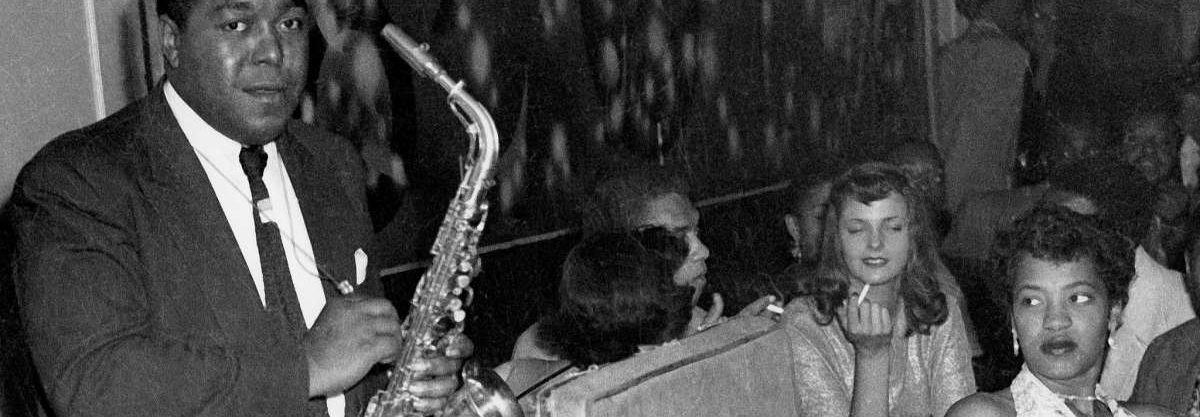

Parkeology 021: Bing and Ben
I used to live at the Cecil Hotel, which was next door to Minton’s. We used to jam just about every night when we were off. Lester, Don Byas, and myself—we would meet there all the time and exchange ideas. It wasn’t a battle or anything. We were all friends. – Ben Webster, Les Tomkins interview, January 1965.
Ignorance isn’t necessarily bliss. In my original posting, I estimated the time frame here as 1941, but I recently discovered that Webster was on the road with Ellington non-stop all year, and the same is true of 1942. I made the ill-informed assumption that Webster was in New York City when the band wasn’t on the road, but they were always on the road! The above quote must refer to a period no earlier than early 1943, when the Ellington band returned to the New York area.
This casts doubt on the anecdotes concerning interactions between Bird and Webster at Minton’s. Bird hit town with Jay McShann in February 1942, but the Ellington band was only in New York City for one day that month, on February 26, for a recording session. They had been in Buffalo the night before and they appeared in Washington DC the following night. They spent March in Baltimore, Philadelphia, and Pittsburg, and by April they were on the West Coast, where they worked for the next four months.
In short, prior to mid-1943, Webster’s influence on Bird must have occurred almost entirely through recordings. Thankfully, that doesn’t really change much. Back to the matter at hand!
Webster’s chromatic motif from his “Cotton Tail” solo, became a fundamental building block in Bird’s vocabulary (Parkeology 018, Brute Force). It must now be retroactively labeled Motif 1, because Webster shares two other motifs with Bird, although they don’t compare in frequency or significance.
Motif 2 comes from Webster’s solo on “Linger Awhile” (November 7, 1940). This quote became another of Bird’s building blocks. He plays it almost exclusively in F concert, as he does here in “Scrapple From The Apple” Take C. I’ve transposed it down a whole step to match Webster’s key:
The six notes of Motif 2 outline a major II V progression. The first four notes are a descending arpeggio of the II chord, from the flat-7th to the root. The two ascending notes imply an augmented V chord, moving from the sharp 5th to the 3rd above.
There’s no way to prove Bird ever heard Webster’s “Linger Awhile” solo, but there’s also no need, because Motif 2 has another source. It appears twice in the “Cotton Tail” saxophone soli (slowed down for clarity):
Bird rarely plays Motif 2 in B-flat concert, which is surprising, since that’s the original key, but he does so here, on “Anthropology” (Birdland, March 31, 1951):
The following examples, all in F concert, come from “Billie’s Bounce” Take 3, “Marmaduke” Take 5, and “Scrapple From The Apple” (January 22, 1949, Royal Roost):
There are jazz writers who claim that Webster actually wrote the “Cotton Tail” saxophone soli. If so, he deserves much more credit than he gets (almost none) for his contributions to the modern jazz vocabulary. Let’s not forget we’re talking about May 1940.
Motif 3 is unrelated to “Cotton Tail,” and presents a mystery. It appears in the A section of Webster’s composition “Dirty Deal” (September 1943), and it outlines a IV major chord changing to IV minor. The key is B-flat major:
Motif 3 is quite similar to a motif Webster uses in his solo on Ellington’s “Five O’Clock Drag,” (September 29, 1941). He plays two variations, also in B-flat:
Motif 3 is much more elusive in Bird’s hands because he shifts it early by half beat, as he was wont to do with certain borrowed phrases. He also uses it at much faster tempos, so it goes by in a blur. It’s woven into his vocabulary so thoroughly that it’s unrecognizable, but it matches Webster’s “Dirty Deal” motif note-for-note and it’s even in B-flat.
Bird uses Motif 3 on “Cherokee,” in bars 7 and 8, where concert E-flat major changes to E-flat minor. These two excerpts are from the Effrege Ware session (Bird, guitar, inaudible drums, June 1944). For purposes of comparison, the “Dirty Deal” excerpt precedes the two Bird excerpts (slowed down for clarity):
The following three excerpts are from the version of “Cherokee” recorded at Monroe’s Uptown House, generally dated 1942. (I think it might be later but no time for that now.) The excerpts have also been slowed down for clarity, but remain murky:
Motif 3 appears from time to time throughout Bird’s career, sometimes in keys other than B-flat. Here are three (slowed down) excerpts culled from the early 50s: two identical excerpts from “An Oscar For Treadwell” (June 6, 1950, C major) and one excerpt from “She Rote,” (January 17, 1951, Bb major). Note that Bird has unshifted the motif, which now begins on beat one, as does Webster’s.
Here’s the mystery: It turns out that Bird uses Motif 3 (unshifted) on his first recording, “Honey and Body,” (mid-1940) years before “Dirty Deal” and months before “Five O’Clock Drag”:
He also uses it in “Coquette” (December 2, 1940).
And he uses it again (slowed down for clarity) in “I’m Getting Sentimental Over You” (February 6, 1941):
It’s clear, then, that Bird didn’t get Motif 3 from Webster.
Here it is again, from “I Cover The Waterfront” (Bird At St. Nicks, February 15, 1950). Bird stretches out the first note, making it sound more like a quote than any previous iteration:
By the time Bird uses it on “Hot House” (Massey Hall, March 15, 1953) he has added a held note at the beginning, making the aura of a quote even more pronounced:
And it turns out that this is indeed an actual quote. The song “Please” was a hit for Bing Crosby in 1933, when Bird was thirteen years old:
Is this quote distinct from Motif 3? Maybe, but both can certainly coexist. Bird fashioned much of his early vocabulary out of quotes from popular songs and jazz improvisations, transforming them into motifs that were often unrecognizable. Young Bird may have distilled “Please” into a melodic building block, trimming the first note for rhythmic purposes, which also helped disguise it. Then, later in his career, he may have decided to quote it verbatim.
I realize all this this puts a ding in my Webster argument, but Motif 3 wasn’t carrying a lot of weight in the first place.
Ultimately, my argument rests on Webster’s chromatic motif from his “Cotton Tail” solo, now christened Motif 1. Even if that were Webster’s sole contribution to Bird’s vocabulary, he would still qualify as a major influence, because Motif 1 appears in every Bird solo from 1944 onward, often multiple times. Statistically, then, Ben Webster’s influence outweighs Lester Young’s.
Them’s fightin’ words.
 Charlie Parker 2020 - A Bird Centennial Blog