
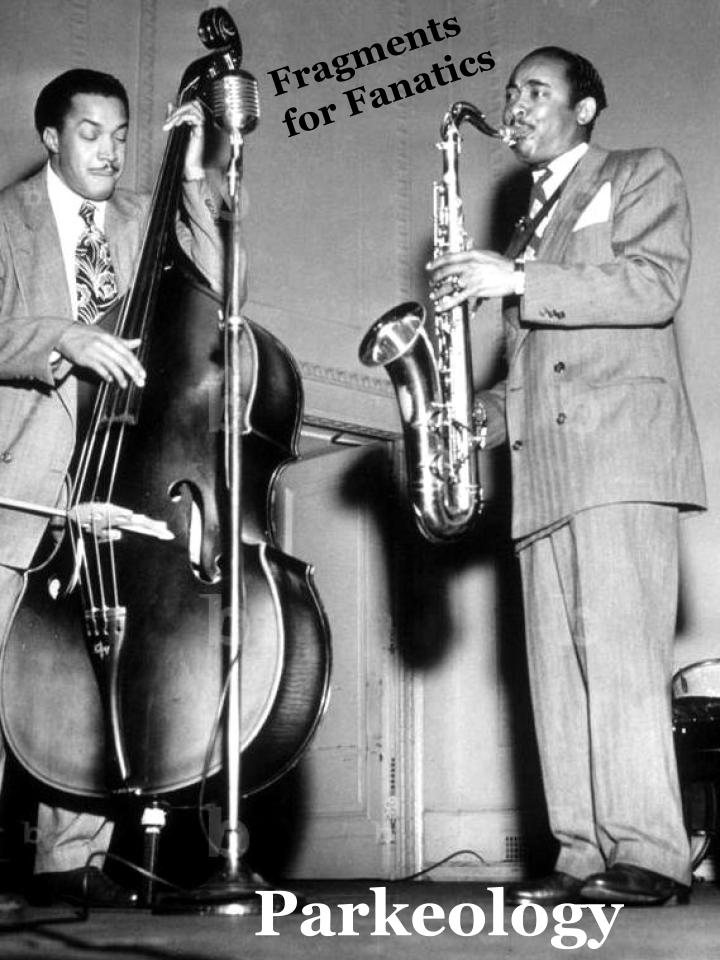
At Monroe’s, I’d listen to trumpet men like “Lips” Page, Roy, Dizzy, and Charlie Shavers outblowing each other all night long. And Don Byas was there, playing everything there was to be played. –Charlie Parker
By some accounts, there was no love lost between Bird and Don Byas. If Ross Russell is to be believed–and lies were his bread and butter–bad blood existed between the two men, dating back to 52nd Street days. He tells a tale of an encounter in Paris, in 1950. Bird and Byas are drinking together at a nightclub and an argument breaks out. Bird invites Byas to settle matters outside, whereupon both men draw knives. At this point, Bird decides to make light of the situation. Russell even provides dialog. Bird: “Don, I really believe you’d try to cut me.” Byas: “You’re so right, Bird, I would.”
Perhaps it’s best to take this metaphorically. Bird and Byas certainly tried to cut each other musically during their association in the mid-40s. The two were in close contact throughout 1945, and they certainly influenced one another. A case can be made that Byas was more harmonically advanced than Bird at that point, but that’s an argument for another day.
It’s possible, however, that Bird adopted a four-note pattern from Byas that became a common motif in his own playing. There’s no way to prove Bird got it from Byas, but it can be found in Byas’s playing in 1944, and it doesn’t appear in Bird’s playing until November, 1945. This pattern is probably considered some form of enclosure in jazz education circles, but I’m just going to call it the 4-cell.
The 4-cell is essentially chromatic, but it has a lot of harmonic versatility. From the starting note, it drops down a minor third, then rises two consecutive half steps, coming to rest a half step below the starting point. If F is the first note, the 4-cell would be spelled F-D-D#-E. Rhythmically, the 4-cell consists of four eighth notes and always starts on an upbeat. Both Bird and Byas approach the 4-cell with an eighth note on the downbeat, thus all recorded excerpts (slowed down for clarity) contain five notes.
Despite his contributions to the emerging vocabulary, Byas never fit the mold of a modernist. His sound and articulation stayed true to the swing era, which pigeonholed him as a transitional figure. It didn’t help that he moved to Europe in 1946, removing himself from the scene while it was still flowering.
Here he is, using the 4-cell on “1944 Stomp,” recorded on July 28th. Though destined to become a cliche, this phrase was newly minted at the time, and possibly devised by Byas himself.
By the time of the Royal Roost broadcasts, the 4-cell had been integrated into Bird’s vocabulary for years, and it functions in multiple keys. Here are fourteen examples, taken from the four solos broadcast on December 11, 1948.
Byas’s legendary “I Got Rhythm” performance at Town Hall (June 9, 1945) makes clear that the 4-cell had become deeply ingrained. The tempo is so fast that Byas is relying heavily on his reflexes, which may explain why the 4-cell crops up so often in the same iteration. It appears twelve times in the space of two choruses, or approximately every five bars.
Byas often approaches the 4-cell from a whole step above, while Bird always approaches from below. Both use it to imply a V-I resolution, by outlining the scale degrees 4-2-b3-3.
But they also apply it to dominant 7th chords, outlining the scale degrees b9-b7-7-8. In this instance, Byas uses it on the secondary dominant in the “I Got Rhythm” bridge. He approaches from below, beginning on the 3rd, thus leaping up a major sixth to the starting note.
Bird always approaches from below, but he’s flexible as to distance, which results in a variety of opening intervals. Here, he uses the same formula as Byas did above, but on a V-I resolution.
Bird will often approach from a minor third below, so that the first and third notes have the same pitch.
Byas uses an interesting variation that doesn’t technically qualify, but deserves inclusion. Again, he approaches from a whole step above, but this time from the 6th, thus spelling out 6-5-2-b3-3.
I can find no evidence that Bird was using the 4-cell in 1944, though admittedly there’s only one place to look. On September 15th, he recorded as a sideman with guitarist Tiny Grimes. This session offers an embarrassment of riches: multiple takes of four tunes, each containing extensive solo space for Bird. (Hitherto, his only commercial recordings had been two studio dates with the Jay McShann Orchestra, and these contained only eight-bar or twelve-bar solos.)
The Tiny Grimes date is so expansive that I’m willing to rest my case on it. If Bird were using the 4-cell in this period, it would be found somewhere in one of his many solos here, and it isn’t. But he comes close, and this is perhaps the best evidence that it isn’t there. Here are three excerpts where he would have likely used the 4-cell, had it been part of his vocabulary.
Here, he outlines 4-b3-3, but leaves out 2.
Here, he plays two consecutive chromatic cells, outlining 2-b3-3, and 1-b2-2.
And, closest of all, here he zigs where he might have zagged.
So when did the 4-cell enter Bird’s vocabulary? In July, 1945, he led a band at the Three Deuces wherein Byas replaced Dizzy in the frontline. In theory, the 4-cell caught Bird’s attention during this month of nightly performances, which makes his November 26 date for Savoy the logical place to look. Accordingly, I listened to every solo on every take multiple times and came up emptyhanded. Dispirited by this setback, I was preparing to follow Bird to Los Angeles when it hit me: the 4-cell first appears in the head to “Billie’s Bounce!” Duh.
It makes intuitive sense that the 4-cell appeared compositionally before it entered Bird’s improvising vocabulary. I can’t think of another example of this off the top of my head, but it might be a fruitful line of inquiry.
As to bad blood between Byas and Bird, bald-faced liar Ross Russell strikes again! Here’s what Byas told Art Taylor in “Notes and Tones:”
I met Bird when he was about fourteen in Kansas City, so I’ve been knowing him for a long time. That was in the early thirties. Bird was a little cat, fourteen years old and blowing! Even after Bird got to New York with Jay McShann, we were still real tight, and he used to always come and get me when he wanted to go and jam, which was damn near every night. He would say: “Come on, Don, we’re going to play ‘Cherokee.'” That was his favorite tune.
And then there’s an apocryphal story that doesn’t really add up, but I believe contains some truth. Bird is in Paris, scheduled to perform with local musicians, when he vanishes. His sidemen search everywhere in alarm. When Bird finally turns up, they ask him what happened. He tells them he wandered into the train station and saw that there were trains to Copenhagen, so he took one. When they asked why, Bird replied, “To have a saxophone lesson with Don Byas.”
If you’re still itching for a knife fight, though, here’s a three-way cutting contest from June, 1945. The tune is “Sweet Georgia Brown” and all we have is the trading at the end, but it’s invaluable. I don’t believe we have any other live recordings of Bird and Byas together. In my opinion, Bird somewhat mops the floor with both Byas and Dizzy, but they’re all in excellent form.
By the way, Byas uses the 4-cell all over the place, beginning with twice in his opening phrase:
Here’s the complete track:
 Charlie Parker 2020 - A Bird Centennial Blog