Every jazz musician who falls under the spell of Bird’s music attempts, on some level, to divine its inner workings. Most express their understanding through their playing. I express mine through my ravings about Bird’s thought processes. Thomas Owens expressed his through his heroic 1974 dissertation, wherein he identified over 100 motives that form the basis of Bird’s vocabulary.
Charlie Parker: Techniques of Improvisation is a triumph of scholarship, but it was never Owens’ goal to provide a practical guide for jazz players. That’s why I’ve decided to write this series of Parkeology posts, recasting his motives into more accessible forms, within a new hierarchy.
Academic strictures may have prohibited Owens from including chord symbols over his motives, since they are meaningless in classical music, and tradition may have forced him to notate Bird at concert pitch. I believe that all motives should include chord symbols for harmonic context, and are best understood (and more playable) when pitched in E-flat.
The biggest stricture of all, or so I presume, was that speculation about Bird’s thought processes was forbidden. I can see why academic rigor wouldn’t allow it; nothing could be more intangible. On the other hand, if you can’t delve into Bird’s thinking, all you can do is catalog the notes he played. Owens organized them as motives and described their function in great detail, at the deepest level of understanding, but this stricture limited his scope.
Owens presents his motives in order of frequency, starting with thirteen examples of the most common motive, M. 1A, which appears approximately 1600 times in his transcriptions:
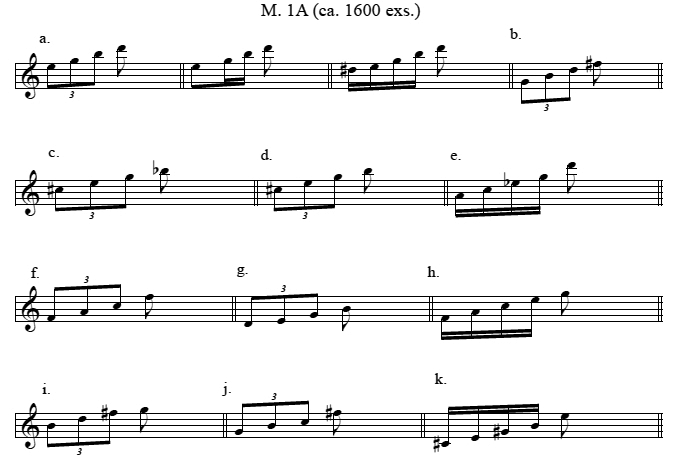
It’s plain to see what all these motives have in common: Bird is traveling upward in thirds. To put it another way, they’re arpeggios. Without chord symbols, though, it’s a bit of a Tower of Babel. They appear to be in a number of different keys, for reasons not specified, and it’s unclear what else connects them.
There’s a remarkable moment in Bird’s radio interview with John Fitch on WHDH Boston (June 13, 1953). Fitch brings up the recording “Intuition” by Lennie Tristano, an early experiment in free jazz. Bird finds it hard to believe they weren’t using any harmonic structure, saying, “There must be a buildup to…the chord structure that tends to create the melody.” Elsewhere, he says, “If you listen close enough, you can find the melody traveling along with any series of chord structures.”
Bird seems to be saying that he believes melody springs from chord structure. I will exploit this to justify adding chord symbols above Owens’ motives: Bird would have wanted it that way! I’ll go with the most obvious choices:
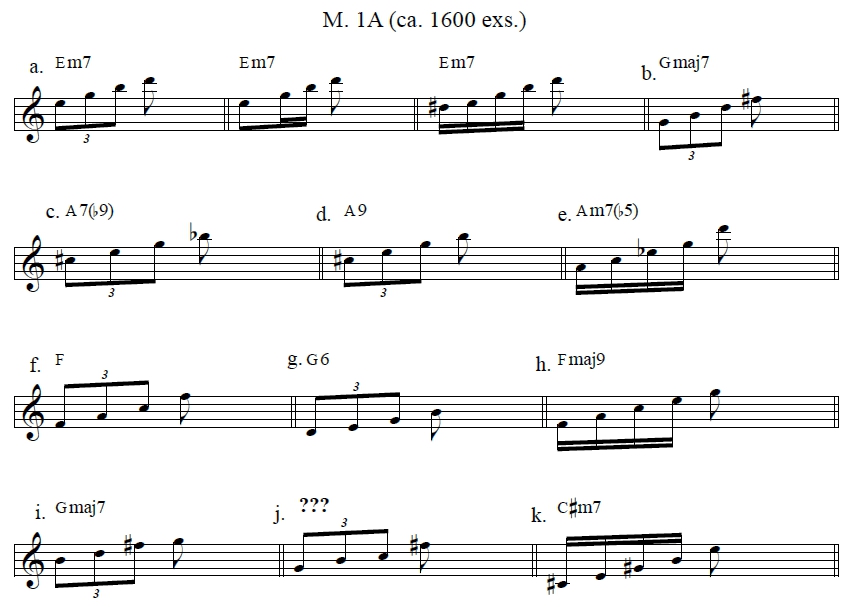
It’s now apparent that these motives represent distinctly different harmonic situations in multiple keys, making it that much harder to say what they have in common, besides moving in thirds.
Motive 1B is similar to Motive 1A, moving upward in thirds, but it includes an additional note at the end that drops down a step. It’s also rhythmically different, based on 16th notes instead of triplets. Motive 1C also moves upward in thirds, extending all the way to the 11th.
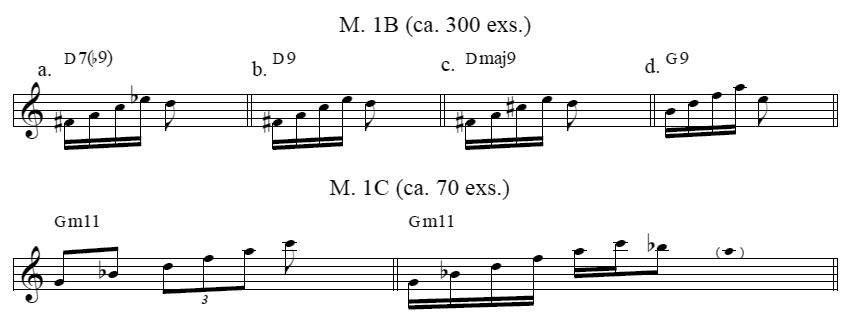
Owens doesn’t offer an underlying principle that gives rise to these motives and unites them, but that doesn’t mean he didn’t divine one. If he did, I wish he had shared it somehow, outside the confines of academia.
It may not surprise you that I have my own underlying principle to offer: Crackpot Theory #1! Bear with me.
We know for a fact that the first two tunes Bird taught himself were “Honeysuckle Rose” and “Up A Lazy River,” in the key of D major for alto saxophone. He also taught himself the D major scale. As he put it in the Marshall Sterns interview (May 1, 1950) “I didn’t never stop to think about there was other keys or nothing like that!” (This is Bird speaking informally, without the concern for proper grammar he would display in other settings.)
Both these tunes contributed a lot to Bird’s vocabulary if you look for it (see Parkeology Hypothesis). “Honeysuckle Rose,” however, did much more than that, opening Bird’s eyes to the entire realm of upper structures. Some may argue that young Bird couldn’t have deduced such knowledge from a mere five notes, but he was a genius, and that’s exactly what geniuses do.
“Honeysuckle Rose” was unique for its time, in that the harmonic basis of its first four bars is a repeated II-V progression. It’s easy to forget that II-Vs (as we know them today) didn’t exist in jazz harmony in the 20s and 30s. For Louis, Lester, and Bird, there were only V chords.
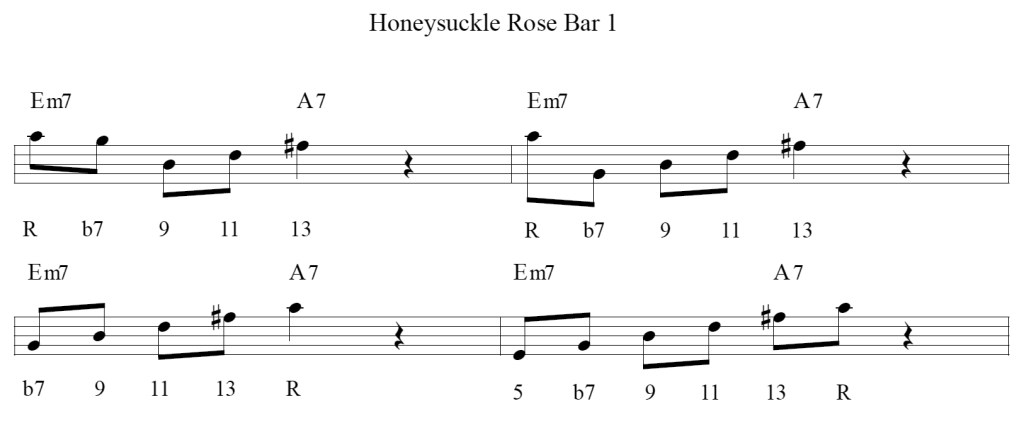
I have analyzed the first bar against the Em7 below, rearranging the notes step-by-step to arrive at an Em11 chord. The idea that Bird did likewise is at the heart of Crackpot Theory #1.
I presume that Bird analyzed these notes against the A7, as well:
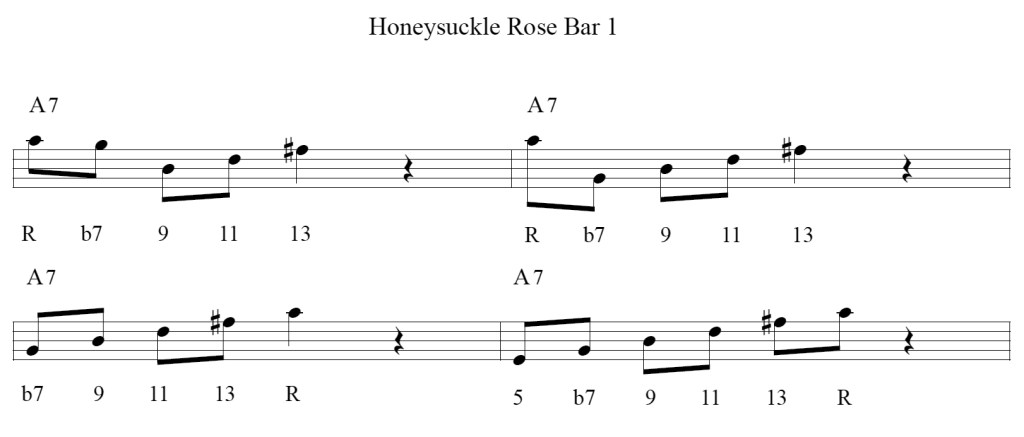
It would have been apparent to Bird that the Em11 spelled out the full upper structure of the A7, when superimposed upon it.
I don’t consider it farfetched that Bird was thinking along these lines, but I am, of course, said crackpot. I’m willing to concede, however, that this thought process might have evolved over the course of time. Bird could have been drawn intuitively to the sound of Waller’s melody–a rolling wheel of upper structures–long before he analyzed it.
But those who pooh-pooh the primacy of “Honeysuckle Rose” do so at their peril. Its first five notes became one of Bird’s most common motives, veiled by shifting the first note to an upbeat. It’s often placed on the “and of four” or the “and of two,” but can occur on the “and of one” or the “and of three” (not shown).
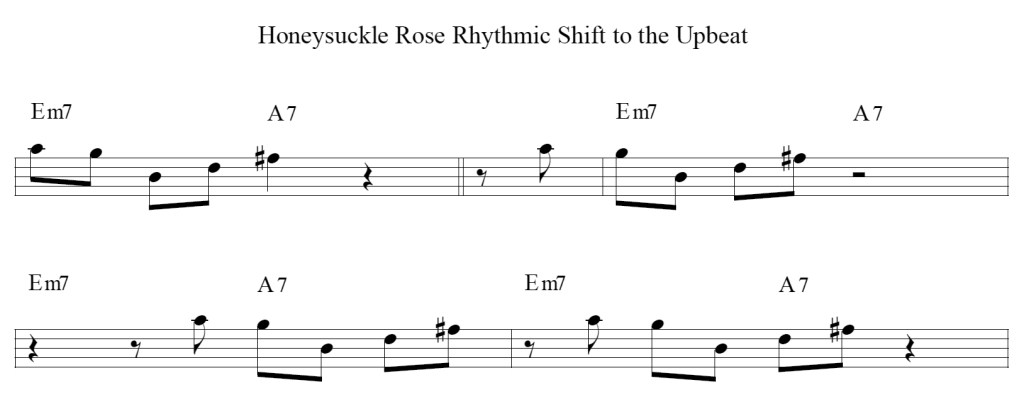
Here are three examples. Bird uses it as a half step substitution on the “and of one” in his very first recording of “Honeysuckle Rose,” but this motive appears most often in G major (Bb concert), in this case on “I Got Rhythm” and “Perdido,” respectively.
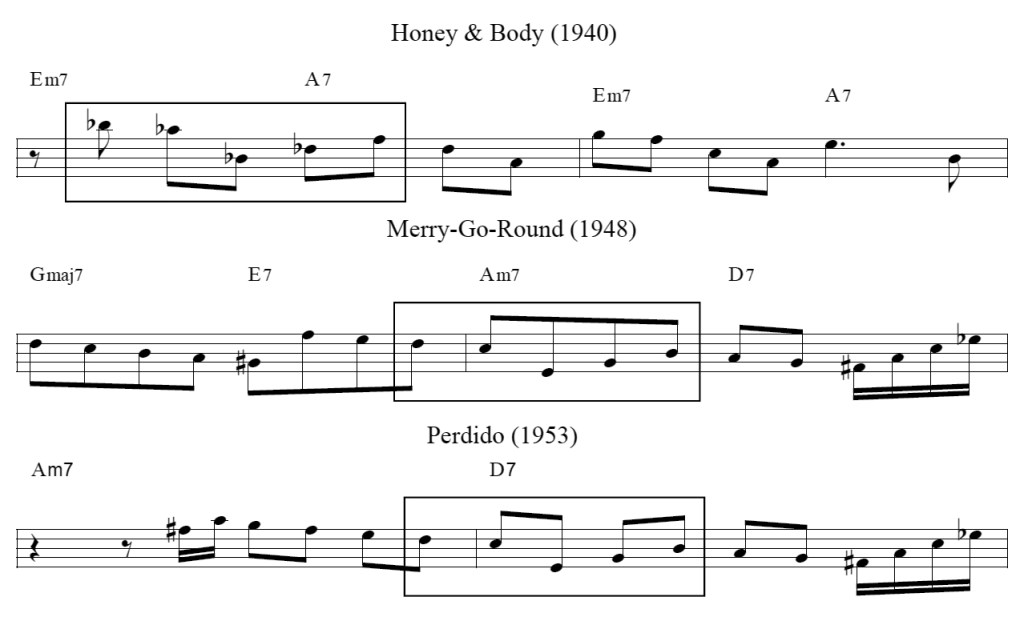
In my crackpot opinion, of course, this “Honeysuckle Rose” motive originated with Bird. But Tadd Dameron allegedly wrote “Lady Bird” in 1939, and he didn’t meet Bird until 1940, so it’s conceivable that his tune brought the motive to Bird’s attention. These dates, however, are far from ironclad, and Occam’s razor favors Bird. And riddle me this: why did Tadd name his tune “Lady Bird” if he wrote it before they met?
In any event, this five note group became public property and entered the modernist lexicon. Miles used it unaltered in “Donna Lee,” as did John Lewis, shifted by half a beat, in “Afternoon In Paris.”
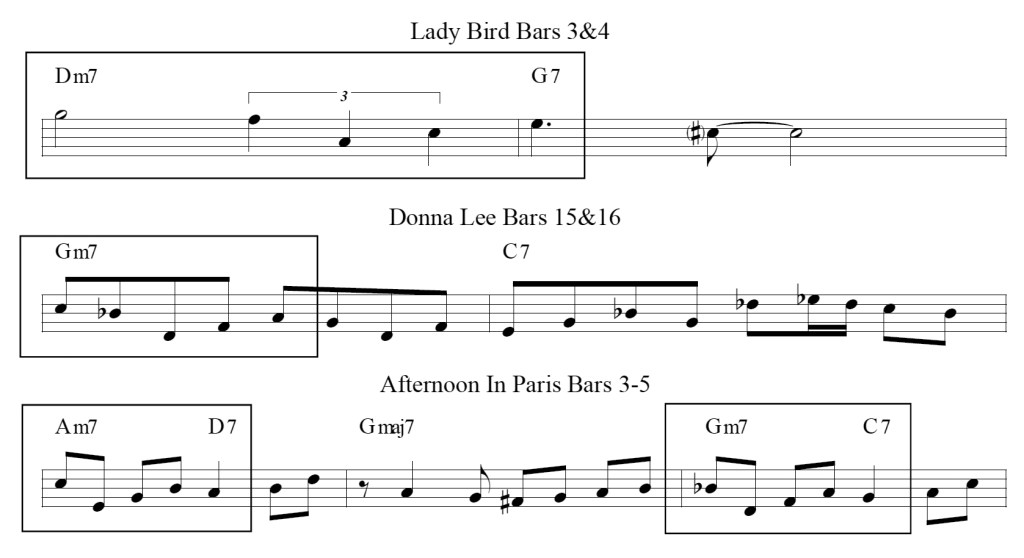
Around 1950, both Bird and Bud Powell began using it as a freestanding tritone substitution. Here’s Bird on “Smoke Gets In Your Eyes,” where he uses it twice:
Here’s Bud using it four times on “Ornithology” at Birdland:
Where does this motive rate in Owens’ top 100? It charts at a respectable #20, but only as a hinge in a longer motive, one we’ve seen before:
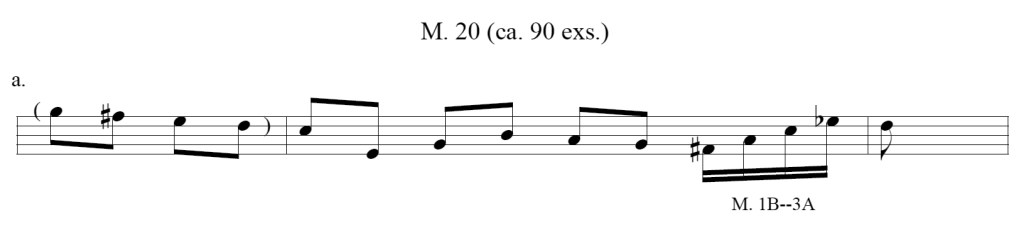
Owens never cataloged this five note group as a motive in its own right, nor does he give “Honeysuckle Rose” special attention. It would seem that the rhythmic shift disguised its source from him. But Bird’s predilection for shifting phrases by half a beat is no secret, and such shifts are common practice in jazz.
Here’s the problem: it’s a thought process.
 Charlie Parker 2020 - A Bird Centennial Blog