
Note: Reading the Owens Chronicles in order is recommended, since each post builds on the last. All examples are in alto saxophone key. Recordings have been slowed down for clarity.
We now rejoin Crackpot Theory #1, already in progress.
Efferge Ware’s four-to-the-bar accompaniment on “Cherokee” (full track below) throws Bird’s playing into stark relief. Paradoxically, it offers Bird a rhythmic freedom that’s lacking on other dates with transitional rhythm sections, and the momentum he generates matches or exceeds that of later solos.
More to the point, you can hear how much modernist harmony is implicit in Bird’s lines. A prime example of this takes place at the end of the first A of Bird’s second chorus (mm 76-80). Ware sits on an F7 for four bars, more or less, while Bird outlines a much more sophisticated harmonic structure.
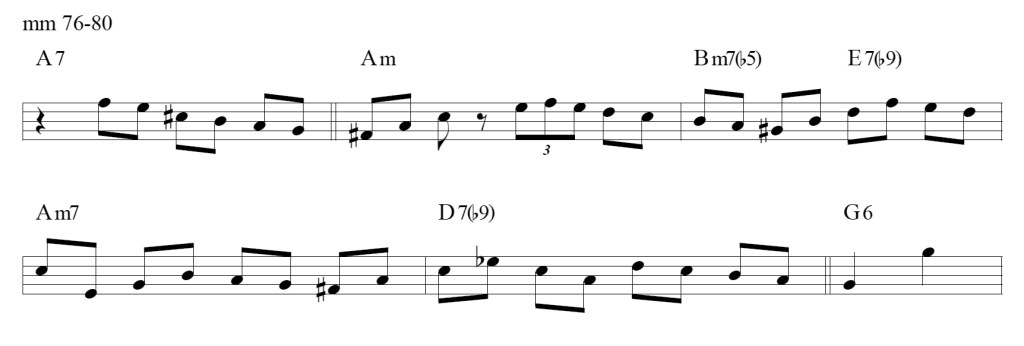
The same thing happens again in the next chorus (mm 141-144). Ware seems to be trying to adjust to what Bird is playing, but he can’t catch hold of it. (This is the man who taught Bird harmony in the Ozarks, in 1936!)

Here’s the 3rd Rung again:

Obviously, it’s just the II chord, but there were no II-Vs in 1943, only V chords. Bird was superimposing the 3rd rung over them, clearly outlining II-V progressions melodically. A prime example of this is the “Tea For Two” sequence he uses on the “Cherokee” bridge.
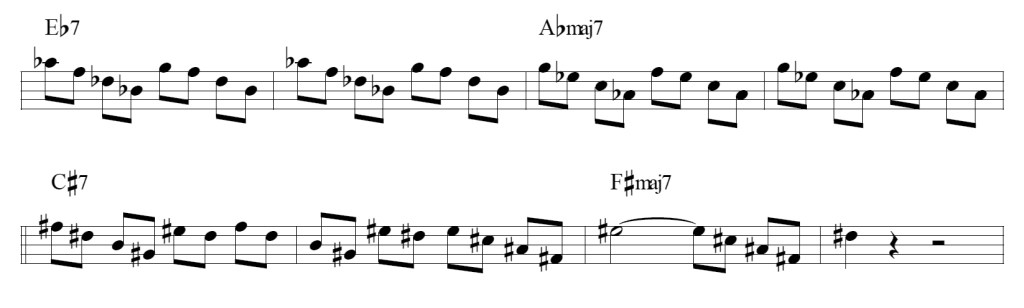
Indeed, if you wanted to boil down Bird’s innovation to its smallest iteration, it would be two notes: the flat seven of the II chord moving down a half step to become the third of the V chord. That’s what the top notes of Bird’s lines are doing in the “Tea For Two” sequence above. I don’t see how you could outline a II-V more clearly than that.

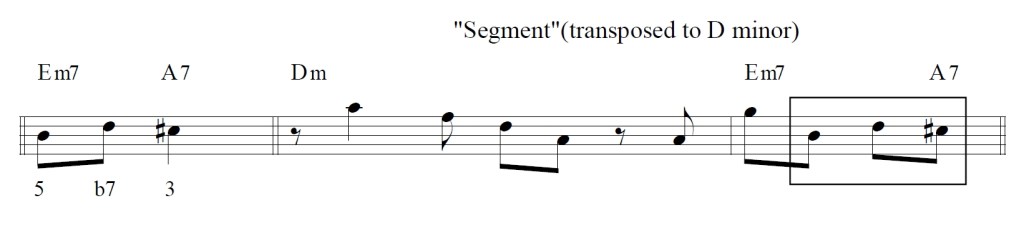
Bird uses a three-note motive in which the b7 is preceded by the 5th. One notable example occurs in the melody to “Segment.” Surprisingly, Owens doesn’t catalog this motive, at least as a stand-alone, three-note group.
Here’s a recap of Owens’ Motive 1 thus far:
Motive 1A ex. a, the most common motive, is what I call the 3rd rung.

Motive 1A ex. d is what I call the 2nd Rung.
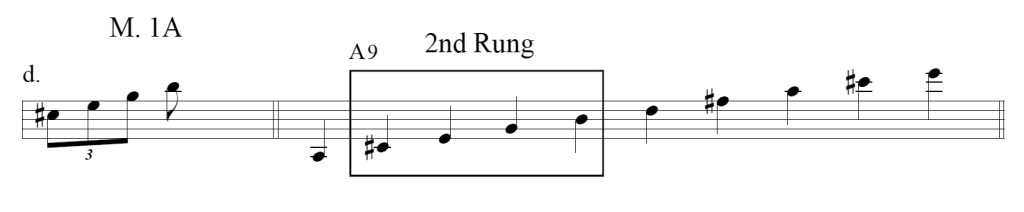
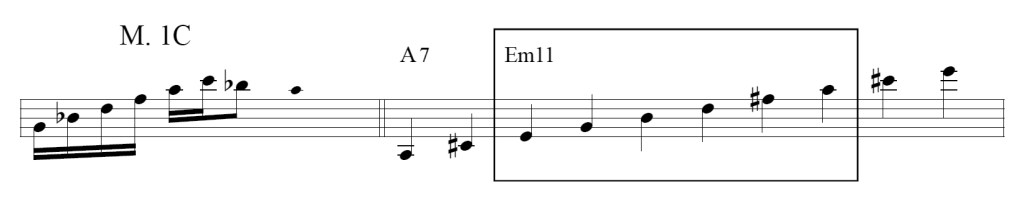
Motive 1C is what I consider to be the Em11 chord that Bird divined from “Honeysuckle Rose.”
There are some iterations of Motive 1A that I don’t know what to do with, other than note them. Motive f. is just an F major arpeggio. Motives i and j don’t move in thirds, so I’m not sure where they fit in.

Motive g. is easily recognized, but it’s a major pentatonic idea, often found in a blues context. Although it seems out of place, it’s a great excuse to revisit Bird’s solo on “Hootie Blues,” from his very first recording session (Decca 1941).

We have three iterations of Motive 1A left to go: b., h., and k.

To complete Crackpot Theory #1, however, we will have to climb a bit higher.
Here’s the complete 1943 “Cherokee,” with Bird with Efferge Ware.
 Charlie Parker 2020 - A Bird Centennial Blog