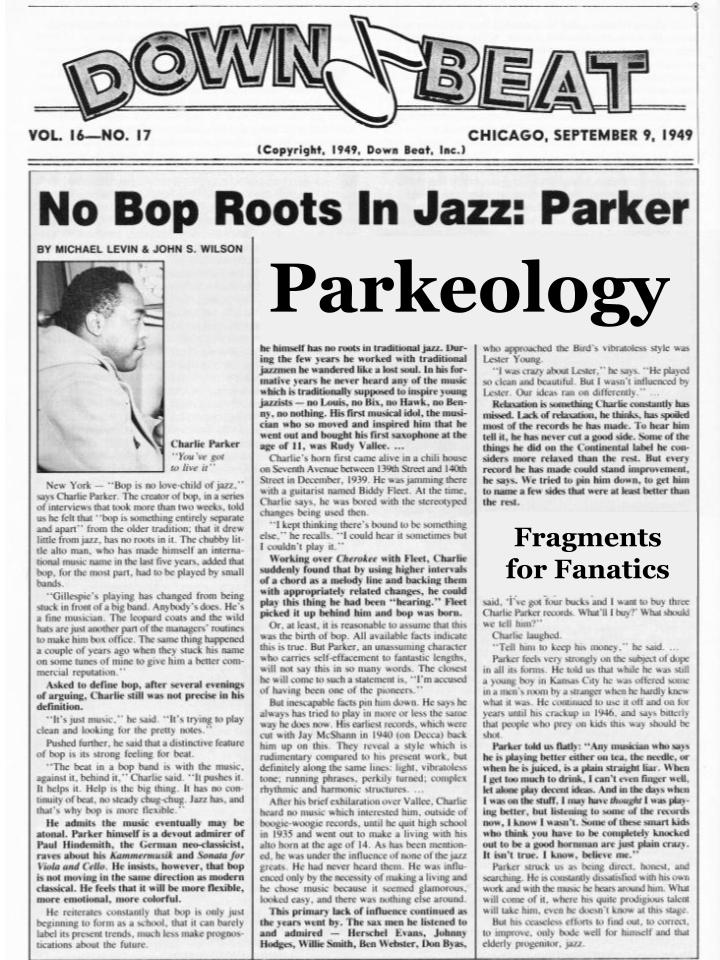
“Bop is no love child of jazz,” says Charlie Parker. The creator of bop, in a series of interviews that took more than two weeks, told us he felt that “bop is entirely separate and apart” from the older tradition; that it drew little from jazz, has no roots in it. The chubby little alto man, who has made himself an international music name in the last five years, added that bop, for the most part, had to be played by small bands. –Michael Levin and John S. Wilson, “No Bop Roots In Jazz: Parker.”
Thus begins the questionable Levin-Wilson article, published in Down Beat magazine on September 9th, 1949. Foremost among the questions is this: to what extent was Bird putting the authors on?
But first things first. Chubby little alto man? I’ll try not to get hysterical, but this description makes me doubt the judgement of both writers. Regardless of how it was meant, it’s demeaning. More to the point, it’s inaccurate. Bird stood approximately 5 ’10”.
Moving on. Levin and Wilson quote Bird verbatim and at length. In general, the direct quotes they select pertain either to Bird’s definition of bebop or his opinions about Dizzy, both highlighted, perhaps, to stoke controversy. But most of the biographical information is paraphrased, which forces us to rely on their editorial judgement. How accurately did they convey what Bird had told them?
As with so many things about Bird, no definitive answer is possible. But the information Levin and Wilson relay often flies in the face of established facts, at times to the point of absurdity. A lot can be forgiven, since few biographical facts were known in 1949, but it appears they overlooked Leonard Feather’s 1947 Metronome article, “Yardbird Flies Home,” which established a basic framework, including Bird’s correct birth year, 1920. Levin and Wilson give it as 1921, another ding in their accuracy. Nevertheless, “No Bop Roots In Jazz” was a foundational document. Three of Bird’s most iconic quotes appear there:
It’s just music. It’s trying to play clean and looking for the pretty notes.
Music is your own experience, your thoughts, your wisdom. If you don’t live it, it won’t come out of your horn.
They teach you there’s a boundary line to music, but, man, there’s no boundary line to art.
I don’t doubt these are Bird’s exact words. But when Levin and Wilson paraphrase biographical information, all hell breaks loose. Take this paragraph:
Parker’s indifference to the revered jazz tradition certainly will leave some of his own devotees in a state of surprise. But, actually, he himself has no roots in traditional jazz. During the few years he worked with traditional jazzmen he wandered like a lost soul. In his formative years he never heard any of the music which is traditionally supposed to inspire young jazzists–no Louis, no Bix, no Hawk, no Benny, no nothing. His first musical idol, the musician who so moved and inspired him that he went out and bought his first saxophone at the age of 11, was Rudy Vallee.
The problem here is that this can’t possibly be true. (We’ll leave poor Rudy Vallee out of it.) Were we to invoke Occam’s razor, we might conclude that Bird was simply putting on a couple of squares, but that’s taking the easy way out. If Bird did indeed engage in a series of interviews, then he was taking the opportunity seriously, and the direct quotes seem entirely sincere.
But it’s simply a fact that once Bird discovered jazz, in his early teens, he absorbed everything around him, in Kansas City, the shadow capitol of advanced swing, and on record. It’s all there in his playing, and if you need further proof, there’s always his 1948 Down Beat blindfold test, in which he readily identifies Stan Kenton, Benny Goodman, Red Norvo, Bud Powell, Igor Stravinsky, “Hot Lips” Page, Dizzy Gillespie, Count Basie, Charlie Barnet, Duke Ellington, and Johnny Hodges. He also misidentifies George Wettling as Baby Dodds, thereby displaying some familiarity with 20s jazz.
Summing up at the end, Bird says to Leonard Feather:
Music, if it’s presented right, is music, whether it be Dixieland, jazz, swing, or what have you. Personally, I just like to call it music.
What does Bird mean when he uses the term “jazz?” This question comes up again and again in the Levin-Wilson article, starting with its very title. The above quote implies that jazz, to Bird’s mind, is something distinct from Dixieland or swing, but that doesn’t help much. When pressed by Levin and Wilson, Bird also makes a clear distinction between bop and jazz, saying, “Bop has no continuity of beat, no steady chug chug. Jazz has, and that’s why bop is more flexible.”
This lack of a clear definition may have contributed to Levin and Wilson’s confusion over Bird’s musical roots, and Bird’s resistance to labeling music likely made matters worse.
Continuing their paraphrasing of Bird’s development, the authors write:
Tossed into the jazz world of the mid-30s with this kind of background, he had no familiar ground on which to stand. For three years he fumbled unhappily until he suddenly stumbled on the music which appealed to him, which had meaning to him.
This isn’t within shouting distance of the truth. We know Bird spoke to them of early humiliations at jam sessions, and he probably belittled his own abilities as a beginner. Did the authors reduce all this to “fumbled unhappily?”
Once Bird hit high school, he abandoned academics and pursued music with a single-minded intensity, trying to play with, and learn from, everyone he could, and gradually earning a place for himself on the bottom rung of the Kansas City jazz scene. Everyone agrees that he didn’t show much promise early on, but his determination was evident, and he worked with any number of local bands. In no sense did he “wander like a lost soul.”
All of which makes this paragraph seem very much like a put-on:
After his brief exhilaration over Vallee, Charlie heard no music which interested him outside of boogie-woogie records, until he quit high school in 1935 and went out to make a living with his alto horn at the age of fourteen. As has been mentioned, he was under the influence of none of the jazz greats. He had never heard them. He was influenced only by the necessity of making a living and he chose music because it seemed glamorous, looked easy, and there was nothing else around.
I’m not sure this paragraph contains any truth at all.
If you’re wondering what the point is here, your long wait will soon be over. The Levin-Wilson narrative is that Bird had no interest in the music around him in Kansas City, never listened to jazz on record, only took up saxophone to make a living, and felt alienated playing traditional jazz for a period of years. All this is a buildup to the Big Moment in the following paragraphs:
Charlie’s horn first came alive in a chili house on Seventh avenue between 139th Street and 140th Street in December, 1939. He was jamming there with a guitarist named Biddy Fleet. At the time, Charlie says, he was bored with the stereotyped changes being used then.
“I kept thinking there’s bound to be something else,” he recalls. “I could hear it sometimes but I couldn’t play it.”
Working over “Cherokee” with Fleet, Charlie suddenly found that by using higher intervals of a chord as a melody line and backing them with appropriately related changes, he could play this thing he had been “hearing.” Fleet picked it up behind him and bop was born.
We arrive at the point at last: this is not a quote! It’s another Levin-Wilson paraphrase. The distinction is crucial, because this is as close as Bird ever came to explaining his musical thinking, let alone the nature of his breakthrough. As a paraphrase, then, there is good reason to doubt its accuracy, given all of the above.
Somewhere along the line, this paraphrase was converted into a quote, and it has remained so ever since. Here it is:
I remember one night before Monroe’s I was jamming in a chili house on Seventh Avenue between 139th and 140th. It was December, 1939. Now I’d been getting bored with the stereotyped changes that were being used all the time at the time, and I kept thinking there’s bound to be something else. I could hear it sometimes but I couldn’t play it.
Well, that night, I was working over Cherokee, and, as I did, I found that by using the higher intervals of a chord as a melody line and backing them with appropriately related changes, I could play the thing I’d been hearing. I came alive.
It’s clear to me that someone rewrote the Levin-Wilson paragraphs in the first person, rearranging and embellishing them to sound more speechlike. I have my own theory of the crime, with only circumstantial evidence to support it. The above quote comes directly from Nat Shapiro’s book, “Hear Me Talkin’ to Ya,” published in 1955. (Bird died that March.) The premise of that book was to tell the history of jazz in the words of the musicians who created it, and it’s composed entirely of first person accounts from a multitude of jazz players.
When it came to quoting Bird, though, Shapiro only had two sources: “Yardbird Flies Home” and “No Bop Roots in Jazz.” To his credit, all the other Bird quotes he appropriated from these two sources are verbatim, but his motive for transforming the Levin-Wilson chili house paraphrase into a quote couldn’t be clearer. Presumably, “Hear Me Talkin’ to Ya,” became the common source for this “quote” thereafter, the book being easier to get hold of than a fleeting Down Beat article.
We will never know exactly how Bird described his “Cherokee” revelation in his own words. Unfortunately, the Levin-Wilson paraphrase stops short of making sense–the authors weren’t musicians–and yet there are still enough clues to take a serious guess at what Bird was talking about. A little hubris is all that’s required.
I know just the guy.
 Charlie Parker 2020 - A Bird Centennial Blog