Working over “Cherokee” with Fleet, Charlie suddenly found that by using higher intervals of a chord as a melody line and backing them with appropriately related changes, he could play this thing he had been “hearing.” –Michael Levin and John S. Wilson, “No Bop Roots In Jazz: Parker.”
This single sentence paraphrase of Bird’s “Cherokee” revelation has been chewed over for generations, with little to show for it. Had Levin and Wilson simply given us Bird’s exact words, they would’ve saved everyone a lot of trouble. Instead, another poor schmo, namely me, is about to tilt once again at this threadbare windmill.
Here’s what the Levin-Wilson paraphrase suggests to me: Bird had a flash of intuition which made clear that an array of separate harmonic concepts were in fact all connected. Of course, Bird’s thought processes are impossible to know, so no assertion can ever be proven right or wrong. Plausibility is the only measure of any argument.
Whatever Bird’s revelation was, it must have been simple enough to be grasped on the spot. I will argue that it was a self evident, though not necessarily obvious, concept I call the “ladder of thirds.” (If there’s a proper jazz theory term for this concept, I have no idea what it is.)
Once I’ve outlined it, I will turn to the “Cherokee” bridge and argue that its harmonic construction revealed to Bird this ladder of thirds. Adrenalin rush guaranteed!
But first, a note of caution. It’s easy to forget that II-V progressions, as we know them today, didn’t exist in the 20s, 30s, and early 40s. For Louis, Lester, and the fledgling Bird, there were only V chords.
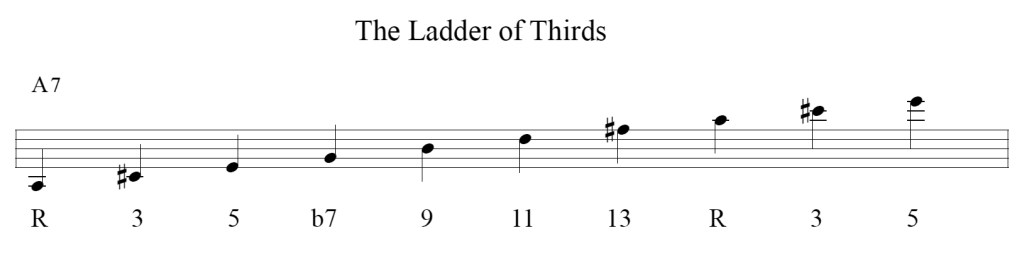
The ladder of thirds is shown below in the key of D major, because that was Bird’s primal key. As a beginner, he taught himself two tunes in D major, “Honeysuckle Rose” and “Lazy River,” as well as the D major scale.
The ladder of thirds is simply a dominant 7th chord ascending diatonically in thirds, starting from the root and rising through its entire upper structure until, two octaves later, it reaches the root again. (The 3rd and 5th are repeated above the second root are for diagrammatic purposes, not musical ones.)
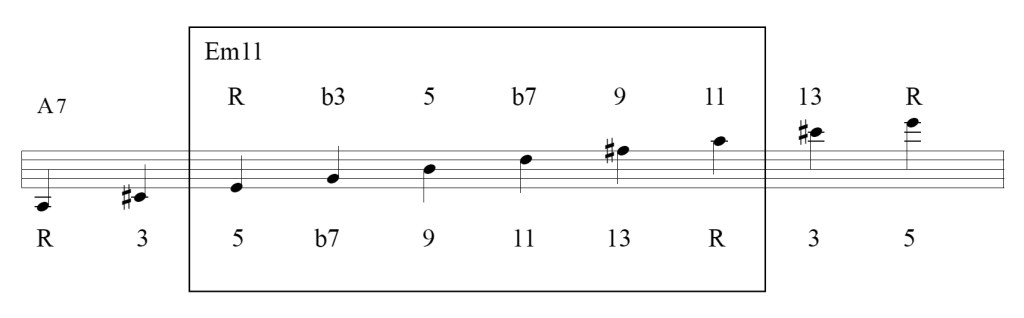
A subset of notes, building from the 5th of the dominant 7th chord, spells out an Em11 chord. We recognize this now as the related II chord, but II Vs didn’t exist in 1939, which is why this subset would have been the starting point in Bird’s revelation.
Here are two examples of Bird running a Bbm7 chord (Gm7 for alto) up to the 11th. The first comes from “Donna Lee” (Savoy May 8, 1947). Bird plays this figure twice in his jittery, repetitive solo on the master take.
The second example comes from the sublime “Out Of Nowhere” Take C (Dial November 4, 1947).
Bird never ran all the way up the ladder of thirds. I contend that he divided the ladder into seven four-note groups. Expanding my dubious metaphor, I will call these four-note groups “rungs.”
To establish the principle that Bird would sometimes think in four-note groups, here’s an excerpt from his 1943 “Cherokee” solo, recorded with Efferge Ware (full track below). He plays the following sequence twice, first in mm 125-128, and later as an ending. He makes it sound musical, but he’s just spelling out seventh chords in the key of G major.

We now turn to the rungs. The 1st rung is inconsequential, in that Bird almost never runs dominant seventh chords up from the root. It just sounds very square, like an exercise. I’m sure an example could be found somewhere, but it would be the exception that proves the rule.

The 2nd rung is quite the opposite. Bird frequently runs dominant seventh chords from the 3rd up to the 9th. There’s nothing remarkable about this. Lester did it all the time, as did Louis before him. Nevertheless, it’s an essential component of Bird’s vocabulary. Here are six examples from the same “Cherokee” solo:

The 3rd rung is significant indeed, given that it guided Bird toward the concept of II-V progressions.

The b7 of the Em7, D, is the so-called “avoid note” on the A7, which is the chord the rhythm section would have been playing behind Bird as he deployed the 3rd rung, requiring him to resolve to C# at some point.
Bird states this resolution very clearly in the “Tea For Two” pattern he applies to the “Cherokee” bridge. Note that Ware is chunking V chords behind him all the way. This example also reinforces the notion that Bird sometimes thought in four-note groups.
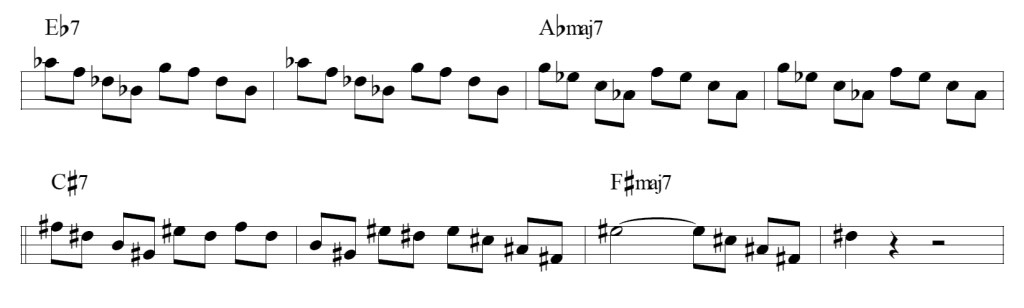
This brings us to the foot of the “Cherokee” bridge, but it’s too soon to cross. There’s more to say about the 3rd rung, which works in tandem with the 4th and 5th rungs. For that, we must turn to “Marmaduke,” Bird’s contrafact on “Honeysuckle Rose,” which was named for his dog.
You heard me, Bird had a dog.
Here’s the complete “Cherokee” track, with Bird and Efferge Ware.
 Charlie Parker 2020 - A Bird Centennial Blog