
I’d learned the scale and I learned how to play two tunes in a certain key, in the key of D for your saxophone, F concert? I learned to play the first eight bars of “Lazy River” and I knew the complete tune to “Honeysuckle Rose.” I didn’t never stop to think about there was other keys or nothing like that! –Charlie Parker
It’s hard to overstate the importance of “Honeysuckle Rose” in Bird’s development. It was the first song he recorded on his own, and among his first with Jay McShann.
Furthermore, “Scrapple From The Apple,” based on the “Honeysuckle Rose” A section, was a mainstay in his repertoire throughout his life. Its “I Got Rhythm” bridge, however, disqualifies it as a contrafact, thus the award goes to the relatively obscure “Marmaduke” (Savoy, September 24, 1948).
More broadly, “Marmaduke” is a study of the key of D major, Bird’s primal key. It’s here that he fashioned the vocabulary that suffused his playing in all keys. It’s also the best place to continue the “ladder of thirds” discussion.
Bird says he learned the D major scale, but what form did it take? I submit that the opening phrase of his solo on “The Jumpin’ Blues” (Jay McShann, Decca, July 2, 1942) is an iteration of the D major scale that sprang from his earliest attempts at improvisation.
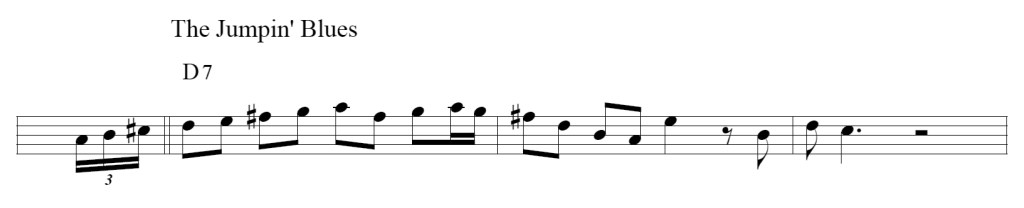
Jazz writers searching for the origins of this phrase often point to Lester Young’s solo on “Shoeshine Boy,” noting that he plays a similar figure coming out of the second bridge.
The similarity is striking, and we know Bird learned this solo note-for-note. Furthermore, Lester is playing this phrase over a concert C7, which on tenor is a D7. Lo and behold, both phrases employ the same fingering.

I remain skeptical. For one thing, they differ meaningfully. Lester doesn’t resolve the ornament to F# in the second bar, skipping down to an E instead. The resolution to F# is the heart and soul of Bird’s phrase. Furthermore, since Bird learned this solo on alto, he would have been playing Lester’s phrase over an A7 (concert C7), not a D7, which requires an entirely different fingering.
In fact, ease of fingering explains a lot. The central ornament in this phrase is easy to execute in the key of D major and such ornaments were common practice in jazz. Given that the phrase is a simple scale run, the similarities between Lester and Bird could be entirely coincidental.
But the best argument might be circumstantial. Given all the wonders in Lester’s solo, why would Bird latch onto an inconspicuous transitional phrase and make it the centerpiece of his vocabulary? I believe it springs from a deeper source.
Bird famously said, “I was crazy about Lester. He played so clean and beautiful. But I wasn’t influenced by Lester. Our ideas ran on differently.” Let’s take him at his word and move along to “Marmaduke.”
Between chirping reeds and fluffs by Miles, Bird needed quite a few takes to get a usable version, offering an extensive look at his “Honeysuckle Rose” vocabulary. He’s in a relaxed, swinging mood, and there’s an air of nonchalance throughout (despite moments of frustration). He’s not trying to break new ground, and some of the ideas that flow from his horn might well date back to teenage years.
The “Marmaduke” melody is in part a transfigured “Honeysuckle Rose.” Here are the first four bars, minus the pickup:

The second bar is “Honeysuckle Rose” shifted over by half a beat. This practice goes all the way back to Bird’s first recording, “Honey and Body,” the generally accepted date of which is early 1940. He repeats the “Honeysuckle Rose” opening phrase as a motive, shifting it by half a beat in the process:

The third bar of “Marmaduke” contains the D major ornament first seen in “The Jumpin’ Blues.”
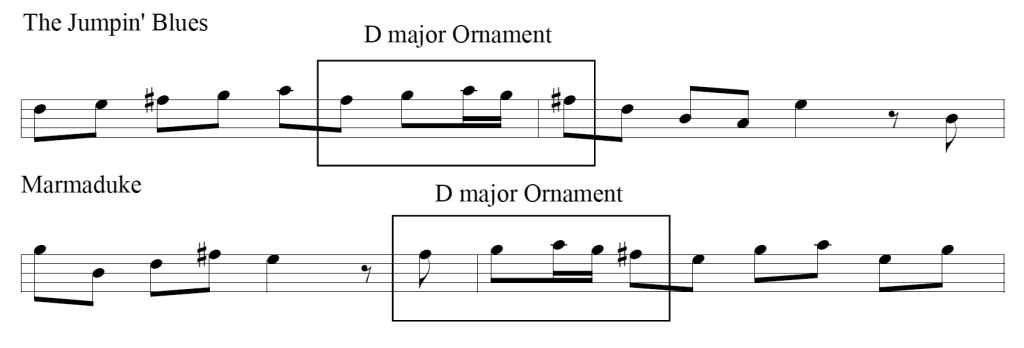
The D major ornament also dates back to “Honey and Body:” (The first note is a ghost note.)
Just for good measure, here’s the D major ornament in Bird’s solo on “Honeysuckle Rose” with Jay McShann (November 30, 1940). Again, the first note is a ghost note.
Bird recorded three complete takes of “Marmaduke,” takes 5, 9, and 12, each with equally good solos. Take 12, having the cleanest ensemble passages, became the master. I will be drawing examples from all three solos, referencing them by take number and timing, rather than by measure numbers.
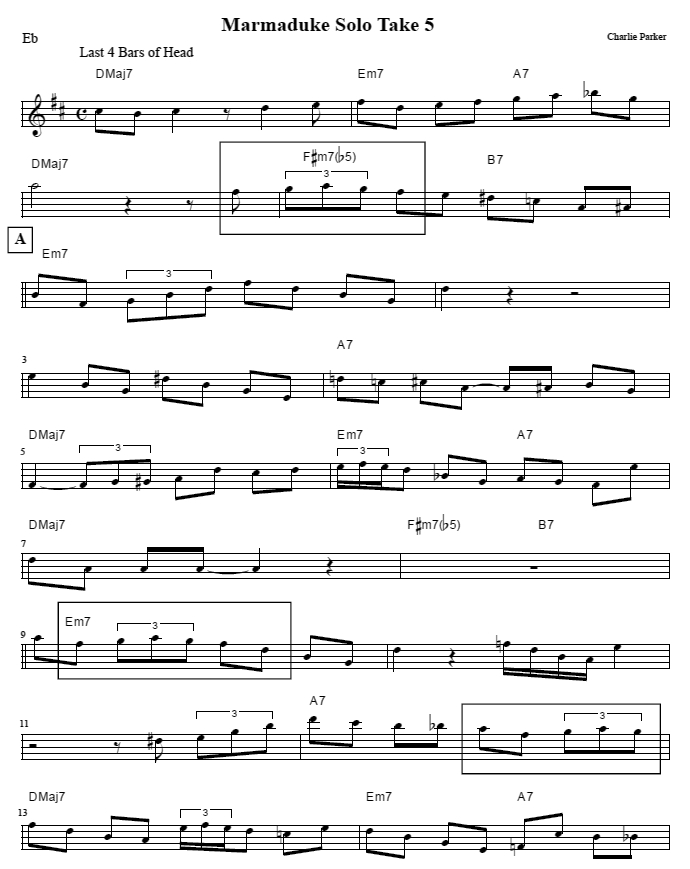
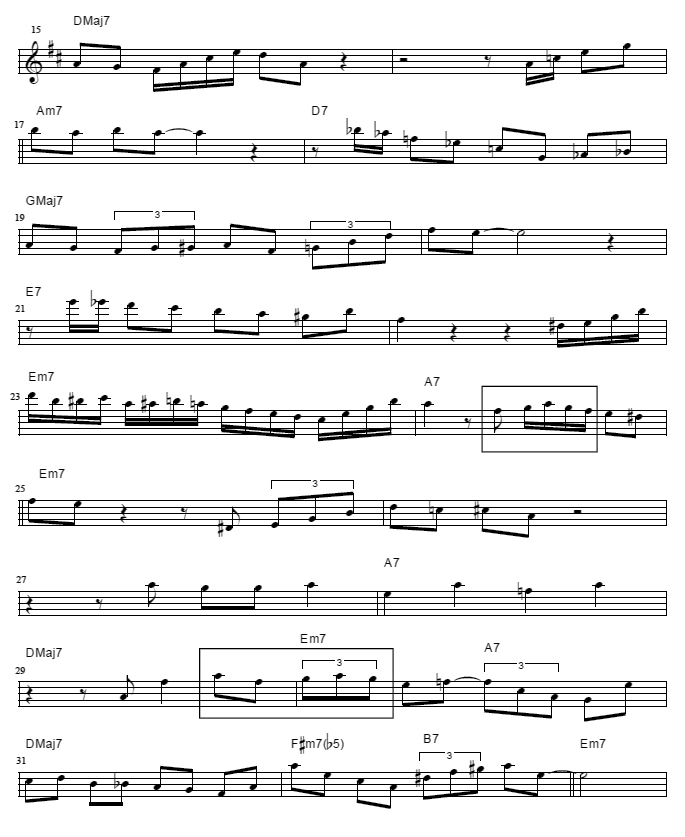
The D major ornament is deeply embedded in Bird’s muscle memory and surfaces five times in Take 5 (full solo below with D major ornament highlighted):
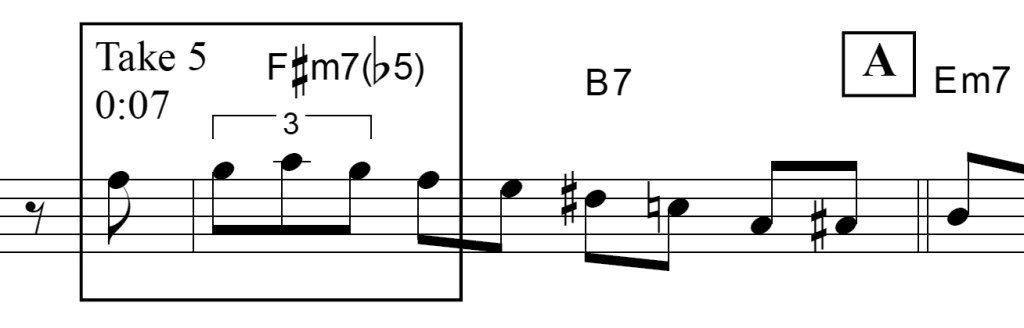
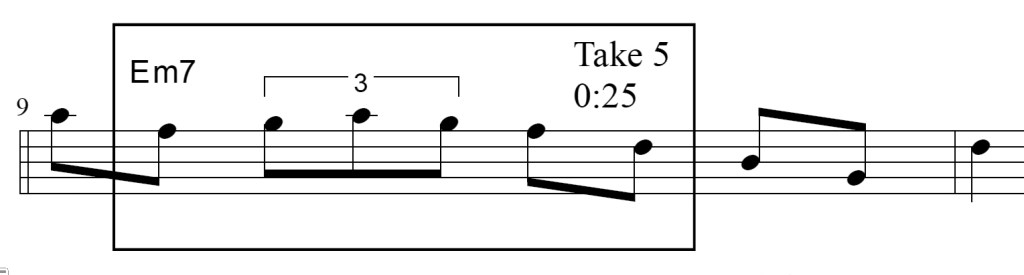
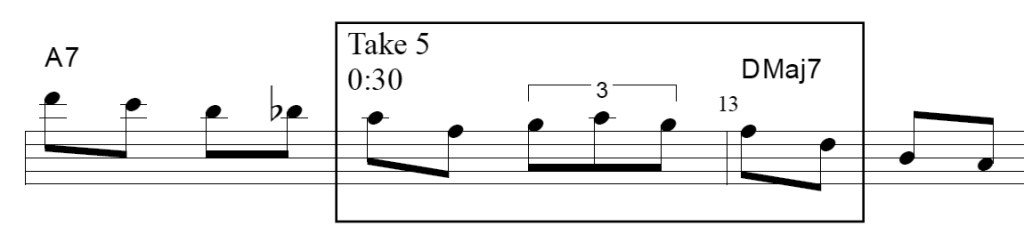
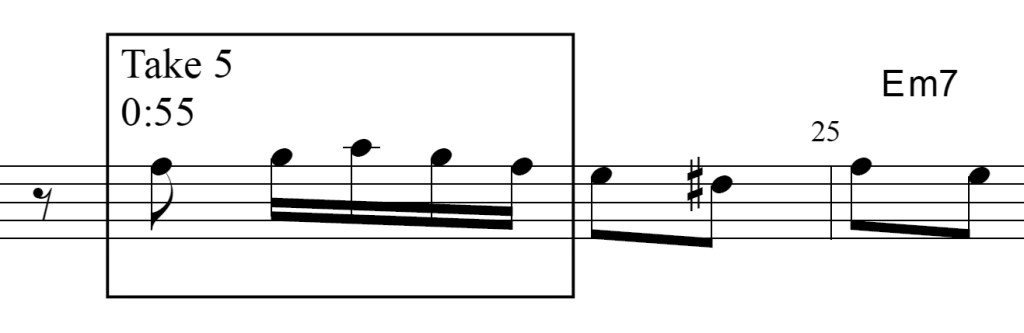
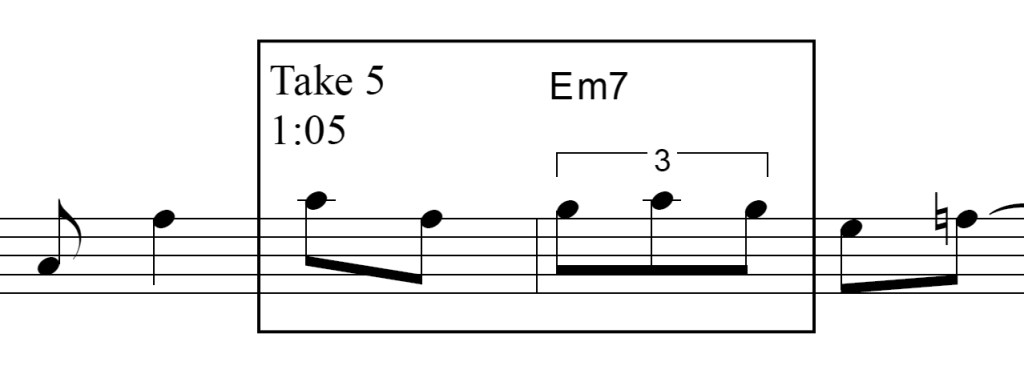
More than any other set of changes, “Honeysuckle Rose” offers a line of sight into Bird’s early development, which began in the key of D major. This is why the ladder of thirds is best conceptualized as the upper structure of A7, the V chord.
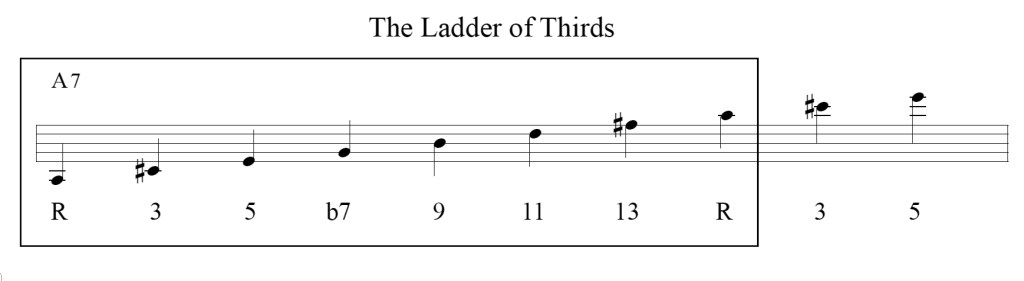
It may be unclear at this point what the D major ornament has to do with the ladder of thirds, or with Bird’s “Cherokee” revelation. The best way to answer that might be to return to the Levin-Wilson one-sentence paraphrase of this revelation:
Working over “Cherokee” with Fleet, Charlie suddenly found that by using higher intervals of a chord as a melody line and backing them with appropriately related changes, he could play this thing he had been “hearing.”
If I had to paraphrase Bird’s revelation in a single sentence, I would put it like this:
Everything is the upper structure of everything else.
Here is Bird’s “Marmaduke” solo from Take 5, slowed down for clarity:
 Charlie Parker 2020 - A Bird Centennial Blog