
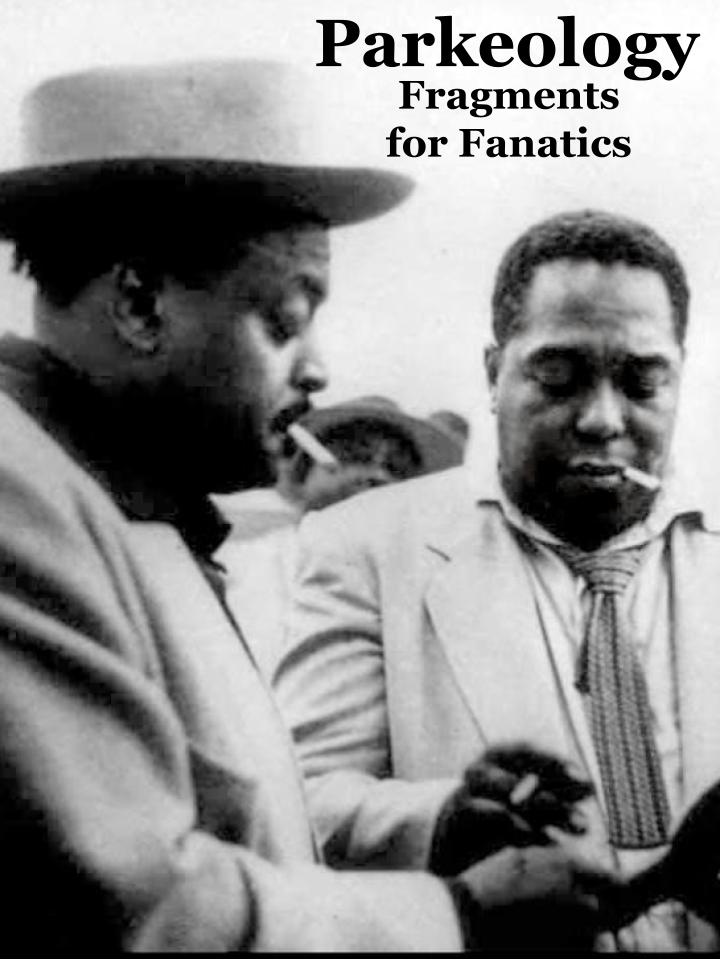
I got word that time that I could be in a jam session with Bird and Diz, and I walked two miles carrying my bass without gloves in ten below zero weather to the Ritz Hotel. It was a fine session. I remember a fellow named Red Cross taped the session. – Oscar Pettiford
Pettiford is referring to the jam session in Chicago on February 15, 1943, recorded by Bob Redcross. Bird switched to tenor when he joined the Earl Hines Orchestra in December 1942, and I’m trying to make the case that he was influenced by Ben Webster at this crucial juncture. Evidence abounds in “Three Guesses,” which bookends “Yardin’ with Yard,” both tracks being “I Got Rhythm” jams.
I’ve already made the argument that Bird adopted a chromatic motive from Webster’s “Cotton Tail” solo (May 4, 1940) that became a fundamental building block in his vocabulary. (When I say chromatic motive, I’m talking about consecutive half steps in a melodic line.) I’ve labeled this Motive 1. Here it is, first Webster, then Bird.

The ultimate point here (don’t hold your breath) is that Motive 1 offered Bird a solution to structural problems in his melodic lines, by replacing descending scale runs with descending chromatic runs. This shift took place gradually, between 1943 and 1945, and culminated in his first recording session as a leader, on November 26, 1945.
First things first.
“Three Guesses” is a mess (full track below). Pettiford isn’t playing, the presence of a second tenor player creates a lot of murk, and the guitarist is unclear on the very idea of form.
In a way, though, this is its strength. It seems unlikely that Bird had high expectations for this particular jam, which appears to have put him in a lackadaisical mood. The first minute and a half is so aimless that even Remi Bolduc didn’t transcribe it. And yet, of all the Redcross recordings, it offers the clearest proof of Ben Webster‘s influence.
Near the beginning of “Three Guesses,” after the two-horn noodling has passed, Bird mimics Webster for 45 seconds straight, from :42 to 1:27. These phrases aren’t quotes, so they can’t be linked to specific Webster solos. Here’s the 45 second stretch:
At 1:28, Bird drops his Webster impression and reverts to his own vocabulary. This is where Bolduc begins his transcription:
It’s also worth noting that in the first few seconds, before the second tenor player begins noodling, Bird launches the whole affair with a Websteresque opening phrase:
We must now address the elephant in the room: Hawk. On the surface, Webster and Coleman Hawkins sound very much alike. Their differences are as subtle as they are profound. The result is a musical Rorschach test that applies equally to Bird’s mimicry. One discernable difference between the two is that Webster employs growls much more frequently, often as tone color. To my ears, Bird is growling throughout this stretch in the Webster style, but if you think it sounds more like Hawkins, drinks are on me.
It would be easy to go off in all directions here, so I will focus on three excerpts that can be traced directly to Webster. This chromatic motive is very similar to a Webster phrase in “Big Eight Blues” (December 15, 1940). I have transposed Bird’s excerpt to match Webster’s key:
The following three-note motive can be traced to both Webster and Hawkins:
Hawkins uses a three-note motive in the opening phrase in his famous 1939 “Body And Soul:”
Nevertheless, I think Bird is closer in spirit to Webster. Here’s an excerpt from Webster’s “I Surrender Dear,” matched with Bird’s three-note motive (I have again transposed Bird’s excerpt to match Webster’s key):
The third excerpt couldn’t be more direct, but it come’s from “Yardin’ with Yard,” not “Three Guesses.” It confirms that Bird definitely had Webster on the brain. We find Bird quoting “Cotton Tail” behind Billy Eckstine’s trumpet solo, and, as the track trails off, Bird continues on, into the opening notes of Webster’s solo. First Webster, then Bird:
Admittedly, this is more of a paraphrase, suggesting that Bird never learned Webster’s solo note-for-note. But he follows it with two uncanny phrases that are pure Webster. Again, these aren’t direct quotes, and that’s the point. Bird is evoking Webster’s feeling, not copying his ideas. Here’s the whole stretch:
Another example of this is the “Cherokee” recording made at Monroe’s Uptown House. (The accepted date is 1942 but I believe it was recorded significantly later.) I’m certain that Bird got the idea for this sequence from the second bridge of Webster’s “Cotton Tail” solo, despite the fact that they don’t intersect in any way (aside from telltale growls). First Webster, then Bird:
In an odd coincidence, Webster left Ellington and Bird left Hines at almost the same moment, in early August 1943. Just days after leaving, Webster opened with his own quartet at the Three Deuces on 52nd Street. Bird jumped ship in Washington DC and stayed in town for a spell before returning home to Kansas City.
We are fortunate that Webster recorded as he embarked on this new phase in his career. The following excerpts come from radio transcriptions made in September 1943 (full tracks below) and demonstrate that chromatic motives continued to play a prominent role in his conception.
I may be exposing my own ignorance here, but I can’t think of any saxophonist of this era who used this type of chromaticism other than Webster.
Motive 2 was mentioned in passing in Parkeology 033, and it’s an equally thought-provoking motive, even if it isn’t as consequential as Motive 1.
Motive 2 comes from Webster’s solo on “Linger Awhile” (November 2, 1940). This quote became another of Bird’s building blocks. He plays it almost exclusively in F concert, as he does here in “Scrapple From The Apple” Take C (Dial November 4, 1947). I’ve transposed it down a whole step to match Webster’s key (Eb):

There’s no way to prove Bird ever heard Webster’s “Linger Awhile” solo, but there’s also no need, because Motive 2 has another source. It appears in the “Cotton Tail” saxophone soli, likely written by Webster:
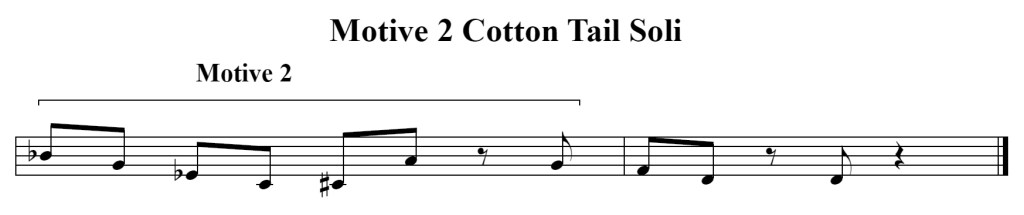
Bird rarely plays Motive 2 in B-flat concert, which is surprising, since that’s the original key, but he does so here, on “Anthropology” (Birdland, March 31, 1951):
The following examples, all in F concert, come from “Billie’s Bounce” Take 3 (Savoy November 26, 1945), “Marmaduke” Take 5 (Savoy September 24, 1948), and “Scrapple From The Apple” (Royal Roost February 5, 1949):
Motive 2 can’t hold a candle to Motive 1 in terms of frequency, but it’s a mainstay nonetheless. More to the point, it helps corroborate Webster’s influence.
But my argument doesn’t end here. At some point between 1943 and 1945, Bird split Motive 1 in two, separating the five descending notes from the three ascending notes. I have labeled these two motives Motive 1A and Motive 1B.

It was in fact Motive 1A that offered Bird the solution to structural problems, independent of Motive 1B, and it turns out that Motive 1B was already present in Bird’s vocabulary, dating back to “Honey & Body.” These matters will be addressed in Part Three.
I warned you not to hold your breath.
* * * * * * * * * * * * * * * * * * * * * * * * * * * * * * * * *
Here’s “Three Guesses:”
Here are the eight tracks from the September 1943 transcriptions (in the same order as the excerpts above): “Woke Up Clipped” (Webster), “Teezol” (Webster), “The Horn” (Webster), “Don’t Blame Me,” “I Surrender Dear,” “Tea For Two,” “Dirty Deal” (Webster), and “‘Nuff Said” (Webster).
Personnel: Ben Webster tenor, Hot Lips Page trumpet, Clyde Hart piano, Charlie Dayton bass, Denzil Best drums.

