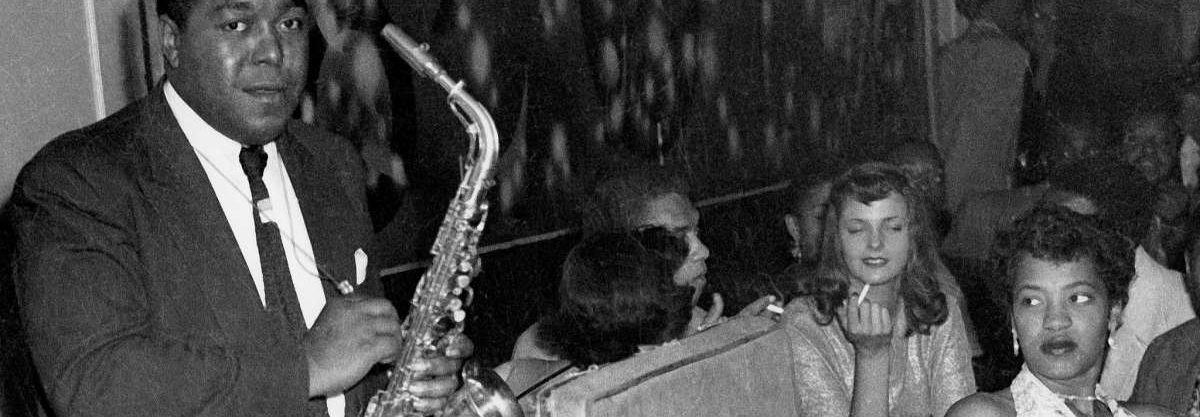
When was Bird’s first version of “Cherokee” recorded? (Part Two of Three)
How often have I said to you that when you have eliminated the impossible, whatever remains, however improbable, must be the truth? –Sherlock Holmes
Welcome to the Hall of Mirrors, wherein I shall present my final argument concerning the recording date of Bird’s first “Cherokee.”
Here’s the recording in question:
Here’s the problem: The assumptions involved make this argument a house of cards. My guess about the recording date is based on the musical evidence presented in my previous Ben Webster posts. In order to believe this guess has any validity, you have to also believe that I’m correct about Webster’s influence on Bird and the timing thereof.
As we set sail once again across these fog-shrouded seas, we have four new compass points to guide us:
- In December 1942, Bird switched to tenor and joined the Earl Hines Orchestra, rehearsing with them throughout the month.
- The Hines Orchestra played a one-week engagement at the Apollo Theater, January 15-21, 1943, then departed NYC on tour.
- On or about January 15, 1943, Ben Webster returned to NYC after months on the road with Ellington. On January 17, the Ellington Orchestra convened at Nola Studios for a full week of rehearsals.
- Billy Eckstine reports that Webster first encountered Bird at a jam session at Minton’s, in which Bird was playing tenor.
The upshot of my Webster posts is this: I believe that when Bird switched to tenor, he turned his attention to Webster, beginning with Webster’s “Cotton Tail” solo and the “Cotton Tail” saxophone soli, very likely written by Webster (full track below).
Bird adopted a phrase from the solo I call Motive 1. Here it is, first Webster, then Bird:
Bird subsequently split Motive 1 in two. I call the first half, a five-note chromatic descent, Motive 1A. Here are examples from “Warming Up a Riff” (November 26, 1945, full track below):
Bird adopted a phrase from the soli I call Motive 2. Here’s the soli:
Webster extracted Motive 2 from the soli himself:
Here’s Bird (transposed into Webster’s key):
Bird was adept at mimicking Webster, including Webster’s growl. Examples of this can be found on the Redcross recordings (February 15, 1943), whereas there are no examples of Bird growling prior to the Redcross recordings. Here’s Bird on tenor:
Bird’s first version of “Cherokee” contains Motive 1A, Motive 2, and an abundance of growling.
Motive 1A, the chromatic descent, can be heard at 2:12:
Motive 2 can be heard at 2:16:
Bird fashioned a set piece designed to navigate the first half of the “Cherokee” bridge. He growls throughout these eight bars, beginning at 1:33:
I believe this set piece was inspired by Webster’s “Cotton Tail” solo, specifically the second bridge (1:18). These two bridges share no vocabulary, but they’re tied together by the underlying concept. If you think I’m grasping at vibes, fair enough. Here’s Webster:
The next argument concerns fluency. The “Cherokee” bridge begins in the key of B major, difficult at such a fast tempo, even for Bird. “Tea for Two” was another set piece used to navigate the first eight bars. He deploys it in the second bridge, starting at bar five (2:36) and continuing through bar twelve (2:43):
But Bird forgoes the set piece in the first four bars, which are the most difficult. Instead, he plays a very fluid line, sounding quite at ease in B major. It bears a strong resemblance to a line found in the AFRS transcription of “Cherokee” from April 1946:
Any fragment of mature vocabulary found in Bird’s apprenticeship period acts as a form of carbon dating, suggesting a later rather than earlier recording date.
Another subject covered in the Ben Webster posts is Bird’s use of scale runs. (I define scale runs as consecutive notes of a scale used in a melodic line.) Such runs, often spanning an octave or more, are a defining characteristic of Bird’s early style (1940–1943). I contend that Bird gradually replaced scale runs with Motive 1A. By the time he arrives at his mature style (1944), scale runs typically span a fifth.
Bird’s solos from McShann’s Savoy broadcast (February 12, 1942) contain an abundance of scale runs, all of which span more than an octave (eight scale degrees). On “I’m Forever Blowing Bubbles,” he plays fourteen degrees of Eb major, eleven degrees of F major, and eleven degrees of G minor. On “St. Louis Mood,” he plays nine degrees of Eb major, and thirteen degrees of Bb major. On “Swingmatism” he plays eleven degrees of F minor. Here they are in order:
Scale runs in Bird’s first version of “Cherokee” are less frequent and span smaller distances. At 0:08, he plays seven degrees of C major; at 0:28, he plays nine degrees of A minor; at 0:37, he repeats the same seven degrees of C major; at 1:27, he plays nine degrees of D major; at 2:52, he plays eleven degrees of D major. Here they are in order:
“Cherokee” has a 64-bar form. Bird takes almost two full choruses, but the second chorus fades out at the end of the bridge, making his solo 112 bars. In the space of these 112 bars, though, he only plays five relatively short scale runs. By any measure, it’s a substantial decrease in both frequency and distance.
That’s it! That’s all the evidence I have to support my argument that Bird’s first version of “Cherokee” was recorded after Bird switched to tenor and began absorbing Webster’s influence. This argument is chockablock with assumptions built on assumptions, and I won’t be offended if anyone throws out the baby with all this half-baked bathwater.
What’s that you say? What about the goddamn date???
Here’s the Eckstine anecdote (compass point 4):
Charlie’s up on the stand and he’s wailing the tenor. Ben had never heard Bird, you know, and he says, “What the hell is that up there? Man, is that cat crazy?” And he goes up and snatches the horn out of Bird’s hands, saying, “That horn ain’t supposed to sound that fast.” But that night, Ben walked all over town telling everyone, “Man, I heard a guy—I swear he’s going to make everybody crazy on tenor.”
Compass point 3 tells us that this could only have happened between January 15th and 21st, 1943, after Webster was back in NYC and before Bird left on tour with Hines.
But did it really happen at Minton’s? Webster’s own words contradict this:
“I first heard Charlie at Monroe’s… There was this guy on the stand blowing weird stuff. It was Charlie. I said to Clark, ‘Is that cat playin’ what I think he’s playin’?’ Clark said yeah… I was feeling pretty fit but I wasn’t sure, I didn’t trust my ears.”
Webster can’t have heard Bird for the first time twice, in two different locations. (Talk about a taffy-pull!) It’s plausible, then, that this is the same encounter Eckstine describes, told from Webster’s own point of view, minus the detail that Bird was on tenor.
Did Eckstine, reminiscing in 1954, simply confuse Minton’s with Monroe’s? No! It turns out Eckstine never specified the location! That information has been supplied down the ages by jazz writers framing Eckstine’s quote. It’s received wisdom that overlooks Webster’s own account, and that’s enough for me to toss Minton’s out the window. Look out below!
Webster’s words suggest that Bird went up to Monroe’s at least once after his gig at the Apollo (compass point 2), and I wouldn’t be surprised if he did so every night. Webster could have gone to Monroe’s every night that week, as well, after his Ellington rehearsals (compass point 3). And, for what it’s worth, Morgenstern claims Webster was there two nights in a row.
What about the goddamn date? I believe that Bird’s first version of “Cherokee” was recorded no earlier than December 1942 and no later than January 21, 1943.
There you have it! No exact date, as promised, just a lot of hemming and hawing, as promised. I also promised a prime suspect, but the question of where is still up in the air.
According to received wisdom, the recording location is Monroe’s, but we can infer from Morgenstern’s words that Newman didn’t note the location on his tape box, and discographies are cautious on this score. “Possibly Clark Monroe’s Uptown House” is as far as they’re willing to go. As mentioned last time, the musicians backing Bird on this track sound nothing like the Monroe’s house band.
One plausible alternative is Smalls Paradise, another Harlem jazz club with a house band, floor shows, jam sessions, and even a regular 6 AM breakfast dance. Did Bird ever play there? Probably. Could this “Cherokee” have been recorded there? Possibly. If you prefer certainty, I can tell you this: We definitely don’t know where it was recorded.
As for the prime suspect, meet Seymour Wyse, a Brit who was a childhood friend of Jack Kerouac, and also a friend of Jerry Newman. In the course of a long interview about Kerouac, Wyse touches on his friendship with Newman:
I attended NYU, studying accountancy. Jack was at Columbia University and I don’t think I saw a lot of him at this time. It was during this period that I used to visit a lot of jazz clubs. Jerry would have been a little bit older than Jack and me. I got a recording machine–a disc recording machine–because I wanted to record some jazz. This would have been about ’41 and there was no such thing as a tape recorder in those days, but you could get a portable disc recording machine, and cut an acetate with a cutting head. When Jerry was doing those recordings at Minton’s, I used to go up there and see him. I was at several of those. Jerry went into the army in ’42. and he was here in England for the D-day landings in 1944. In early ’43 I joined the Canadian Air Force, stationed at Lachine, near Montreal. Then, when I went back to the States I met up with him again, and in ’49 I worked for his record shop which was in Greenwich Village–the Greenwich Music Shop. Then later Jerry formed a record company and I became a partner with him.
As is typical of this whole affair, nothing can be proven. But here we have a man who lived in NYC, owned a disc cutter, wanted to record jazz, and had a high opinion of Bird, saying in the same interview, “With Charlie Parker it was different because he was quite a new thing and had brought about a tremendous change in the music.” He also became Newman’s partner in the record business. It seems entirely plausible to me that a paper-backed disc of Bird playing “Cherokee,” recorded by Wyse in December 1942 or January 1943, would have interested Newman enough for him to dub it onto tape, write little or nothing about its origins on the tape box, and then forget about it, all in keeping with his longstanding indifference to Bird’s playing.
It’s a taffy-free argument.
*******************************************
Here’s “Cotton Tail” (May 4, 1940):
Here’s “Warming Up a Riff” (November 26, 1945):
Up next in mid-November: Parkeology 039 Buster’s Mood. Was Bird really influenced by Buster Smith?

