
M.1A is an ascending arpeggio, usually played as a triplet, but also common in other rhythmic configurations. Preceded by an upper or lower neighbor, it frequently begins a phrase. About forty percent of these arpeggios are of minor-seventh chords; E minor-seventh is the most common. – Thomas Owens, 1974 Dissertation

Forty percent is quite a statistic, and the fact that Em7 is the most common certainly suggests that D major was Bird’s primal key. More broadly, it confirms that four-note ascending arpeggios were central to Bird’s vocabulary. This is so self-evident that no examples are required.
What’s needed, though, is an underlying principle that accounts for the many manifestations these arpeggios present, hence the ladder of thirds.
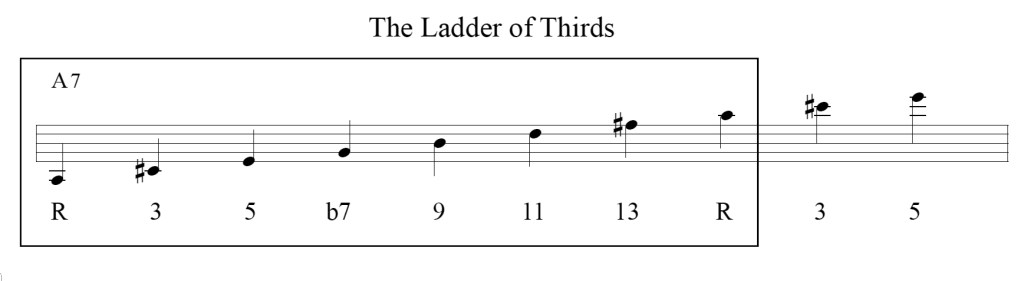
Bird’s thought processes are unknowable, but I’m arguing that his “Cherokee” revelation began with the realization that the Em9 arpeggio spells out the entire upper structure of the A7.
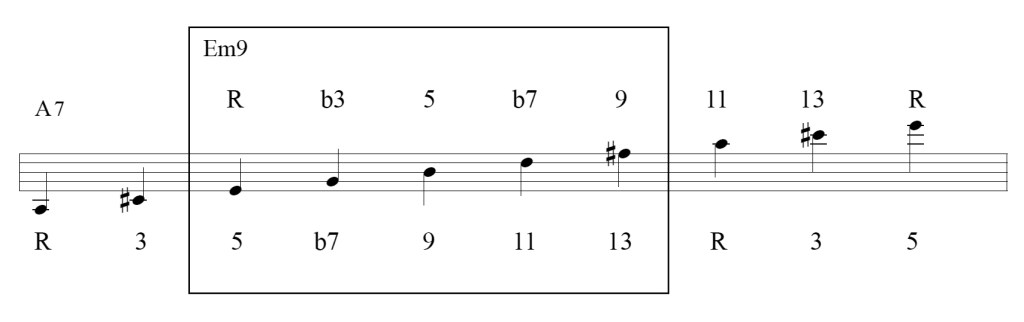
Don’t forget there were no II-V progressions (as we know them today) in 1939, just V chords. Bird, at the age of nineteen, had to conjure up the II chord and invent a new vocabulary that incorporated it, an extraordinary intellectual achievement. To quote Dizzy:
You didn’t find many musicians who could show you on the piano what they were doing. But Charlie Parker could, even then. He was only a kid. We were both only kids.
On a practical level, Bird divided the ladder of thirds into four-note groups, creating seven rungs.



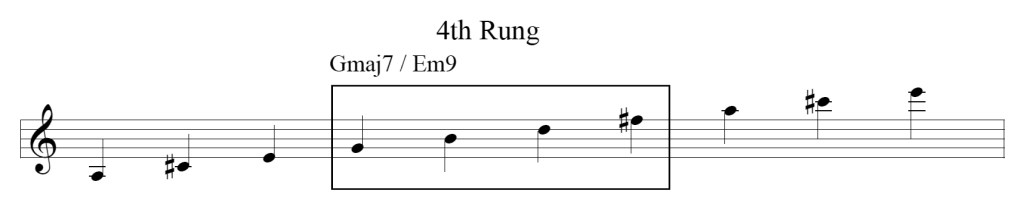
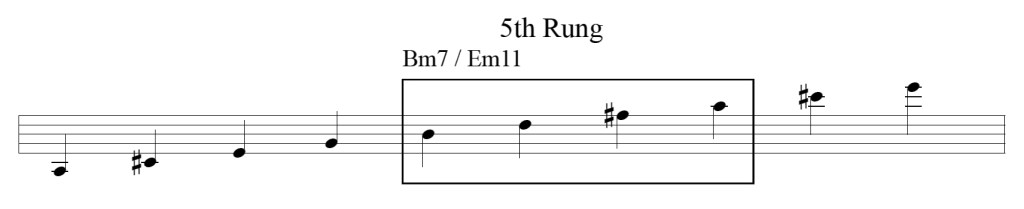
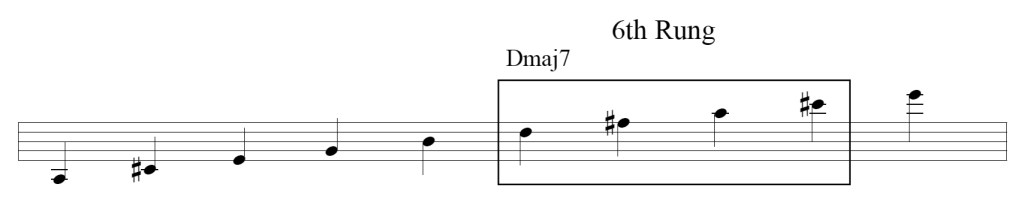
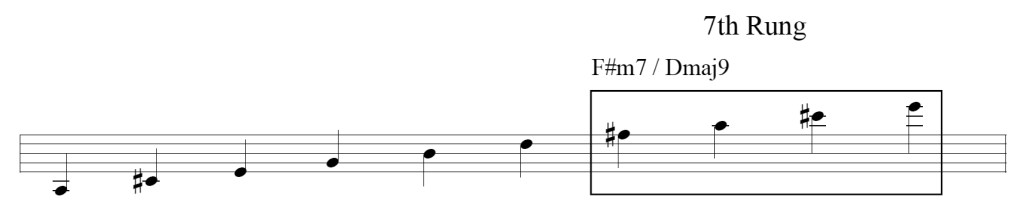
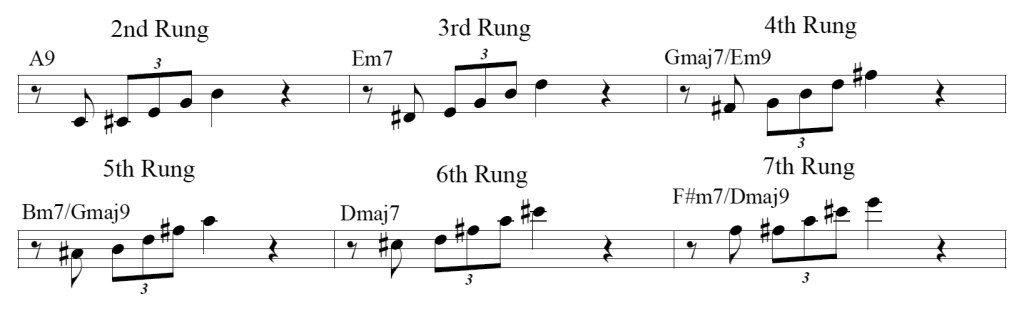
As Owens notes, Bird often played these arpeggios as triplets, leading into them with an approach note. This is such a common form that it functions as a default setting for all rungs. Bird, however, never used the 1st Rung, so it isn’t included below. It’s best considered a foundation that anchors the ladder itself.
In practice, then, the six remaining rungs look like this:
Takes 5, 9, and 12 of “Marmaduke” (Savoy, September 24, 1948) provide any number of examples, but Take 5 is best suited to the purposes at hand. It was already examined in Parkeology 028, documenting Bird’s use of the D major ornament found in the opening bar of “The Jumpin’ Blues.”
The solo from Take 5 below highlights those previous examples with circles, while the new ladder of thirds examples are highlighted with rectangles. Note that rungs can descend as well as ascend. Here’s the full solo, slowed down for clarity:
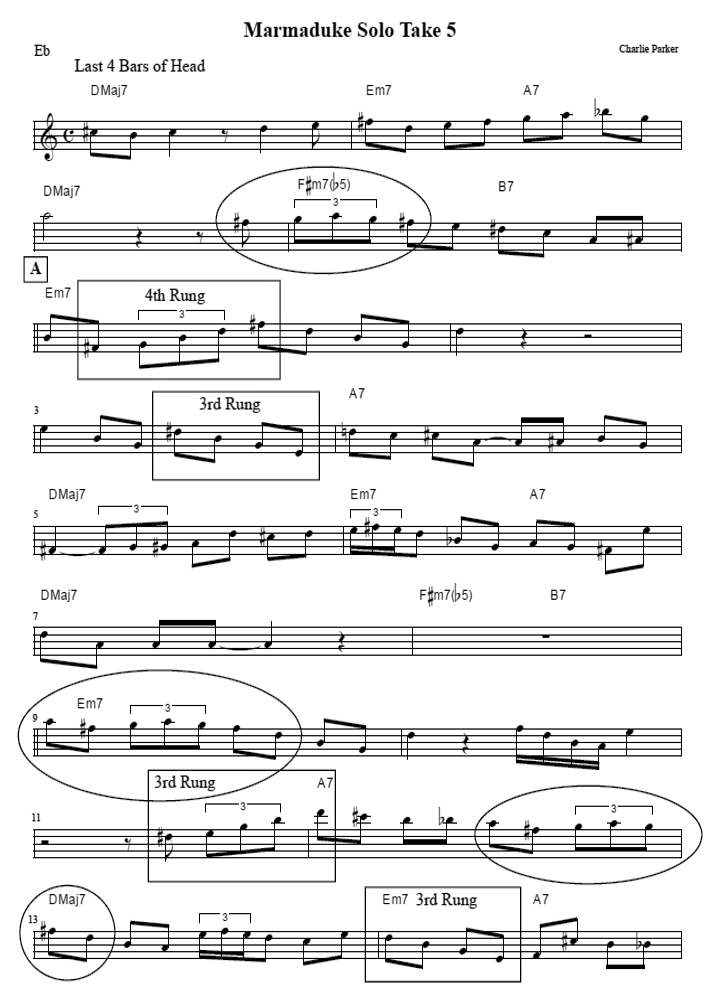
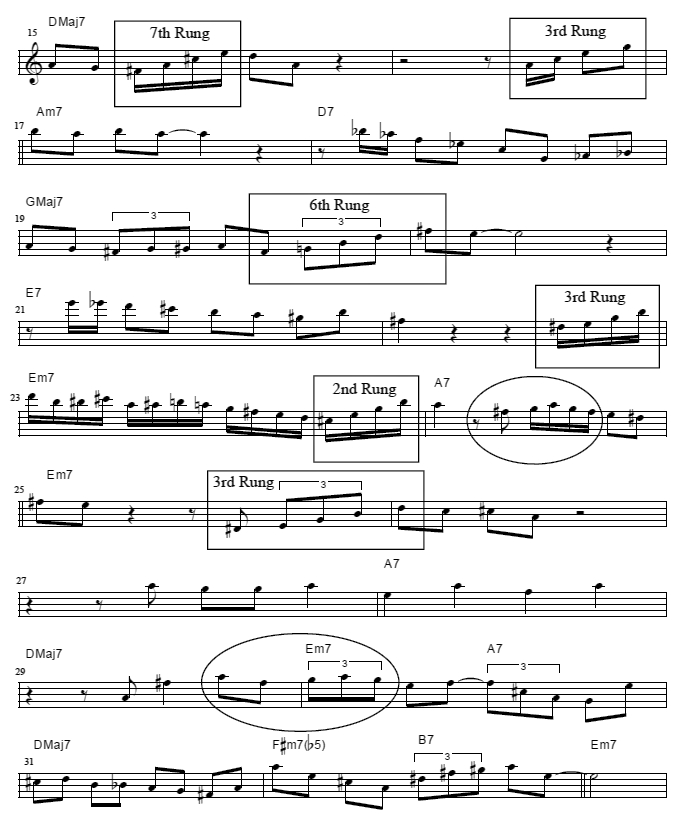
It’s plain to see that the D major ornament is deeply ingrained in Bird’s muscle memory, and that its use isn’t limited to the I chord. In fact, it has even broader applications than these, in other contexts and other keys, but that’s a subject unto itself.
Owens’ forty percent statistic is not only met but exceeded, with the 3rd rung, Em7, appearing five times out of ten. This isn’t surprising, given the key of D major, but it leaves no doubt that minor 7th arpeggios are a key building block.
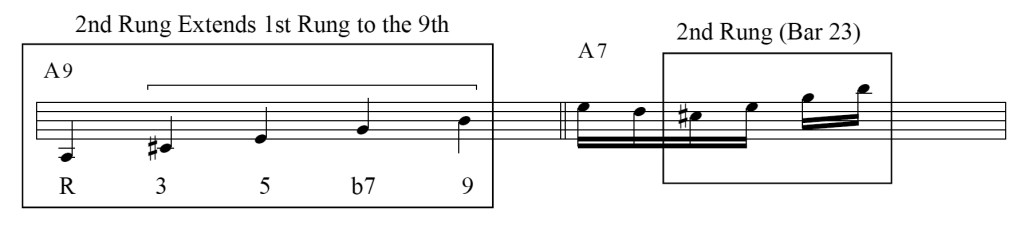
But other four-note arpeggios are quite common, foremost among them the 2nd rung, which runs the V chord up to the 9th:
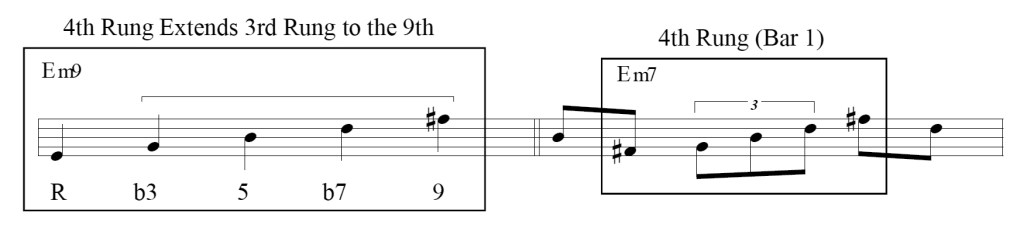
Bird frequently uses the 4th rung, which runs the II chord up to the 9th:
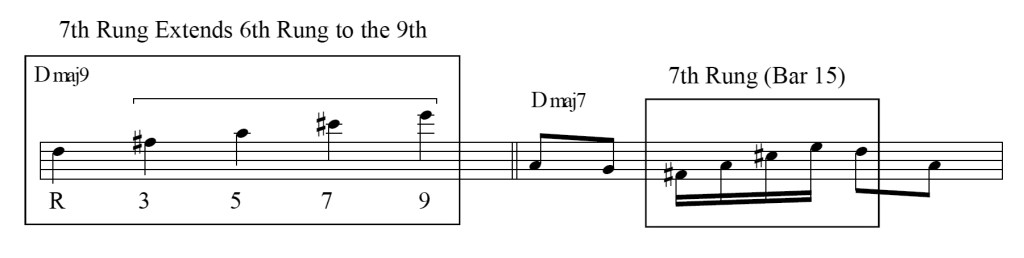
It’s less common, but Bird uses the 7th rung to run the I chord up to the 9th:
Bird also uses the 5th rung, but it’s a special case, rarely seen in the form below. It’s the most ambiguous harmonically, which reflects the ambiguity of the “Honeysuckle Rose” melody itself. The 5th rung deserves its own discussion elsewhere.
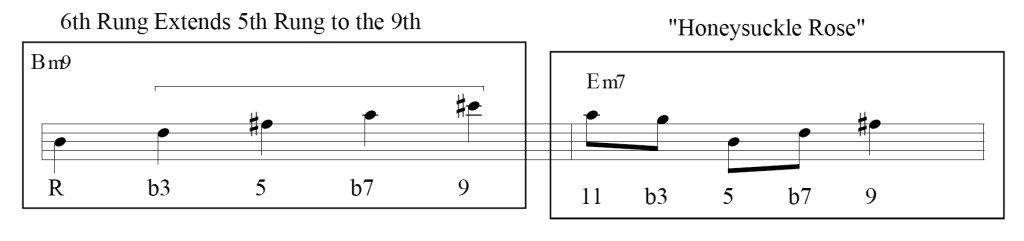
Given all this emphasis on 9ths, dividing the ladder of thirds into five-note groups offers a valuable perspective. It doesn’t, however, negate the fact that Bird primarily thinks in four-note groups.
By viewing the ladder of thirds as four 9th chords, we come as close as we can get to Bird’s 1939 “Cherokee” revelation. Levin and Wilson paraphrased it one sentence:
Working over “Cherokee” with Fleet, Charlie suddenly found that by using higher intervals of a chord as a melody line and backing them with appropriately related changes, he could play this thing he had been “hearing.”
I paraphrase it as: Everything is the upper structure of everything else.
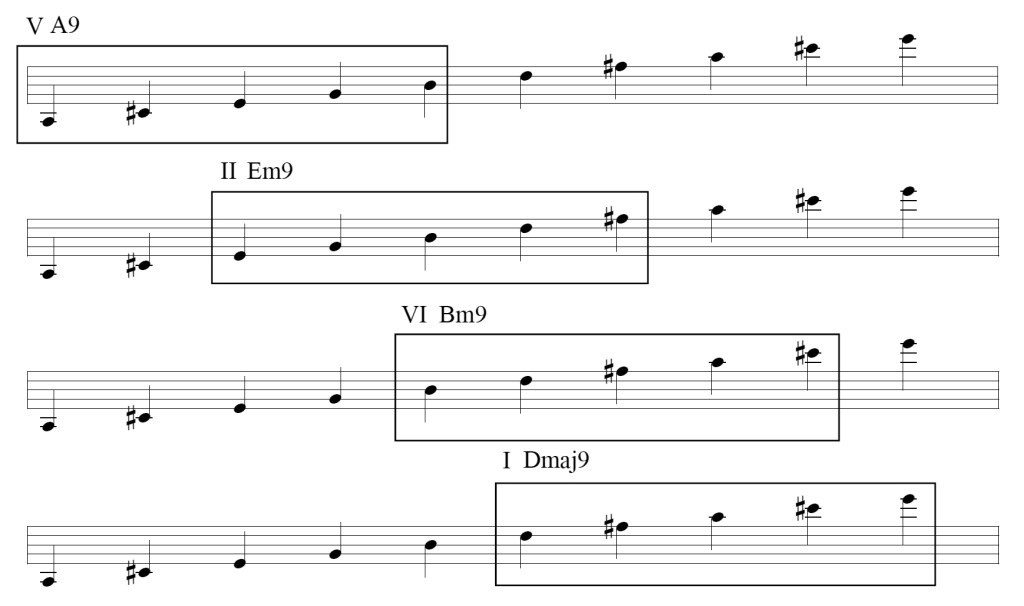
Needless to say, this statement needs further explaining, but the above diagram is somewhat self-evident. I will only add that the phrase “higher intervals of a chord” was a red herring of blue whale proportions.
Bird never thought past the 9th.
* * * * * * * * * * * *

