
Unfortunately, the surviving editor, Nat Hentoff, cannot reconstruct how the second version came to be written in such a way. Hentoff believed that Nat Shapiro edited the Parker section in question, but he felt it was unlikely that Shapiro would have simply altered the Down Beat text to make it read better. Hentoff could not recall if perhaps Shapiro worked from notes supplied by Levin or Wilson. Attempts to pursue this point with John S. Wilson, co-author of the original article, have thus far failed. — Carl Woideck
And that’s the last word on the Levin-Wilson article and its one-sentence paraphrase of Bird’s 1939 “Cherokee” revelation.
Every attempt to understand this revelation meets with the same immovable object: We have no idea what Bird sounded like before 1940. Personally, I would trade every word ever written about Charlie Parker for one solo from 1938. Until such time, it’s all just hot air.
That’s my cue!
Bird, it seems, was drawn to 9ths. It’s apparent from the standards he chose to play (“Out Of Nowhere,” “Star Eyes,” “I’ll Remember April,” “If I Should Lose You,” “Laura”) and in his own compositions (“Red Cross,” “Now’s The Time,” “Bird Feathers,” “An Oscar For Treadwell,” “My Little Suede Shoes”). It’s impossible to say when Bird acquired this affinity, but it was probably innate and guided his development from the start. That’s worth emphasizing here, because 9ths play a key role in his “Cherokee” revelation.
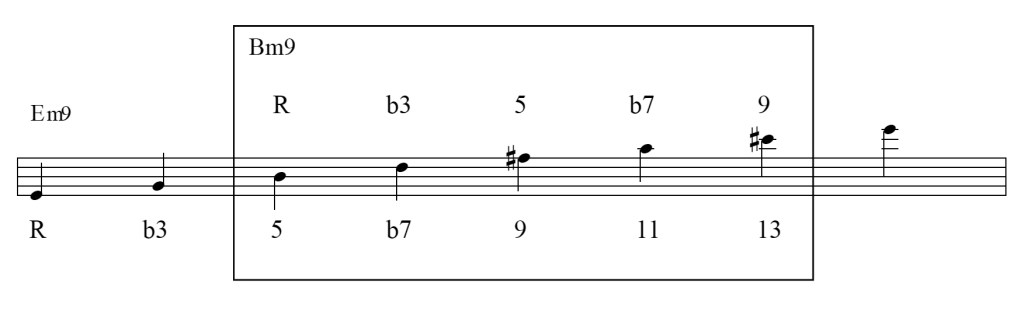
I believe Bird’s flash of intuition revealed something akin to the ladder of thirds:
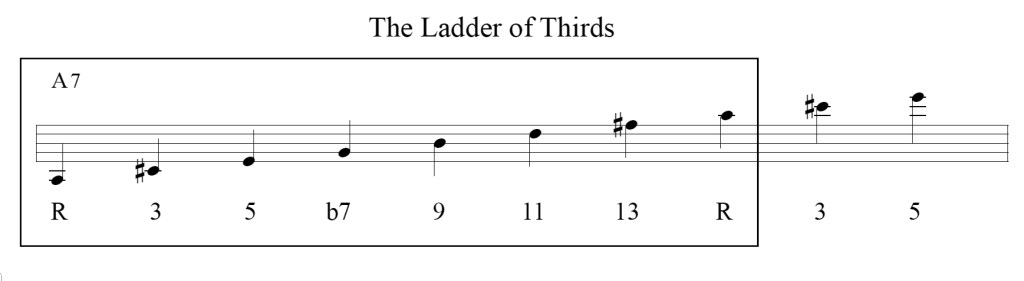
Visualizing it as four 9th chords, Bird suddenly understood that everything is the upper structure of everything else.
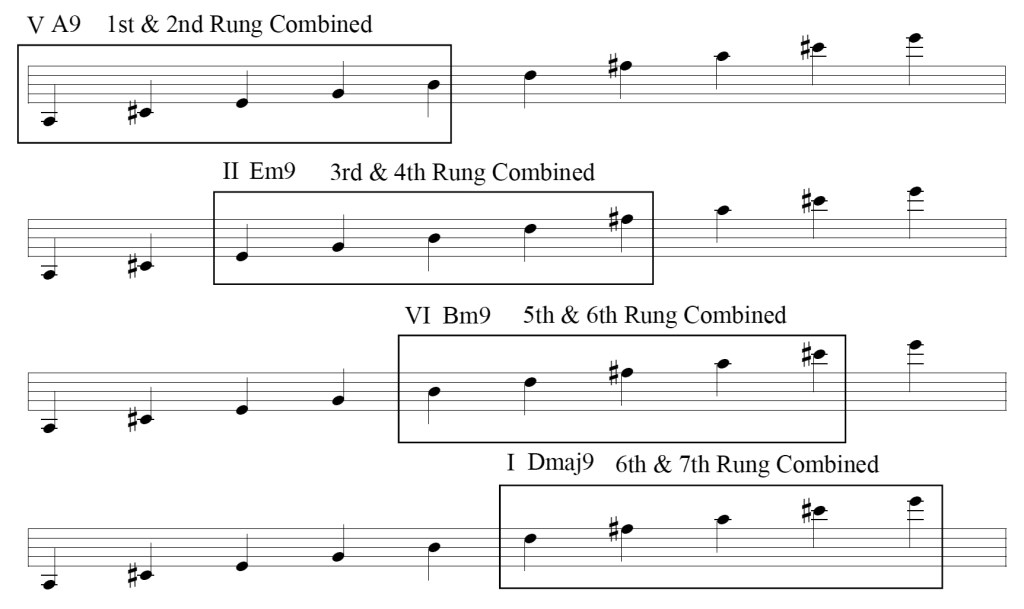
It began with the realization that the Em9, built from the 5th of the A7, spelled out the A7’s entire upper structure.
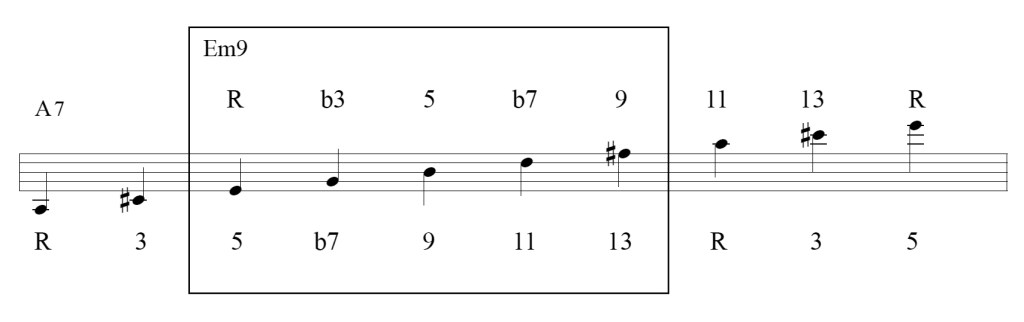
Following the same principle, he realized that the Bm9, built from the 5th of the Em9, spelled out the Em9’s entire upper structure.
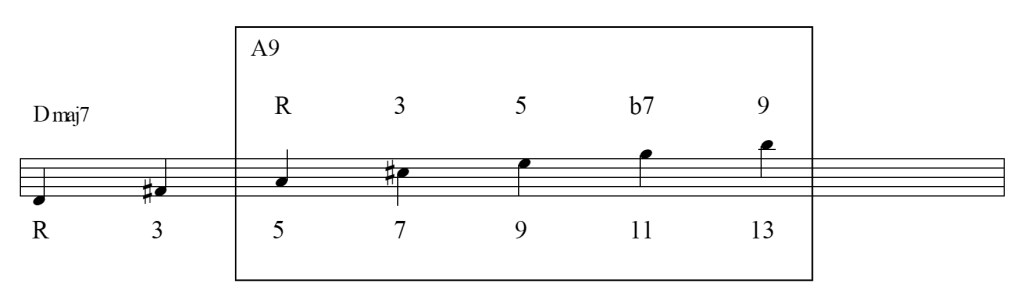
Following the same principle again, he realized that A9, built from the 5th of Dmaj7, formed the Dmaj7’s entire upper structure (notes transposed down an octave for readability), thus bringing the ladder of thirds back to its starting point.
What was it about “Cherokee” that made this so apparent? In short: The bridge. To begin with, the melody has plenty of 9ths, which may have attracted Bird in the first place, but it also has two very telling 13ths.
The example below is in alto saxophone key (as are all examples). It’s worth noting that the melody sits high on alto, which allowed Bird room to descend the ladder of thirds without bottoming out.
Also noteworthy, I am using the changes from the Charlie Barnet version of “Cherokee,” likely the one Bird was most acquainted with. Today’s fake books retroactively add II-V progressions where none exist on the original recordings. This is especially important in bars 33 and 41.
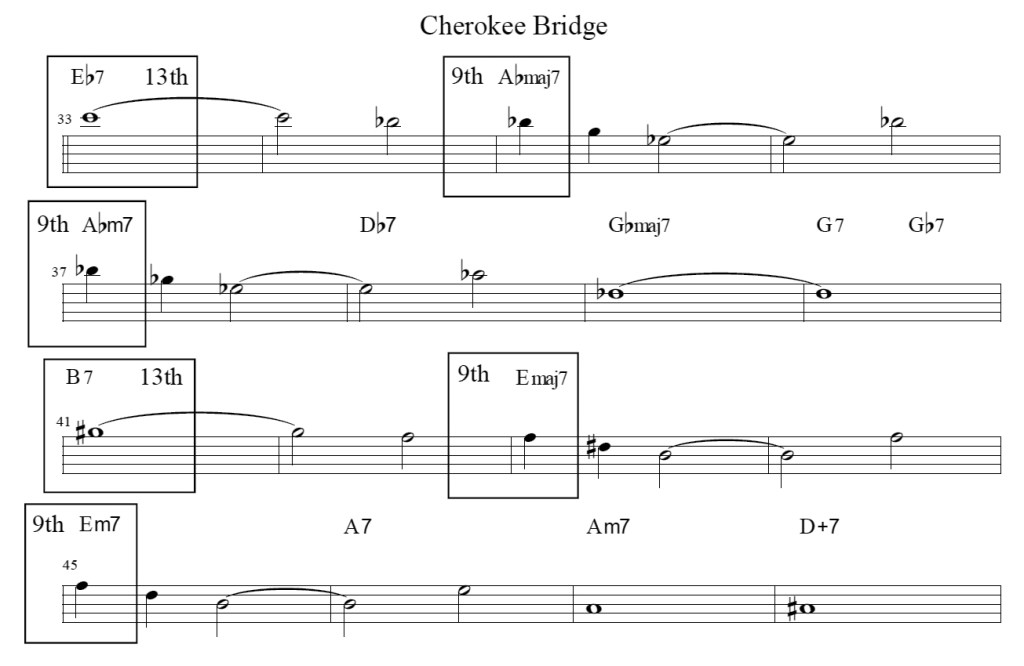
The first chord of the Bridge is Eb7, not Bbm7 (retroactive II chord). This is quite clear on all three recorded versions, Noble, Basie, and Barnet (in order of recording date, full tracks below). This Eb7 sounds as Eb13 because of the melody note and the horn voicings underneath it. This is consistent in all versions:
And Efferge Ware is most definitely strumming an Eb7 behind Bird:
Needless to say, Bird knows he’s on an Eb7 chord, and he knows the melody note is a C (highlighted). Here come the unanswerable questions:
Was he thinking of that note as the 6th? If so, did he suddenly realize he could think of it as the 13th instead? Did it just suddenly sound like the 13th to him?
“I kept thinking there’s bound to be something else,” he recalls. “I could hear it sometimes but I couldn’t play it.”
If Bird suddenly heard/realized that the melody note was a 13th, did he simply connect the dots down the ladder of thirds, all the way to the root?
Did the melody note in the next bar, a Bb on top of Abmaj7 (highlighted), suddenly sound like the 9th instead of the 2nd?

This new intuition would have been reinforced and broadened by the next two bars, in which Abmaj7 becomes Abm7, thus setting up a bona fide II-V-I progression, still unusual in 1939.
Here’s this key moment of transition from all three recordings:
The melody notes (highlighted) explicitly walk down the II chord (Abm7) from the 9th, land on the 5th of the V chord (Db7) (written 8vb), and end up on Db itself (8vb). This can also be viewed as a descent via the ladder of thirds. The fact that it begins on the II chord and carries through the V chord only reveals the ladder’s function more clearly.
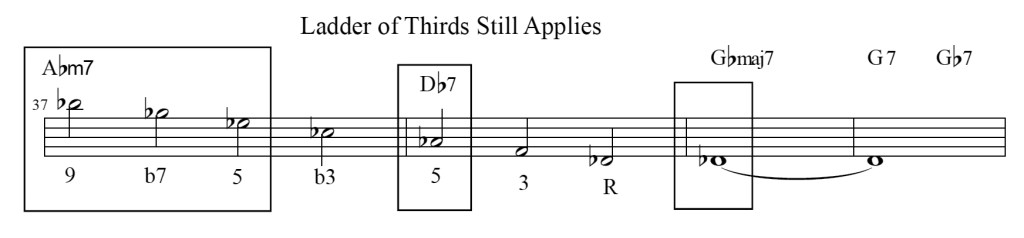
This would have been the moment of truth, when Bird realized that the Abm9 spells out the entire upper structure of the Db7. Again, both ladders above are easily playable on saxophone, from the 13th down to the root, and the same applies to the second half of the bridge, which continues the same pattern.
Did Bird possess the requisite knowledge to grasp all this in a matter of seconds? By 1939, he was, by his own account, striving to move beyond what must have been a more conventional, yet fully realized, style that had made him the darling of Kansas City. It’s not hard to imagine that he possessed, at age nineteen, a wide array of knowledge that still lacked organizing principles. Again, if we knew what he sounded like before 1940, this tedious guesswork wouldn’t be necessary.
Some may find the argument above simpleminded, others too complicated. Bird’s thoughts are unknowable and any argument is unprovable. The only real measure is plausibility, and that’s entirely subjective.
One thing, however, is certain: I suffer from delusions of grandeur. I plan to present a complete analysis of Bird’s style, post by post, for free here on Substack, as well as at charlieparkercentennial.com, until such time as I drop dead.
You can also find me wherever angels fear to tread
* * * * * * * * * * * *
Here are the three recorded versions of “Cherokee” that would have been available to Bird, in chronological order, Ray Noble, Count Basie, Charlie Barnet:


One thought on “Parkeology 030: Child of the Prairie”