
Charlie Parker’s chronology from late 1938 to early 1940 is rather sketchy. It is known that his mentor, Buster Smith, left Kansas City for New York in 1938, and that Parker eventually followed suit. By early 1940, Parker was definitely back in Kansas City working with McShann. –Carl Woideck
We know this because Bird’s estranged father died, stabbed to death by the woman he was living with, and nineteen-year-old Bird was called home to Kansas City for the funeral, moving back in with his mother.
Always eager to go out on a limb, I will argue that Bird spent this crucial period working through the implications of his “Cherokee” revelation, still very fresh in his mind. I will channel Bird’s musical thinking with false bravado, well aware that my bold pronouncements are just untethered speculation.
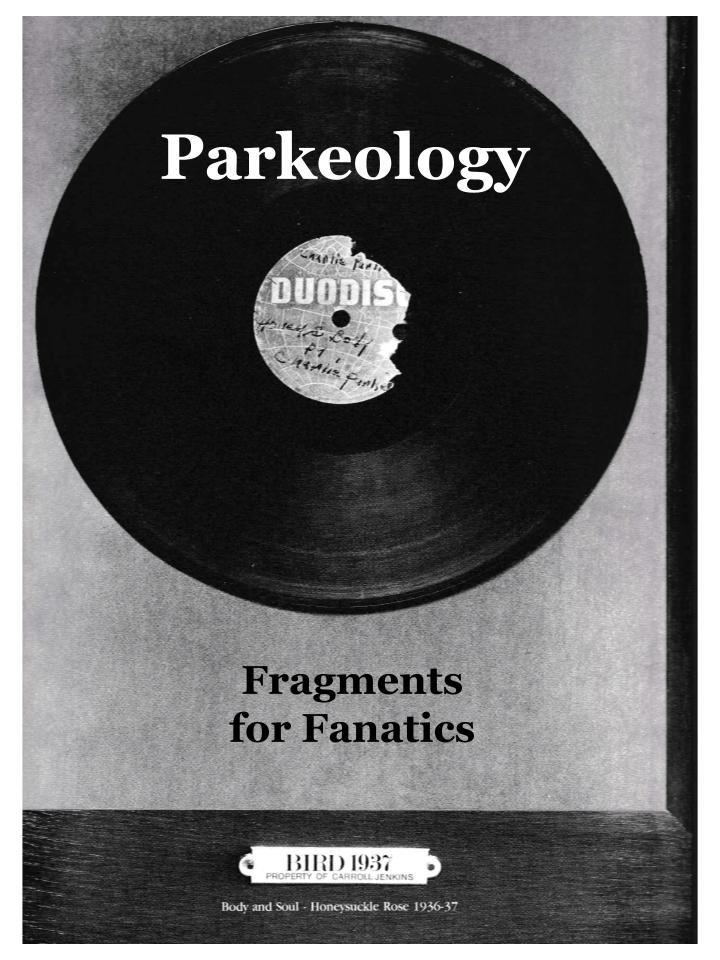
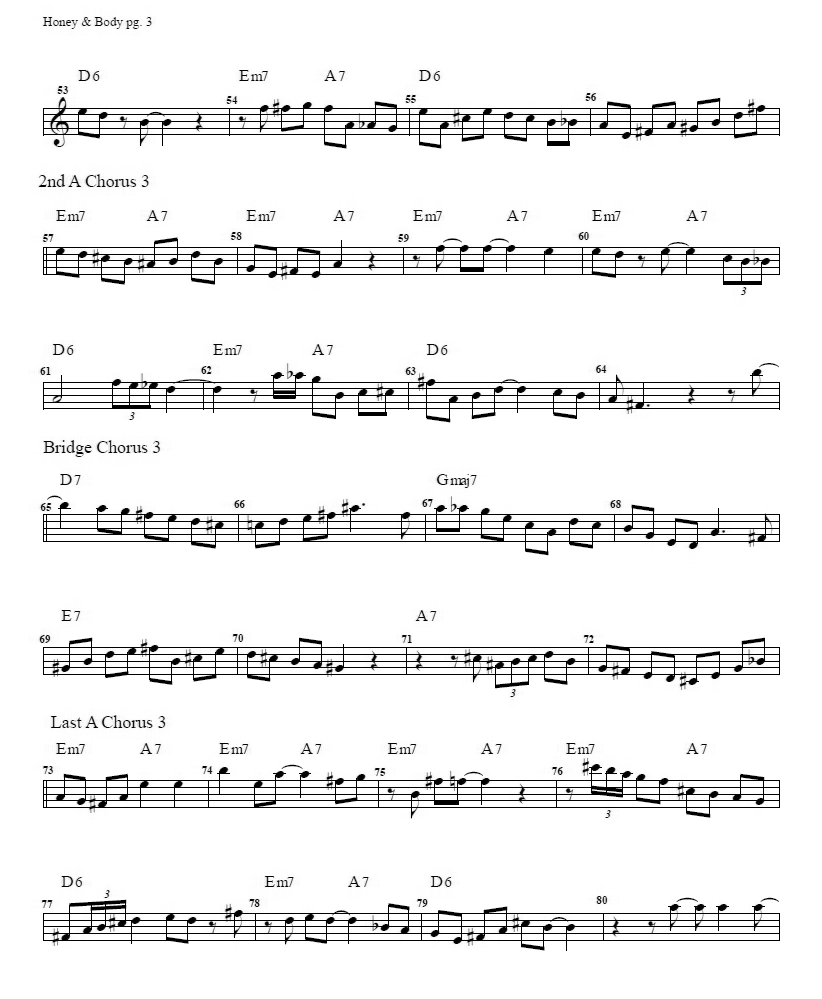
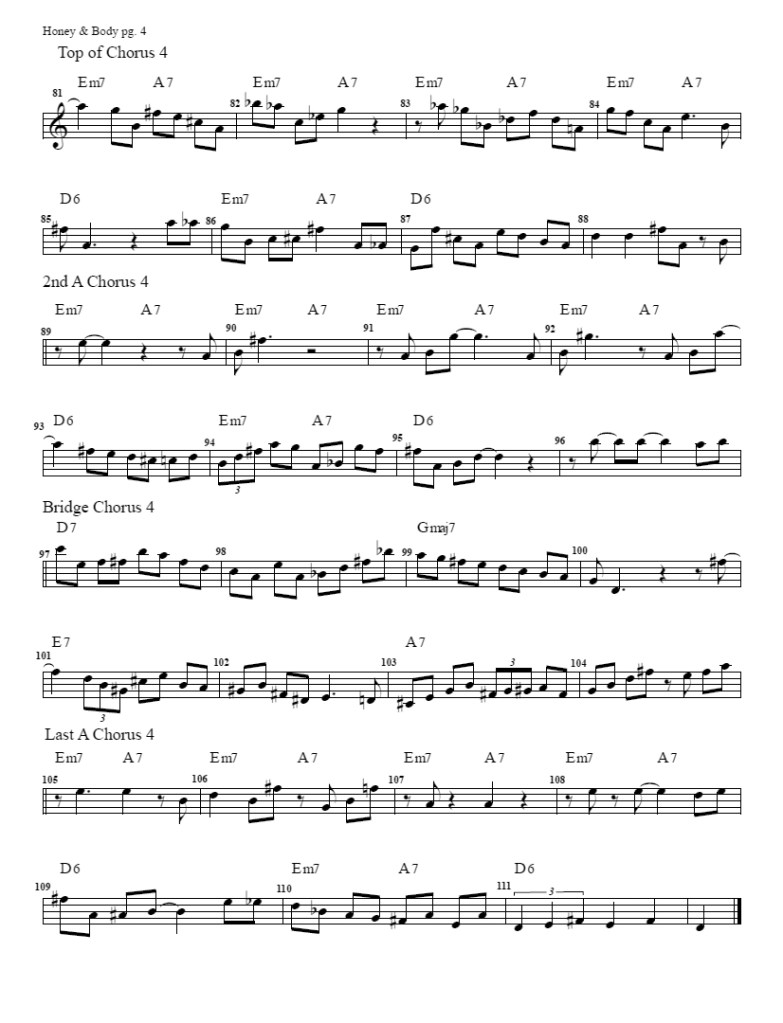
At some point in 1940, Bird made his first recording, informally titled “Honey & Body” (full track and partial transcription below). It’s just Bird alone on alto, playing a medley of “Honeysuckle Rose” and “Body And Soul,” recorded by a Kansas City friend on a portable disc-cutting machine (sound quality abysmal). It documents Bird in the process of creating a new vocabulary. His claim that he practiced between eleven and fifteen hours a day may include this stretch of time.
Since no pre-revelation recordings exist, “Honey & Body” is all we have to give us some inkling of Bird’s earlier style, but it reveals a lot.
I will break down the “Honeysuckle Rose” portion of the track (Bird segues into “Body And Soul” at 2:11) into short segments and sort the phrases into three categories: old vocabulary (pre-revelation), new vocabulary (post-revelation); and mature vocabulary (still present in his mature style).
The recording (slowed down for clarity) fades in as Bird is finishing the second A, heading into the bridge. This first phrase is actually the end of a phrase whose beginning wasn’t captured. It’s important, and will be discussed later, but I am starting with the first complete phrase, which begins with pickups into the bridge. The first bar of the bridge will be designated as bar 1.
Here are the first five bars:
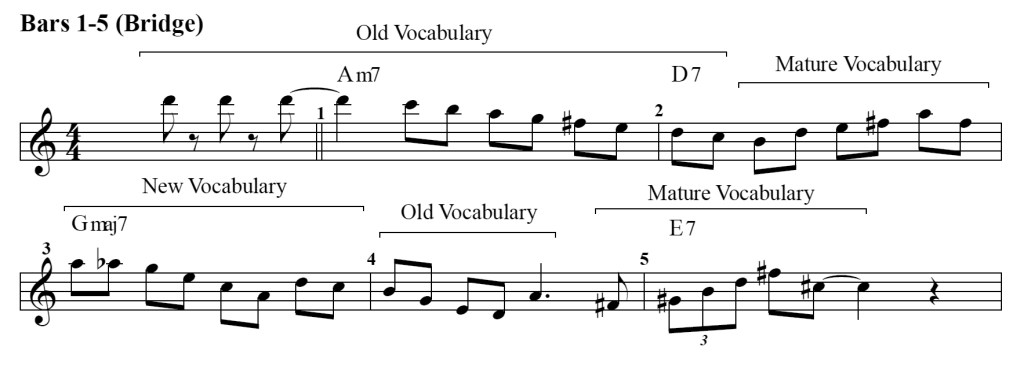
Right off the bat, we get very old vocabulary. The opening idea, three repeated notes on consecutive upbeats, probably dates back to Buddy Bolden, and is certainly part of Louis Armstrong’s vocabulary, not to mention Lester Young’s. This is followed by a long descending scale run, uncharacteristic of Bird’s mature style. Whatever the nature of his “Cherokee” revelation, it had nothing to do with scale runs, so this has to be considered old vocabulary.
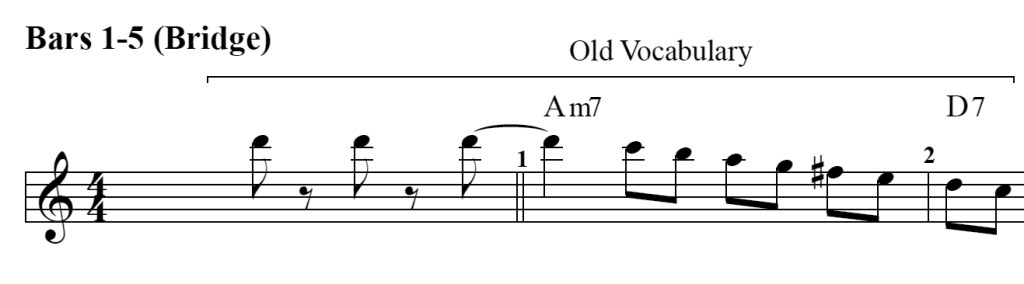
The fragment in bar 2 appears frequently in Bird’s mature style.
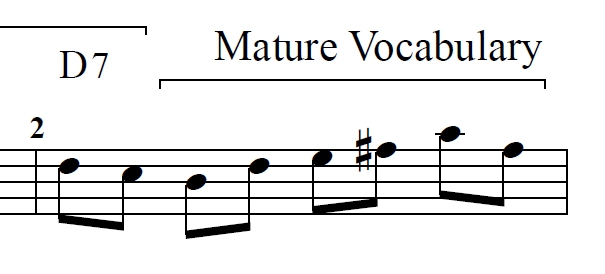
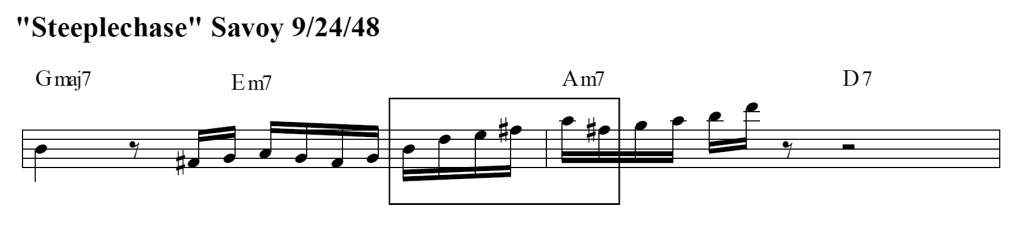
This is followed in bar 3 by new vocabulary, inspired by his “Cherokee” revelation. The descending Am7 arpeggio (highlighted) is a product of the ladder of thirds.
Bird actually uses this same descending Am7 arpeggio in the next bridge, at 0:45.
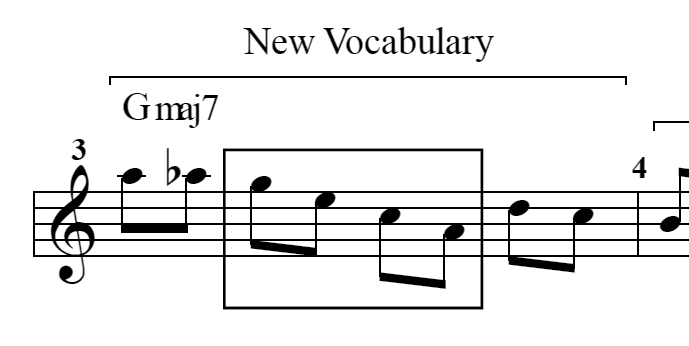
Bar 4 is clearly old vocabulary, a simple major pentatonic phrase that Bird often used in a blues context. The fact that it rests on the 9th suggests that his love of 9ths predated his “Cherokee” revelation.
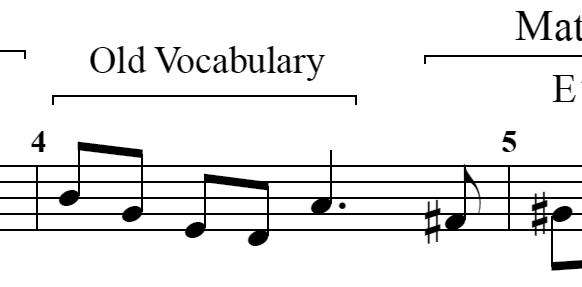
The figure in bar 5 is the legendary Motive 1A of Thomas Owens, which ranks number one on the basis of sheer frequency. Owens groups all such arpeggios together without regard to harmonic differences. The ladder of thirds unites the many iterations of this motive that Owens catalogued.
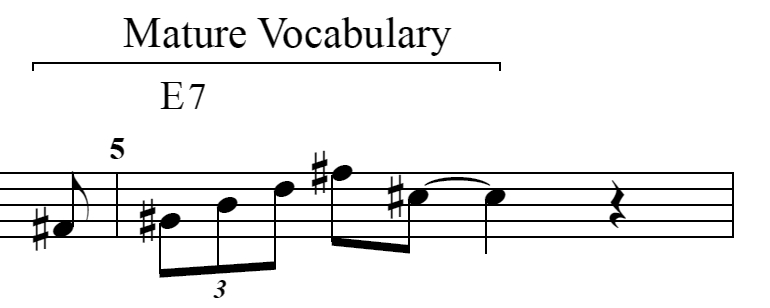
This figure (transposed) occupies the 2nd rung on the ladder of thirds. Measure 60 of “Koko” (Savoy 11/26/45) provides an example.
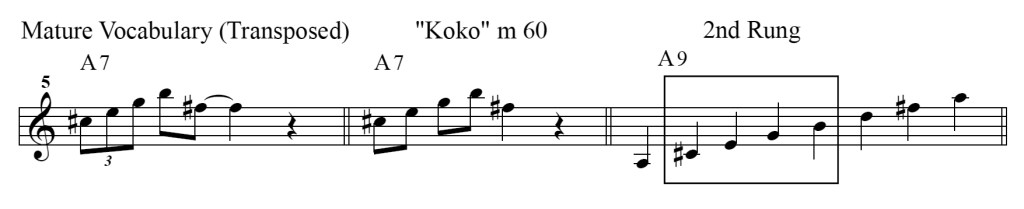
The 2nd rung is a dominant 7th chord run from the 3rd up to the 9th. 2nd rung vocabulary is easy to find. Here are six examples from “Honey & Body.” Note that Bird often ends these arpeggios on the b9.
2nd rung vocabulary didn’t originate with Bird. Louis ran dominant 7th chords up to the 9th all the time:
The first five bars of “Honey & Body” are an intriguing amalgam of old and new melodic material, but it’s important not to lose sight of the forest here. These opening bars are a continuous melodic line made up almost entirely of eighth notes.
Louis’s 1920s vocabulary was quarter-note based, although it pointed the way toward eighth notes. Lester’s 1930s vocabulary was, all in all, still quarter-note based, but it offered a clear blueprint for an eighth-note based vocabulary. This was not lost on Bird!
Working over “Cherokee” with Fleet, Charlie suddenly found that by using higher intervals of a chord as a melody line and backing them with appropriately related changes, he could play this thing he had been “hearing.” –Michael Levin and John S. Wilson, “No Bop Roots In Jazz: Parker.”
Levin and Wilson were unwitting masters of misdirection, drawing our attention to higher intervals while Bird’s innovations were almost entirely a matter of rhythm, articulation, and phrasing, all in service of an eighth-note based vocabulary.
Which raises the question: if Bird’s “Cherokee” revelation was entirely harmonic and in no way rhythmic, how different could his pre-revelation style have been? We know it was formidable. In 1938, Bird hoboed his way to New York via boxcar, passing through Chicago, where he stopped at a breakfast dance. Looking every inch the hobo he was, he borrowed “Goon” Gardner’s alto and astonished everyone, including Billy Eckstine, who never forgot it.
So the “Cherokee” revelation may have been a significant harmonic turning point for Bird himself, allowing him to access melodies that had hitherto eluded him, but would listeners have noticed a big difference? It stands to reason that Bird was already deep into fashioning an eighth-note based vocabulary well before his revelation. It’s even possible he was trying to fashion it from day one, and that his early reputation as the worst saxophone player in Kansas City had been earned due to such efforts.
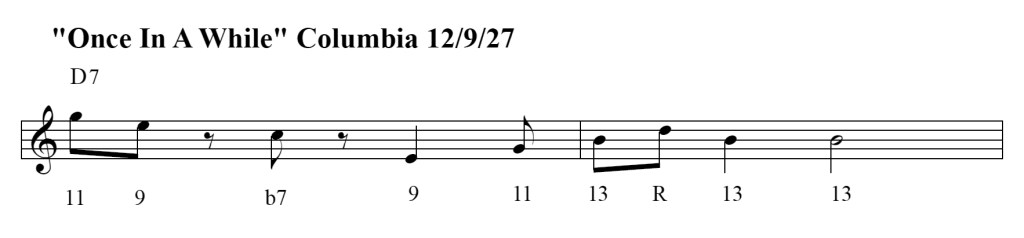
As to those “higher intervals,” they’ve existed in jazz from the start. We can save a lot of time if we stick to one unequivocal example, from Louis’s solo on “Once In A While,” December 9, 1927. This excerpt is a garland of 9ths, 11ths, and 13ths over a secondary dominant chord, in this case D7:
It’s hard to find anything that wasn’t foreshadowed by Louis. As Nicholas Payton put it, “Some of the things he was doing in the 20s and 30s, people still haven’t dealt with.”
* * * * * * * * * * * *
Here’s “Honey & Body:”
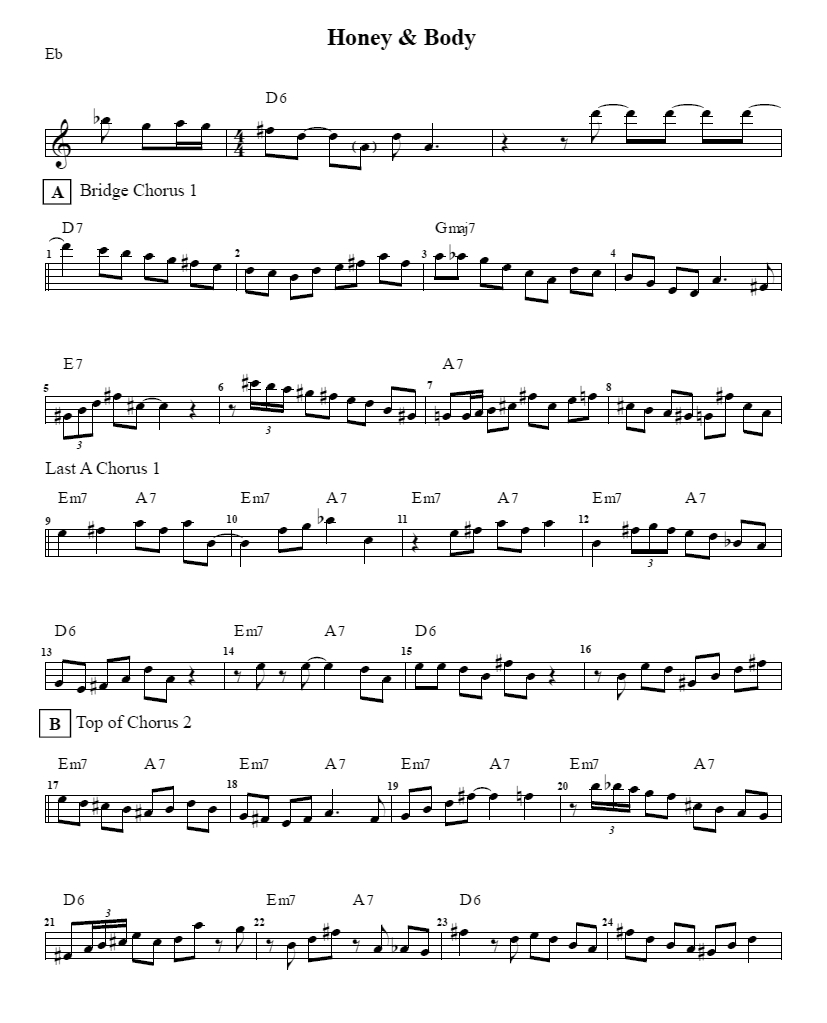
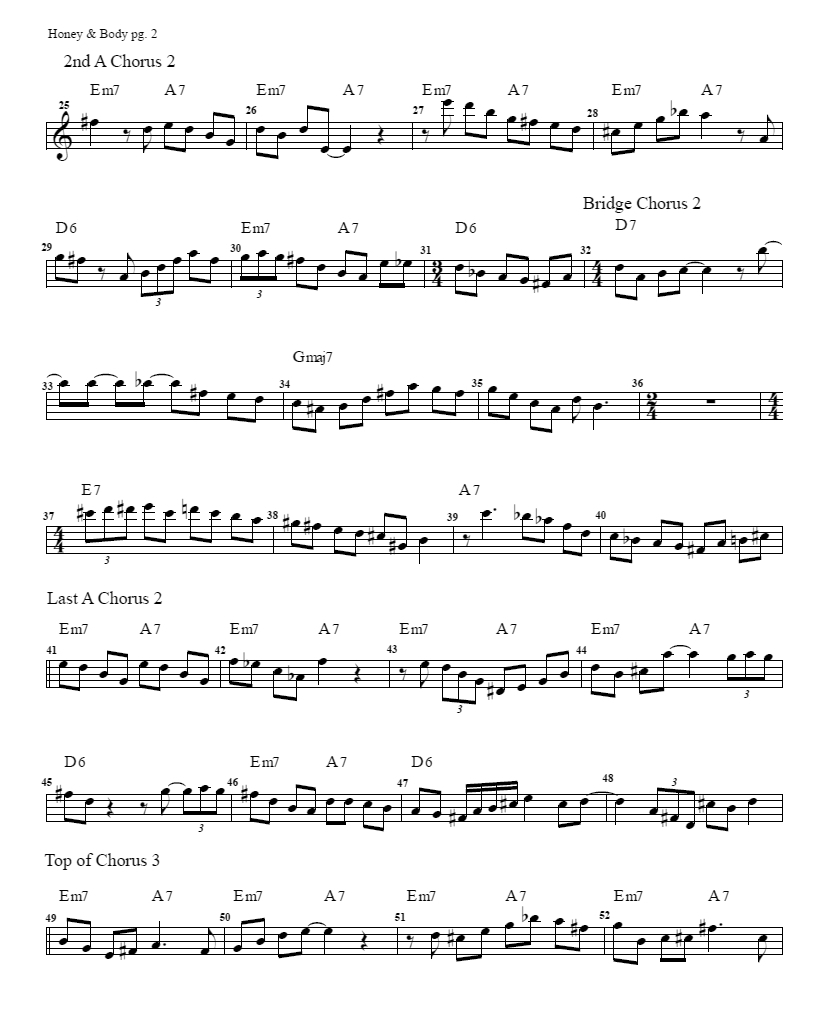
Here’s “Honey & Body” with a transcription of the “Honey” portion of the track:


One thought on “Parkeology 031: Every Honeybee”