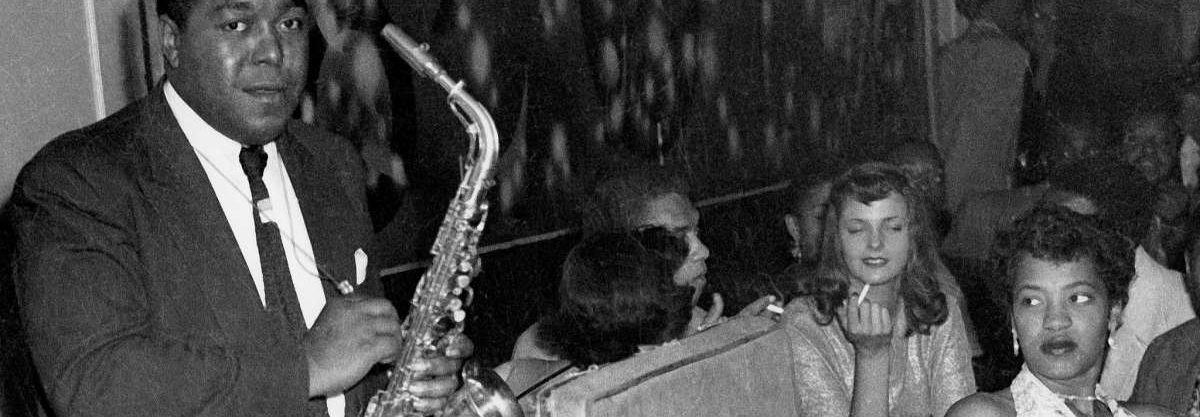
“I put quite a bit of study into the horn, that’s true. In fact, the neighbors threatened to ask my mother to move once, when I was living out west. They said I was driving them crazy with the horn. I used to put in at least eleven, from eleven to fifteen hours a day.” –Charlie Parker, Paul Desmond Interview, January 1954
When Bird returned to Kansas City for his father’s funeral (late 1939 or early 1940) he moved back in with his mother. His wife, Rebecca, and his son, Leon, were living nearby, but Bird didn’t reunite with them, instead asking Rebecca for a divorce. He continued living and working in Kansas City, or touring locally, until 1942, when he moved to New York City.
It’s impossible to know whether or not Bird was referencing this period in the quote above. In some ways, though, this period is more plausible than earlier periods, when he was committed to marriage and fatherhood.
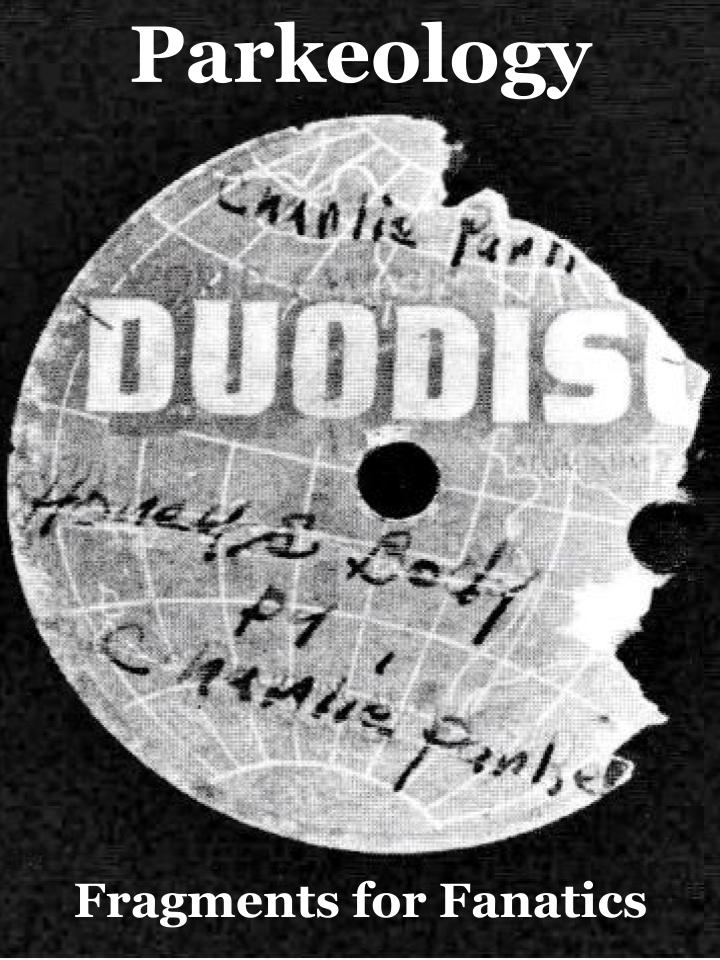
Bird had returned to Kansas City from New York with his “Cherokee” revelation top of mind, and it’s safe to assume he practiced a great deal when he wasn’t working. When you compare “Honey & Body” with the Wichita Transcriptions, only months apart, the rate of progress is striking. By the end of 1940, all the fundamental elements of his mature style are in place.
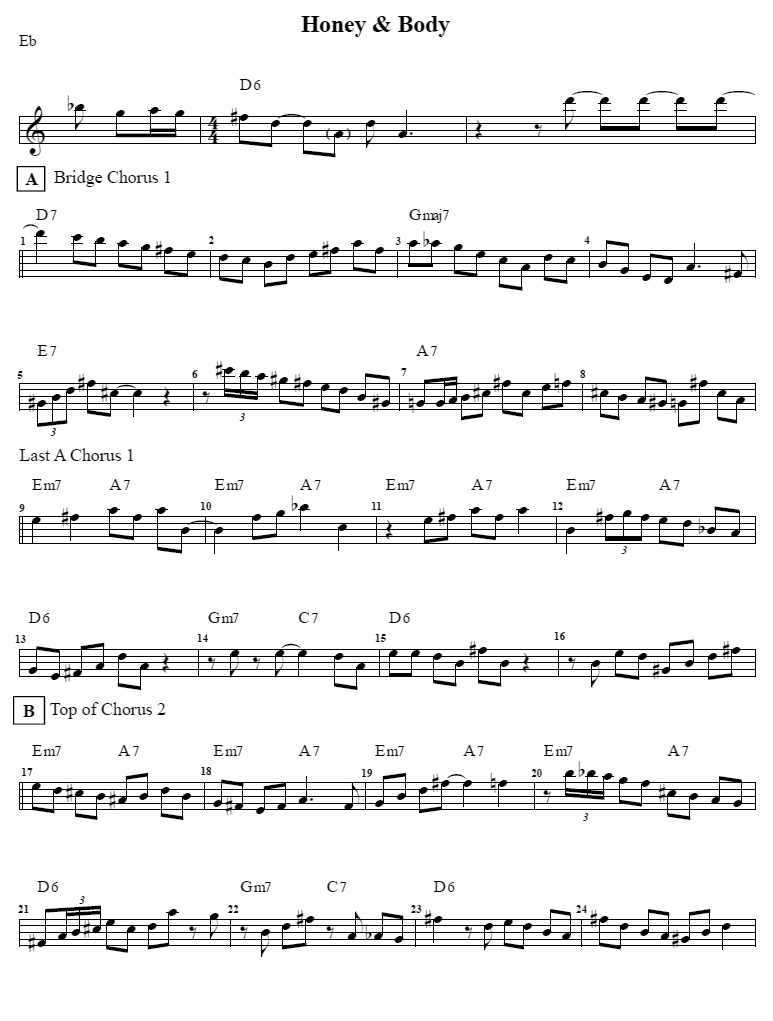
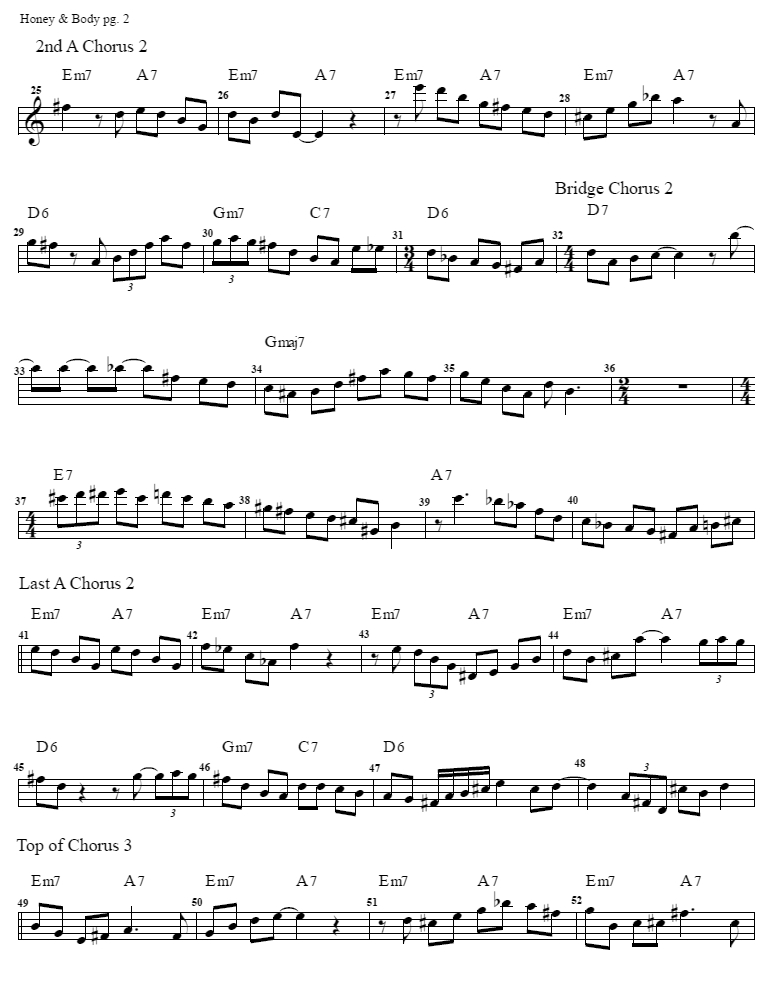
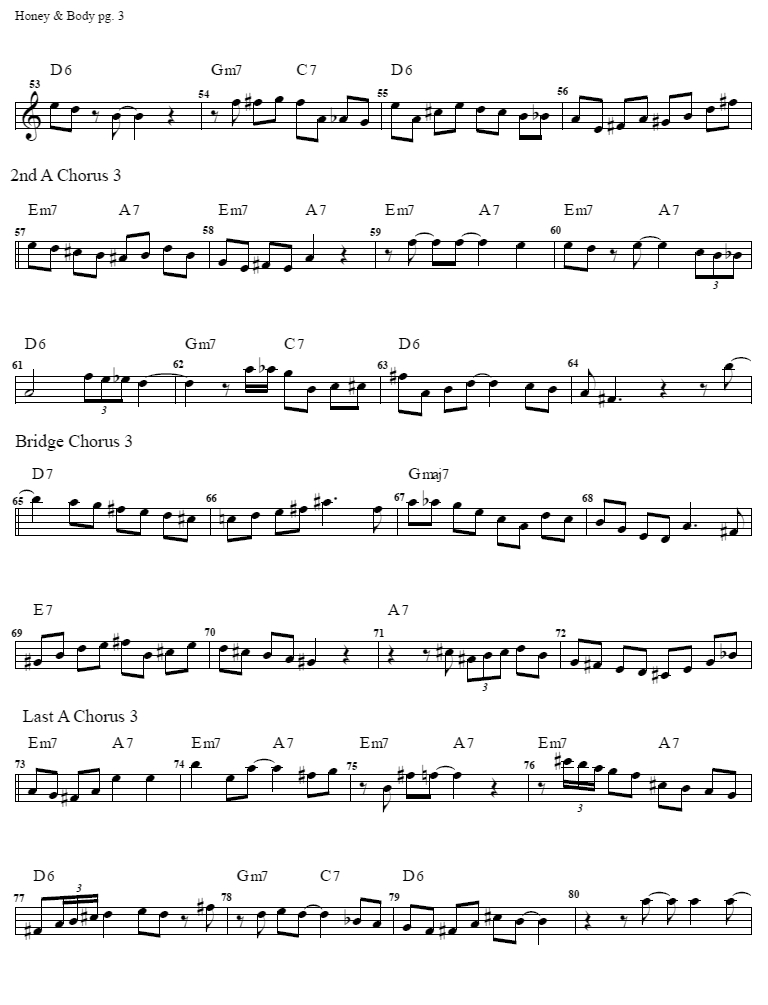
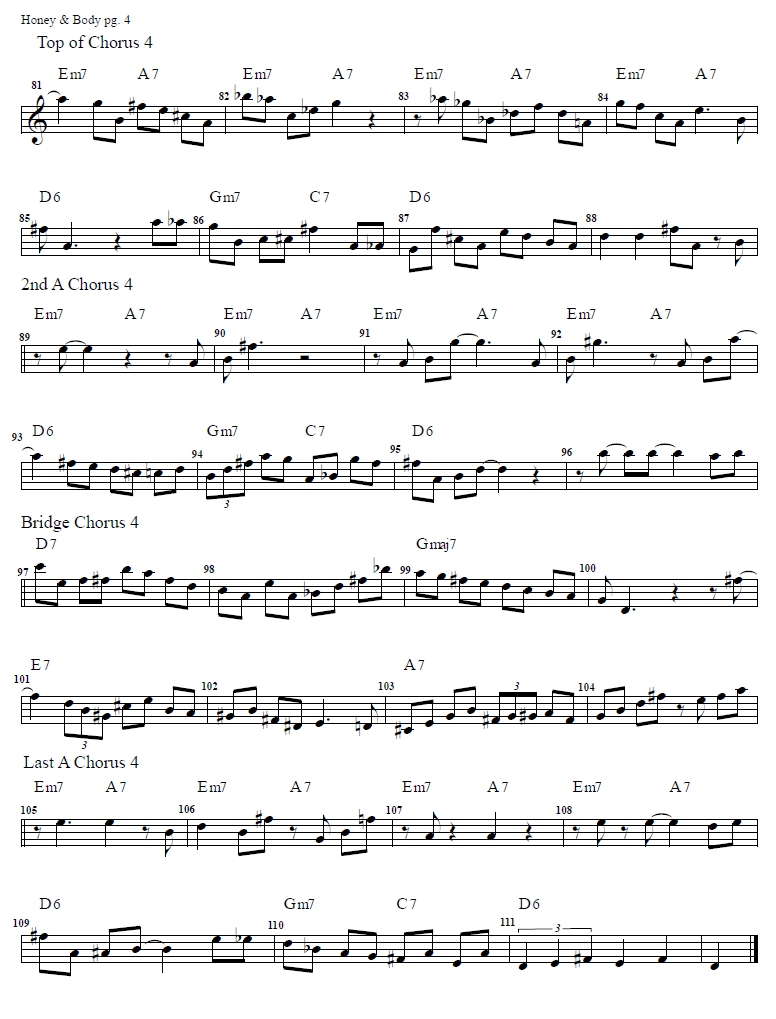
But on “Honey & Body” (full track and partial transcription below), Bird was still in the thick of developing the eighth-note based vocabulary that would enable syncopation at a deeper level. Lester had clearly pointed the way, but that still left Bird with an intricate puzzle to solve.
Picking up where I left off, below are the last three bars of the first bridge (bars 6, 7 & 8). On balance, this phrase can be considered mature vocabulary.

The first six notes in bar 6 are commonplace in Bird’s mature style:
The figure in bars 7 and 8 is a prototype, so to speak, of a mature figure from “Scrapple From The Apple” Take B (Dial 11/4/47) that hinges on the #5.
As Bird enters the last A, he seems to fall back on old vocabulary, playing three simple, unsyncopated one-bar phrases (bars 9, 10 & 11). He creates tension by moving up a half step to Eb major, an early experiment in chromaticism, but one too simplistic to survive the transition to his mature style.

A much more sophisticated version of the concept can be found in the last A of “Scrapple From The Apple” Take C, in essentially the same place. Bird moves up a half step to Eb major, but here he plays a melodic fragment from the “Honeysuckle Rose” A section, a favorite formulation in his mature style.

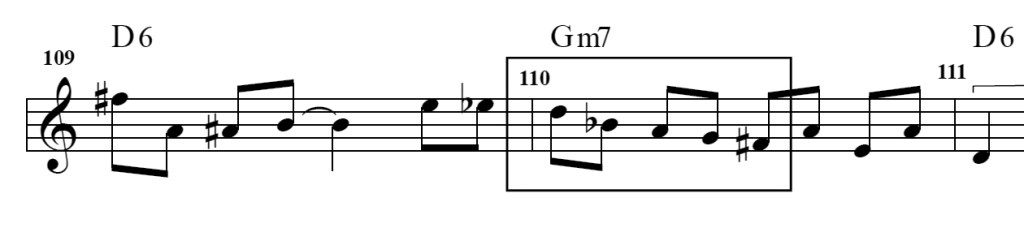
Bars 12 and 13 qualify as new vocabulary, given the burst of 8th notes. The highlighted notes outline a cell (5, b3, 2, R.) that Bird uses to imply IV minor, in this case G minor. IV minor is an essential component in Bird’s vocabulary, inherited from Lester, the jazz tradition in general, and harmony itself.

Bird seems to be struggling to fit this cell into the melody rhythmically. Starting it on an upbeat causes problems. The G should naturally resolve to F#, but it seems he’s forced to place an E in between, diluting the resolution.
Bird plays a similar idea in bar 32 (leading into the bridge of the second chorus). This time, the cell falls on the downbeat, and the G resolves directly to F#. Astute observers will notice that bar 32 only contains three beats. This brings up a topic much too involved to address here.

In bars 78 & 79 (the last two bars of the last A of his second full chorus), Bird seems to combine both previous attempts. Giving the D a longer value makes the Bb feel like the beginning of a three-note cell starting on a downbeat. This more definitive outline of IV minor makes the E sound more musical.

Bird closes out the “Honey” portion of the track with the IV minor cell in its strongest iteration (bar 110):
By the time of the Wichita Transcriptions, Bird is able to integrate the IV minor cell with ease into his uptempo solo on “Honeysuckle Rose” (December 2, 1940). He deploys it on the downbeat within of a rapid stream of 8th notes.

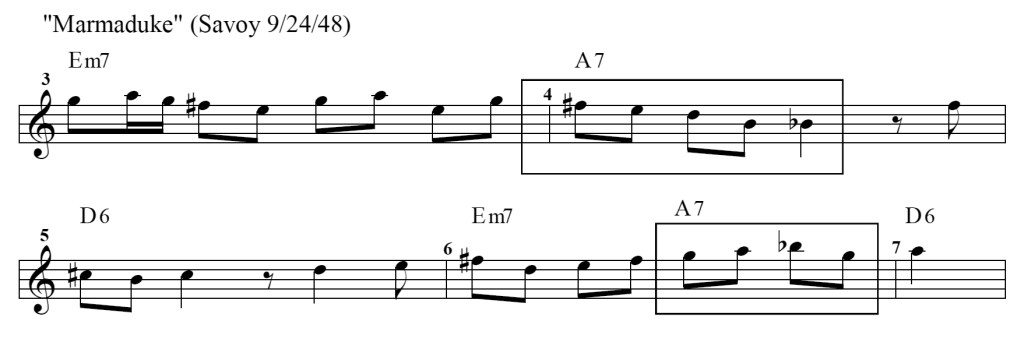
IV minor is fully in evidence in Bird’s mature style, including in his compositions. “Marmaduke” implies IV minor twice, in bars 4 and 6. Some would argue that the Bb in bar 4 sounds as the b9 of the A7, but I hear that bar as Gmaj7 going to Gm(maj7). The Bb in bar 6 can also be looked at as a b9, but to me those four notes clearly outline G minor. And who says it can’t be both?
There’s a larger lesson to be drawn from Bird’s trial-and-error use of this particular cell.
Bird’s innovations were largely a matter of rhythm, phrasing, and articulation, which is why his “Cherokee” revelation, confined to harmony, may not have precipitated a radical change in style. But rhythm, harmony, and melody can be impossible to disentangle.
An eighth-note-based vocabulary presents intrinsic challenges. Quarter notes, and longer note values, are essential to melodic structure. Creating a melody that consists entirely of eighth notes requires a new conception of melody itself. This is the task Bird took on.
In Bird’s eighth note lines, rhythm has to be expressed through shape, articulation, and dynamics. Eighth-note triplets are another important tool. The shape of the line is rendered by changes in melodic direction, but these changes also create the rhythmic structure, so the two become inseparable.
All of which goes to say that Bird’s “Cherokee” revelation, while primarily harmonic, would have had a big impact melodically, which in turn would have produced new rhythmic innovations. “Honey and Body” documents Bird deep in the process of working all this out.
The idea that the “Honeysuckle Rose” solo (below) could predate “Honey and Body” is unthinkable, so the only question is how much time separates the two. Given the degree of progress, I believe “Honey and Body” was recorded in early 1940, shortly after his return to Kansas City. Even Bird would have needed months to put his “Cherokee” revelation into practice.
He had to take it one fifteen-hour day at a time.
* * * * * * * * * * * *
Here’s the full “Honeysuckle Rose” solo (12/2/40):
Here’s the full audio of “Honey & Body” with a transcription of the “Honeysuckle Rose” portion: