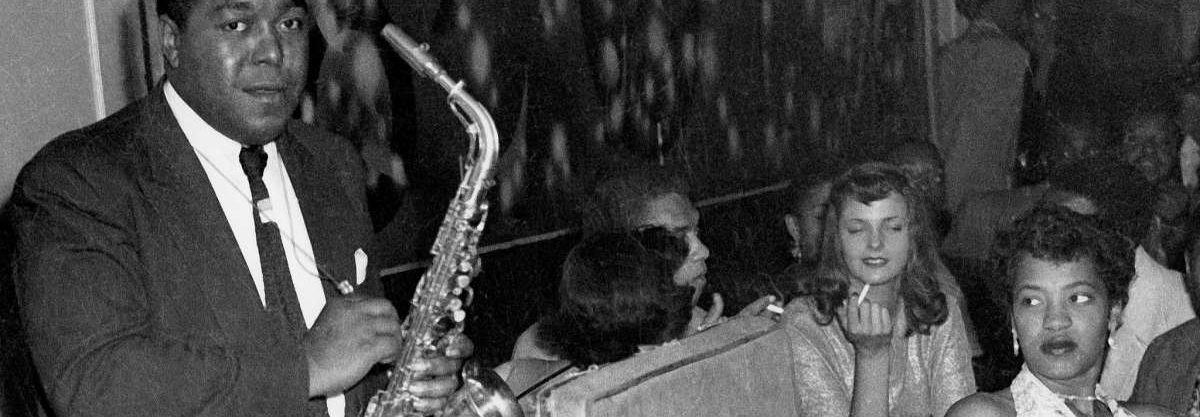
When was Bird’s first version of “Cherokee” recorded? (Part One of Three)
From a considerably better recorded paper disc in the collection of the late Jerry Newman (although probably not recorded by Newman himself), this is believed to be Bird’s earliest extant performance of the tune he virtually invented modern jazz with. The circumstances as to how this tightly swinging solo concerto, with definite prearranged accompaniment, was recorded are still vague. – Dan Morgenstern
Everyone loves a good mystery, but it’s hard to love a mystery that can’t be solved, such as the exact date of Bird’s first “Cherokee” recording. When the solution is a lot of hemming and hawing, getting there better be half the fun. That’s the hope here, so let’s kick things off by listening to the track in question:
The Who, What, When, Where, and How of this recording are all adrift in a shadowy sea of red herrings. We do have a compass, though, and the argument keeps coming back to these four points:
- Bird visited New York City in 1939, exact dates unknown. He was there for months, often jamming at Monroe’s, but was back in Kansas City by 1940, where he began working with Jay McShann.
- Bird returned to New York City with McShann in January 1942. He is presumed absent from NYC in 1940 and 1941.
- Jerry Newman returned to NYC from Europe on August 14, 1939. He enlisted in the army on December 19, 1941 (shortly after Pearl Harbor) and no Newman recordings have come to light between that date and the end of World War II. (Newman took part in D-Day.)
- Ben Webster was on the road with Ellington throughout 1941 and 1942, and is therefore presumed absent from New York City, with two known exceptions: February 26, 1942 (Ellington recording session), and March 2, 1942 (non-Ellington gig at Stage Door Canteen).
The opening Morgenstern quote comes from liner notes for the CD release of Early Bird, on Stash Records (February 1991). To some extent, he wrote these new liner notes by cannibalizing his previous liner notes for Onyx 221, Charlie Parker First Recordings, released in May 1974.
Onyx was the first label to issue this “Cherokee” recording, and Morgenstern’s notes from that album lay out the elements of this mystery quite clearly:
The “Cherokee” that starts part two of our Bird trip comes from the Jerry Newman Collection. According to notations on Newman’s tape boxes it was recorded on a paper disc. Newman’s flaw was that he didn’t care for Bird; he never recorded him. He also did not use paper discs. So it’s reasonable to assume that Newman himself did not record “Cherokee.”
Obviously, it’s not from a jam session. There is a formal arrangement, at least a well-rehearsed “head,” for the little band. Producer Don Schlitten, friend and colleague Ira Gitler and other mavens guessed, proposed and argued, but there were no clues other than that “Cherokee” was Bird’s feature number with McShann. This was no clue at all, since neither piano nor band here is in McShann’s sound, style and size.
There was little to go on until Ben Webster posthumously lent a helping hand. In an interview with John Shaw in Jazz Journal, Ben reminisced about his first encounter with Bird. “I first heard Charlie at Monroe’s… There was this guy on the stand blowing weird stuff. It was Charlie. I said to Clark, ‘Is that cat playin’ what I think he’s playin’?’ Clark said yeah… I was feeling pretty fit but I wasn’t sure, I didn’t trust my ears.” Ben said he would return the next night to make sure he’d heard right, and Clark Monroe answered, “Well, if you come back tomorrow I’ll put him in the show, and he’ll be playing “Cherokee!”
Eureka! Here was our clue. If Bird played “Cherokee” in the show at Monroe’s, which had a small house band led by George Treadwell, this meant there had to be a small-group arrangement. And the music on Newman’s disc was no longer a mystery.
Dating the music precisely is impossible, but most likely it stems from the period after Bird left McShann. Though he had frequented Monroe’s earlier, he would not yet have had a special spot in the floor show, complete with arrangement, while a casual visitor. I surmise that it stems from the late summer, early fall of ‘42. The bass and drums, especially the former, give good support, but the piano’s vamping under Bird’s first chorus sounds a bit awkward.
A bit awkward?!? I will take this opportunity to argue that the pianist’s polka-like accompaniment makes Bird’s solo sound less modern than it is, possibly affecting attempts to date it, and the poor audio quality contributes to the same archaic atmosphere. In the unknown pianist’s defense, he handles the bridge of the melody chorus in a spare, Basie-like manner, suggesting that his regressive comping might have been dictated by the arrangement.
In more recent times, some researchers have claimed that the pianist is Jay McShann, which only makes me shake my head in wonder. Morgenstern dismisses this possibility on very solid grounds, and his reasoning is sound in many other respects, but he did make a serious, if understandable, mistake when “surmising” the date himself. Late summer, early fall of ‘42 certainly aligns with Bird’s whereabouts, but runs afoul of compass point 4. As soon as he adds Ben Webster to the story, he invalidates his own surmise.
Morgenstern had no way of knowing Webster was on the road virtually nonstop in ‘42. Webster’s presence in NYC on February 26 and March 2 means it’s not impossible that he heard Bird at Monroe’s after hours. But in Morgenstern’s telling, Webster encounters Bird two nights in a row. Again, not strictly impossible, but it requires stretching the facts like taffy.
It’s time, however, to bring Jerry Newman into the picture.
Newman has two competing claims to fame that tend to cancel each other out. He has the jazz world’s undying gratitude for the live recordings he made at Minton’s Playhouse, and the jazz world’s undying frustration with his dislike of Bird’s playing. He put it this way:
But Parker—I really passed him up. He blew so wild I used to turn off the machine when he started playing.
Newman documented the birth of modern jazz in 1941. Without him, we wouldn’t have the priceless recordings of Charlie Christian live at Minton’s, not to mention Dizzy, Monk, Kenny Clarke, Don Byas, Roy Eldridge, and many others. Oceans of laudatory ink have been spilled about that.
But his other claim to fame followed him like Mary’s lamb. The headline on the November 1, 1952 issue of Melody Maker, a British publication, dubbed him The Man Who Stopped Recording as Bird Began to Blow.
That article contains a lot of information about Minton’s, little of which pertains to Bird, aside from the headline and the above quote. However, an article from Esquire (January 1957) proves to be a holy grail of sorts. In it, Newman talks about his beginnings:
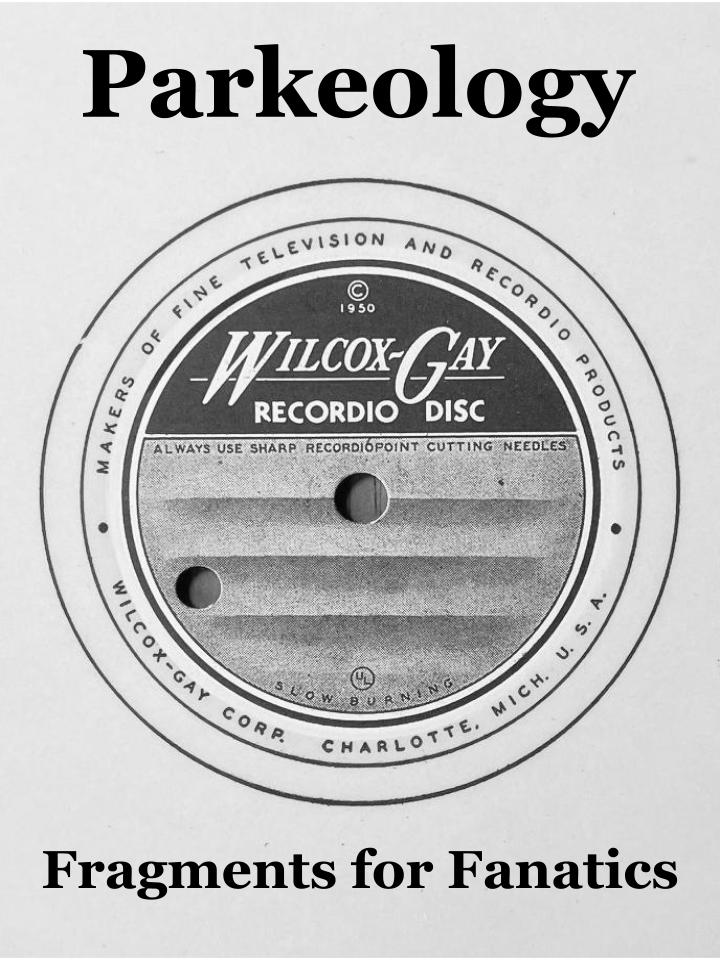
It was 1937, and I was taking a university extension in psychology. We had a lab hour, and people would come in and say strange things so we could study them, and we used to have a mic hidden and record what they said. The guy who ran the machine was a friend of mine, and he taught me how to cut records. In 1939 I bought my first disc cutter, a Wilcox-Gay; then in 1940 I got a Federal. I was nuts about jazz, and I used to take the machine up to Harlem to Minton’s, which was really the birthplace of bebop. I made thousands of hours of records–Charlie Christian, Charlie Parker, lots of others.
The identification and dating of the Wilcox-Gay and Federal disc cutters is the aforementioned holy grail, but Newman’s casual mention of recording Bird at Minton’s is the hammer to the forehead. What?!?
It’s possible that Newman was just trying to avoid another screaming headline, but he’s not necessarily contradicting himself. In the Melody Maker article, he adds:
“I gave Monroe a batch of the Parker stuff I’d taken down and forgot all about it. It was on paper-backed discs and I never took a copy.”
What’s implicit in the “I used to turn off the machine” quote is that Newman encountered Bird on a regular basis. And what’s implicit in the other quotes is that he didn’t always turn off the machine, otherwise he wouldn’t have had a batch of paper-backed discs to give Clark Monroe. The fact that he gave them all away is a measure of his indifference, but it seems he did record Bird after all. (Here’s a question: What became of those discs???)
Newman provides another bit of evidence in the Melody Maker article:
I was in on the earliest days at Minton’s. It started in January ‘41, at the Hotel Cecil on 118th Street. They turned the dining room into a club and built a stage for seven, and a bar.”
If this is true, and it is, Newman couldn’t have recorded Bird at Minton’s, due to compass point 1: Bird was back in Kansas City in 1941. But there’s a discrepancy here, anyway, because Newman says he gave his “batch of Parker stuff” to Clark Monroe. The notion that he would give discs recorded at Minton’s to the owner of Monroe’s is another taffy-pull. So any Newman recordings of Bird were almost certainly made at Monroe’s.
But when? This is where compass points 2 and 3 come into play. The only time Newman could have plausibly encountered Bird on a regular basis was in the final months of 1939, because it’s the only period when they were both in New York City at the same time.
So we can now say with confidence that any recordings of Bird were done on Newman’s first disc cutter, the Wilcox-Gay. (He didn’t buy the Federal until 1940.) This machine had a maximum blank size of ten inches, and a ten-inch blank had a time limit of about three minutes, assuming it was cut at 78 rpm.
Paper-backed blanks wouldn’t have been Newman’s only option, but they were less expensive and he was just getting started. In any case, the fact that he says he gave Monroe “paper-backed discs” confirms that he was using that type, in his early days, anyway.
So to recap:
- Newman says he actually did record Bird.
- “Cherokee” was recorded on a paper-backed disc.
- We are certain that Newman used such discs.
- “Cherokee” is short, 2:49, suggesting it was recorded on a ten-inch disc at 78 rpm, the Wilcox-Gay format.
- It all adds up!
No, it doesn’t. A 1939 recording date is impossible, based on the musical evidence. We know what Bird sounded like in 1940, and “Cherokee” is light years beyond that.
1942 is a plausible recording date musically, but highly implausible in every other respect. If you want to argue that the “Cherokee” in question was recorded by Newman in 1942 (after Bird came back to New York with McShann), you have to assert that Newman, serving in the US Army during wartime, came back to NYC on leave and hauled his old Wilcox-Gay disc cutter up to Monroe’s to record the one musician he specifically made a point of not recording.
It isn’t an impossible argument to make.
How much do you like taffy?
************************************************************************************************
Many thanks to Mike Parenti and Bill Pauluh for their assistance with this post.
One of Bird’s lesser-known “Cherokee” performances is also one of his greatest. In my opinion, it’s by far the most masterful track recorded during Bird’s time in LA, perhaps because it was early on in his stay, before heroin troubles began to affect his playing. The proposed date, April 1, 1946 isn’t entirely certain, but it’s good enough.
It was an AFRS (Armed Forces Radio Service) Jubilee transcription (No. 186), recorded at NBC’s Radio City West in Hollywood. Bird is backed by the Nat King Cole trio with Buddy Rich, and Ernie “Bubbles” Whitman is the MC. Bird succinctly mocks Whitman’s Uncle Tom persona in three little words. “Cherokee” was part of a medley, but I’ve left out Benny Carter and Wille Smith, with apologies.

