
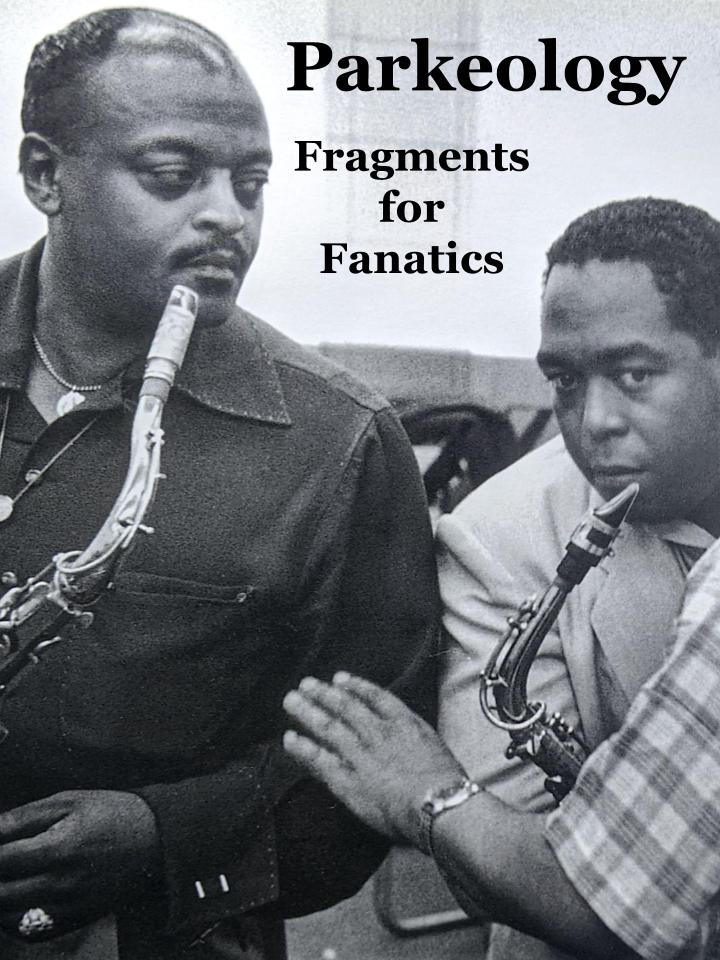
One prominent critic wrote, “Parker’s version of bebop varies from Dizzy’s in so much as he plays chromatic scales up and down all the keys.” Charlie was to quote this gem for years, often admonishing his sidemen to “watch out for those chromatics.” –Ross Russell, Bird Lives
One of the clearest distinctions between Bird’s early style (1940-43) and his mature style (1944 onward) can be found in his use of scale runs. (I define scale runs as consecutive notes of a scale used in a melodic line.) In Bird’s apprenticeship period, scale runs often spanned an octave or more. By the time he reached his mature style, scale runs generally spanned a fifth.
I’m arguing that Motive 1A, identified last time, allowed Bird to replace these descending scale runs with descending chromatic runs. (When I say chromatic runs, I’m talking about consecutive half steps in a melodic line.) Here’s Motive 1A:

(Bird’s early recordings are few, which makes them easy to pore over, and Remi Bolduc’s transcriptions make it easier still. Anyone can go to YouTube and evaluate the following argument on their own.)
Motive 1A allowed Bird’s lines to descend unbroken without spanning octaves. This made it easier to connect chord tones together, and made his lines more compact in general.
As Webster deduced, five is the magic number. Harmonically, it spans a major third. Rhythmically, it starts and ends on a downbeat. In the case of Webster’s “Cotton Tail” solo, Motive 1A connects the 3rd to the root, but it can also connect the major 7th to the 5th. Both Webster and Bird frequently use it this way. In fact, it’s just as common. Here are three Webster examples:
Webster also uses Motif 1A to connect 9 to flat 7, as does Bird in bar 29 of “Thriving From A Riff” (November 26, 1945):
Scale runs are plentiful in “Honey and Body,” Bird’s first recording, which fades in as he’s heading into the bridge. The first complete phrase consists of a descending G major scale (all names in E-flat). He starts on a high D and descends an octave and a third, ending on a B. That’s ten consecutive scale degrees. Here it is:
In bars 37 & 38, Bird plays nine degrees of A major. In bar 99, he plays nine degrees of G major. In bar 118, he plays ten degrees of G minor. Here they are in order:
Scale runs were also common in Bird’s early solos with Jay McShann, known as the Wichita Transcriptions (November 30 & December 2, 1940).
In bars 11 & 12 of “I Found A New Baby,” he plays ten degrees of D minor. In bars 12 & 13 of “Lady Be Good,” he plays ten degrees of B major. In bars 23 & 24 of “Honeysuckle Rose,” he plays nine degrees of D major. Here they are in order:
Bird made startling progress in the fourteen months between the Wichita Transcriptions and the McShann Savoy broadcast (February 13, 1942), but scale runs didn’t change. On “I’m Forever Blowing Bubbles,” he plays fourteen degrees of Eb major, eleven degrees of F major, and eleven degrees of G minor. On “St. Louis Mood,” he plays nine degrees of Eb major, and thirteen degrees of Bb major. On “Swingmatism” he plays eleven degrees of F minor. Here they are in order:
Motive 1A didn’t spread like wildfire. It appears only occasionally on the Efferge Ware date in late 1943. (I disagree with the June 1944 date proposed by Chuck Haddix.) These four excerpts are from “Body and Soul,” “My Heart Tells Me,” and “I Found a New Baby:”
The Tiny Grimes session on September 15, 1944, marks the end of Bird’s “apprenticeship period,” and the dawning of his mature style. Motive 1A appears with much greater frequency here. Five is still the magic number, although Bird extends it at times. These ten excerpts are from “I’ll Always Love You Just The Same,” “Red Cross,” and “Tiny’s Tempo,” in that order:
Bird’s first recording session as a leader (November 26, 1945) demonstrates that the shift is essentially complete.
Evidence throughout this date shows that scale runs of an octave or more are in decline. Five-note scale runs are becoming the norm. Motive 1A is increasingly common, taking over the structural function that scale runs used to perform.
“Thriving From A Riff” and “Warming Up A Riff” provide much of this evidence.
Motive 1A appears three times in Bird’s 32-bar solo on “Thriving From A Riff,” in bars 3, 12, and 29:
There are only two descending scale runs, nine degrees of G major at bar 36, and a sixteenth note run at bar 44, also nine degrees of G major:
There are three descending five-note scale runs: at bar 5, bars 29 & 30, and bars 37 & 38:
“Warming Up a Riff” is much faster, which means Bird is relying more on his reflexes, and the shift toward Motive 1A is even more pronounced. Bird takes two 64 bar choruses here, with an extra 16 bars out front, making this solo 4.5 times as long as “Thriving From a Riff.” That makes it all the more surprising that there are only three descending scale runs (bars 38, 100, and 102).
There are only three five-note scale runs, as well (bars 5, 54, and 86), also a surprising decline:
But motive 1A is everywhere, as bars 18, 24, 36, 45, 58, 63, 72, 77, 79, 83, 121, and 127 make clear.
I will rest my case here. As of November, 1945, Motive 1A had become a lynchpin in Bird’s vocabulary, replacing long scale runs. As time went on, consecutive half steps in his melodic lines continued to expand, although five remained the norm. The record, as far as I can determine, is eleven, just shy of the entire scale. This excerpt comes from “Donna Lee,” (May 8, 1947) bars 37 & 38:
But what about Motive 1B, briefly noted and quickly forgotten?

It may seem an afterthought here, but it also deserves a place in the pantheon of motives, occurring frequently on dominant 7th chords. It appears in bar 32 of “Honey & Body:”
Motive 1B only appears in “Honey & Body” once, but that’s enough to prove it was part of Bird’s vocabulary before he studied Webster’s “Cotton Tail” solo.
Or is it? I don’t relish shooting arrows at my own Achilles heel, but “Cotton Tail” was recorded May 4, 1940, and we don’t know the exact recording date of “Honey & Body.” So it’s possible Bird heard “Cotton Tail” before he recorded “Honey & Body.” And he had plenty of time to study it before the Wichita Transcriptions were recorded (November 30 and December 2, 1940).
But I’m sticking to my guns. It wasn’t so long ago that the handful of McShann studio recordings, with their meager solo space for Bird, were all we had to fill the gap between the Wichita Transcriptions and the Redcross recordings (February 15, 1943). Now we have the miraculous McShann Savoy broadcast.
Freed from the bonds of the recording studio, Bird takes extended solos on four out of the six tunes broadcast that night. Bird’s solo on “I’m Forever Blowing Bubbles” is a straight-up masterpiece, and his other solos aren’t far behind. (All four tracks below.) And none of these state-of-the-art, 1942 solos show any sign of Webster’s influence. There’s no trace of Motive 1A, Motive 2, or even the growls that became a common effect in Bird’s mature style.
Consequently, I stand by my argument that Bird was influenced by Ben Webster beginning in December 1942, when he switched to tenor and joined the Earl Hines Orchestra. Although Bird was probably aware of “Cotton Tail” when it was released, I believe it took on new meaning as he turned to other tenor players for inspiration and fell under Webster’s spell. Little did he know how crucial this influence would be.
And with that stirring bit of oratory, Ben Webster Month comes to a close. If nothing else, this three-part argument has convinced at least one person: me! Parkeology 036, due out in mid-September, will examine Bird’s first “Cherokee” recording, extending some of the arguments in these August posts.
After all, if you don’t drink your own Kool-Aid, how are you supposed to get anything done?
*********************************************************************
Here are the four miraculous tracks from the McShann Savoy broadcast on February 13, 1942. “St. Louis Mood,” “I’m Forever Blowing Bubbles,” “Hootie Blues,” and “Swingmatism” (Bird doesn’t solo on “I Got It Bad” or the sign off theme.)

