
Was Young Bird influenced by Buster Smith? Did Young Bird Abuse Alcohol? Part Two of Four
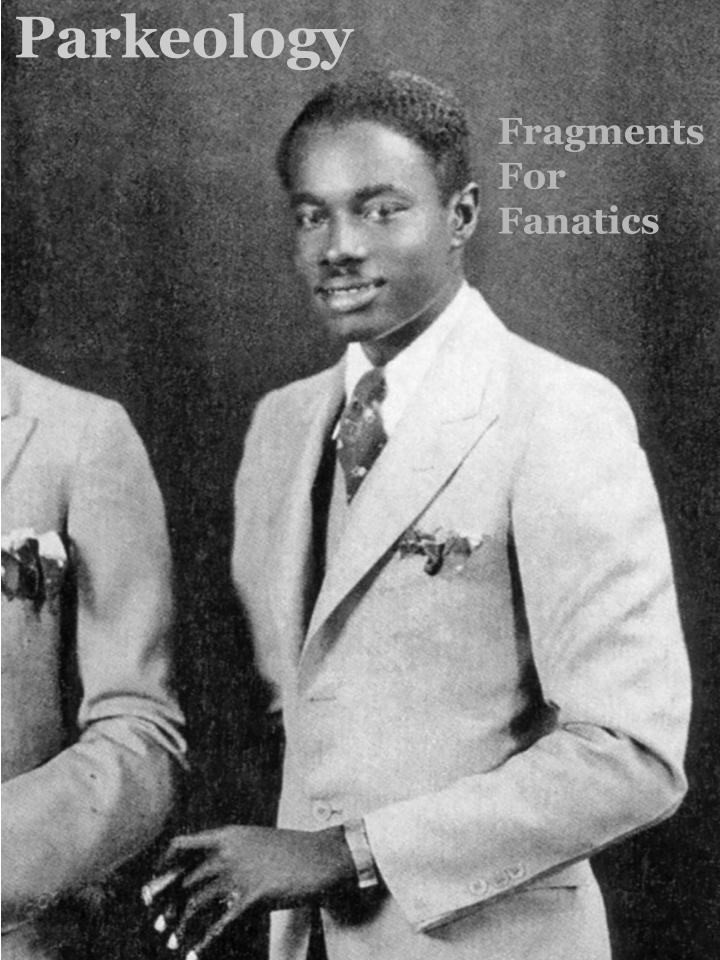
Buster’s originality as well as his influence on the fledgling Bird is confirmed by his better-known Kansas City contemporaries, Ben Webster, Jo Jones, and Lester Young. He was intimately connected with the bands and musicians who once made that city a center of jazz activity, but because his recorded solo work is rare and because he possessed the knack of being in all the right places at the wrong times, he has become something of a legend. He still wears the scholarly air and the spectacles which earned him the nickname “Professor” on the Blue Devils. –Jack McDaniels, Down Beat, July 11, 1956
Here’s Henry “Buster” Smith, on his own roots, as told to Don Gazzaway in a three-part interview published in 1960 in The Jazz Review:
I was born down here in Ellis County [Texas] in 1904 on a farm my family was living on and working on. Our family picked cotton. We ran back and forth between the farm and Dallas trying to raise enough money to pay for the home in Dallas we were buying. Our family had moved to Celina [near Dallas] at that time—still picking cotton. I saw a clarinet in a window in town one day and ran all the way back home to ask my mother if I could have it. It didn’t cost but $3.50 so she told me I could buy it if I picked four hundred pounds of cotton a day. Well, I picked over four hundred pounds for five days, and then went back and bought that clarinet. I quit school when I left Celina. I think I had finished about the seventh grade. When we moved to Dallas I went to work to help make the living. My mother was alone with us five boys so I had to help bring in a little money—I was the oldest.
I don’t really need to point out the irony here, but the man who was nicknamed “Prof” for his scholarly air never even made it past grade school. What’s more, his family lived on a farm and picked cotton for a living, which sounds to me like slavery by other means.
How else might Buster have earned his nickname? Did he have extensive musical training on clarinet, perhaps?
None whatsoever. I just picked it up little by little by watching people who played that same instrument. I’d just watch them and listen and pick up more and more. I used to hear a boy named Jesse Hooker, an awful good clarinet player who used to play down on the Central track at a place called the Tip-Top Club. He couldn’t read either. I’d go down there and listen to him till he moved on. This was in 1922. About that time a little band came up from New Orleans and came in there at the Tip-Top and hired me and another fellow ’cause they were two men short when they got there. Me and the other fellow made five pieces. I played with them for a few weeks until they left and then I gigged around Dallas for a year or so with Voddie White. Then in 1925 the Blue Devils came to town and I joined them.
The Devils were being led by a guy named Coleman at the time—Ermir was his first name. [Walter] Page was playing string bass with a stick that he bumped the strings with, and he’d pluck the strings too. Of course, he played tuba and a good baritone sax. Everybody thought it was great the way he’d run from one instrument to another. It all looked pretty good to me so I joined up with them.
By this time, Buster had begun arranging, another reason the Blue Devils nicknamed him “Prof.”
I knew a banjo player named Johnny Clark that took a liking to me, and he used to come around and say, “Buster, you don’t read, come on out to my house and I’ll show you the value of the notes.” So I went down after he got off work at the Tip-Top and he took me over to his place and showed me the value of the notes. So I started writing reed choruses first and stuck them onto orchestrations and started writing for trumpet–and it sounded pretty good. Page would say, “It sounds all right Bus. You’re doing all right with it.” I did some arranging for the Blue Devils, but I didn’t really get started on that till later with Moten and with Basie and in New York.
Here we have an entirely self-made man, too modest to crow about his accomplishments. By all accounts, though, Buster Smith was vital to the Blue Devils, vital to Bennie Moten, vital to Count Basie, and, of course, vital to Bird. In other words, vital to the evolution of jazz itself. Yet none of this history is documented by recordings of any kind, aside from a single 78rpm disc recorded by the Blue Devils for Vocalion on November 10, 1929. Buster takes two solos on “Squabblin,’” first on alto, then clarinet (full track below):
The next ten years are a black hole from which no sound escapes.
***************************************************
It’s difficult to prove a negative, but there are few credible accounts of Bird abusing alcohol prior to 1946, when he was suffering from acute heroin withdrawal in LA. Jazz writers simply assume that Bird began drinking excessively in his teens, the stage in life when people commonly begin abusing alcohol. When you look for solid evidence, though, it simply isn’t there.
Trombonist Clyde Bernhardt wrote a fascinating autobiography called I Remember: Eighty Years of Black Entertainment, Big Bands, and the Blues. Bernhardt joined the Jay McShann Orchestra in 1942, while Bird was still a member, and he makes some important observations about Bird’s alcohol use, or the lack thereof.
My first job with Jay McShann was on the Tuesday after Labor Day, September 8, 1942. Right there in the Savoy. Jay McShann was one of the best, down-to-earth guys I ever wanted to work for. Just like any other musician in the band. In fact, he was too good, and guys took advantage of his easy nature. But he always tried to keep peace and harmony.
We all socialized on our time off, only it was in two groups—the Lushies and the Users. Jay, Joe Evans, Freddie Gulliver, myself, and others that liked their whiskey, wine, or beer was the Lushies. I didn’t drink much, but sometimes a little whiskey now and then after work. Charlie Parker, Walter Brown, Little Joe, and some others was in the second group. They didn’t drink but was messing with dope and usually kept to themselves.
I used to talk with Parker about his habit. Told me he been smoking reefers as a kid in Kansas City. Now, he said, he tried everything and it had him good. “You New York guys,” he said, “you got more sense than these Western musicians. You don’t mess with this goddamn shit.” I really felt sorry for him. “I know it’s gonna out me one of these days,” he continued, “but man, I’m not a bad cat, this is just my life and I can’t do without it.”
So we now have Bernhardt’s firsthand testimony that Bird wasn’t drinking during this period with McShann, and we already have Buster’s testimony that Bird wasn’t drinking during the two years they worked together (link to 039).
But wait! Don’t forget the all-knowing Ross Russell, author of Bird Lives! He tells a tale in which Bird is drunk and in desperate straits in 1942, attributing this allegation to Gene Ramey. It’s clearly a fictionalization of a Ramey anecdote from Robert Reisner’s book, Bird: The Legend of Charlie Parker. I will let Ramey go first:
In later years he was leaning on me too much so I told him and we had a verbal agreement that he would not call upon me unless in serious trouble. One night he came over to the Apollo Theater where I was working. He looked like an unmade bed. It was 6 degrees above zero and he was wearing a T-shirt, no socks and a black, expensive overcoat. He asked me for two dollars which he said he needed. I gave him the money, and he went to Braddock’s bar and set up some people with drinks. He did this to make peace, for he had been promoting himself a beating by the following: the bar had a two-for-one policy during the hours of six to eight. Bird would come in, reach for a person’s second drink, and polish it off–this with guys who didn’t know him.
Russell’s fictionalizations are finely detailed with utter horseshit, including invented dialog, as is the case here:
On bitter winter nights Charlie would drop into the Braddock Bar, a musicians’ hangout next to the Apollo Theater. Charlie would cruise up and down the bar, his pockets empty, downing “sleepers.” One night he was caught in the theft and called to account by a group of Harlem toughs. Either he would stand them all a round of drinks, or they would take him out the back entrance of Braddock’s onto 126th Street and teach him a lesson. Charlie talked fast. He was getting nowhere until he remembered that the current attraction at the Apollo was the Jay McShann Orchestra. “Give me ten minutes,” Charlie told the toughs. “You’ll have your round of drinks.” Then he went to the stage door and sent a note in to Gene Ramey. Ramey appeared, shocked at what he saw. “Bird was thin and drawn. He looked like an unmade bed. It was six degrees below zero and Bird was wearing a T-shirt, no socks, and an expensive black overcoat. He was in a serious jam at the Braddock and needed two dollars to bail himself out of trouble.” Ramey advanced the money and Charlie made good the round of drinks.
Note that Russell adds or changes words in what he presents as direct quotes from Ramey. He even changes six degrees above zero to six degrees below zero. This sums up everything you need to know about his methods.
It’s difficult to total up the lies in his retelling, and not worth the trouble. All you really have to do is point out the Big Lie. Ramey’s account begins with the words “in later years,” which, by any measure, means the 1950s. All things considered, I would place this anecdote somewhere in 1954, or, given the bitter cold, winter 1955. 1942 makes no sense at all.
So Russell has moved this story backward in time by a decade or more, and for what? He disgraces himself as a researcher throughout Bird Lives!, intent on sensationalizing Bird’s life in order to produce a bestseller. He moves the date of Bird’s “White Christmas” from Christmas Day 1948 to Christmas Day 1949, just to create a dynamite closing sentence for Part Three. So forgive me if I lend no credence to another Russell tale, also supposedly from 1942, which has no attribution whatsoever: “At Monroe’s, where the management stood drinks, he would start the night with two double whiskeys, and continue to down shots between sets.” This behavior is also characteristic of a much later period, but no point in wasting any more time here.
Exit Ross Russell, pursued by a bear.
***************************************************
We finally get to hear Buster on June 30, 1939, approximately a year after he and Bird went their separate ways. The circumstances may be less than ideal, but we are hardly in a position to complain. Pete Johnson, the legendary boogie-woogie pianist, is the leader on the date, thus fate deals Buster two blues solos (“Jump for Joy,” “Baby Look at You,”) and a tune with changes common to any number of songs (“Cherry Red”). All three tracks are in C major, an oddity that’s ultimately an advantage.
This date gives us an idea of what Buster would have sounded like in ‘37 and ‘38, when Bird was by his side every night, and the 12-bar blues form provides an ideal basis for comparison. By 1945, Bird had redefined these chord changes by superimposing (melodically) II-Vs throughout the form, as demonstrated by “Billie’s Bounce” and “Now’s the Time.” It makes sense, then, to examine Buster’s blues vocabulary in search of implied substitutions that might have pointed Bird in that direction.
Bird absorbed everything around him, but developing his own vocabulary was a point of pride, or so it seems. It’s obvious that Lester was a major influence, and yet there are few instances of Bird taking anything from Lester verbatim. This allowed him to claim, in all sincerity, “I was crazy about Lester, but I wasn’t influenced by him. Our ideas ran on differently.” I’m willing to bet that Bird stuck to the same principle with Buster, so my goal is to identify underlying concepts, not verbatim matches.
There is much cheerful harmonic chaos in “Jump for Joy” and “Baby Look at You,” but both follow the 12-bar blues form at its most elemental, so the V chord [G7] occupies bars 9 and 10. In the redefined blues form, Bird superimposes a II-V [Dm7 to G7] over those two bars, and my argument here is that he may have gotten that concept directly from Buster.
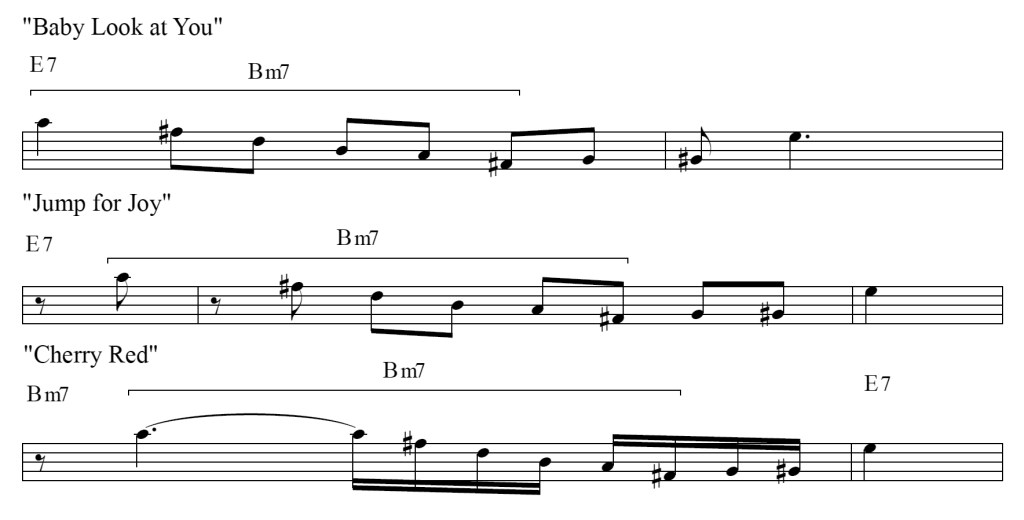
It’s easy to forget that II-Vs, as we know them today, didn’t exist in jazz of the 20s and 30s. There were only V chords. But Buster plays a phrase in all three solos that amounts to a blueprint for the II-V vocabulary that evolved over the next five years. (“Cherry Red” isn’t a blues, but Buster uses the phrase here, as well.)
This is where the repetitive key of C major becomes an advantage, giving us three shots at identifying Buster’s vocabulary in that key. (All examples notated in E-flat, as Buster played them on alto.) Here he is, superimposing (melodically) the II chord [Bm7] over the V chord [E7] in “Baby Look at You,” “Jump for Joy,” and “Cherry Red,” in that order (full tracks below):
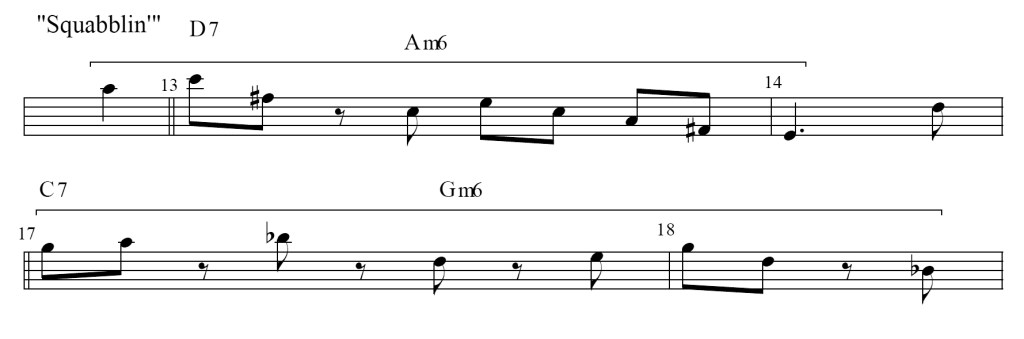
It’s certainly possible, however unlikely, that Buster developed this particular phrase after Bird had left the band, but the same general concept dates back 1929. In his solo on “Squabblin’,” Buster superimposes Am6 over D7 in bars 13 and 14, and Gm6 over C7 in bars 17 and 18:
Back to 1939. So Buster played a phrase in the key of C major that superimposed the II chord over the V chord. If we could find an example of Bird playing a similar phrase in the same key, that might be considered evidence of Buster’s direct influence.
In the 1981 interview with Chris Goddard, conducted for the National Endowment for the Arts Jazz Oral History Project, Buster speaks of Bird’s ability to reproduce anything he heard him play, without asking for explanations.
“He didn’t ask you to show him nothin’. You make it, he’ll make it too. He just listened, and come up behind me and do the same thing I do.”
Bird plays a C major phrase very similar to Buster’s on Take B of “Cool Blues” (February 19, 1947). Here are the two phrases, Buster first, Bird second:
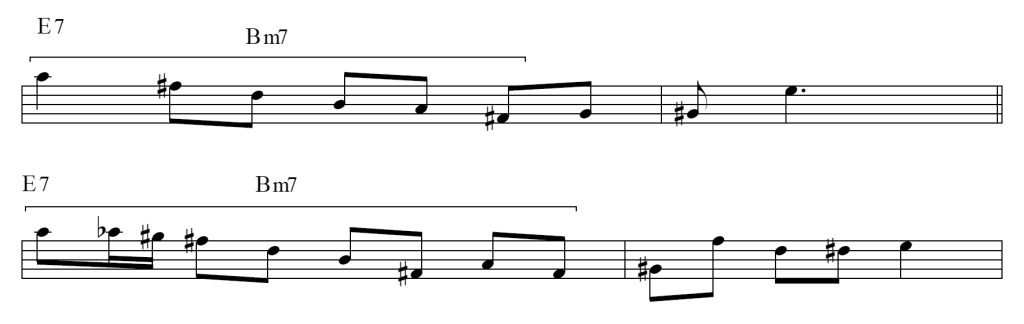
The full phrases aren’t identical, but when you break them down, there’s one exact match (passing tones notwithstanding), and a parallel match.
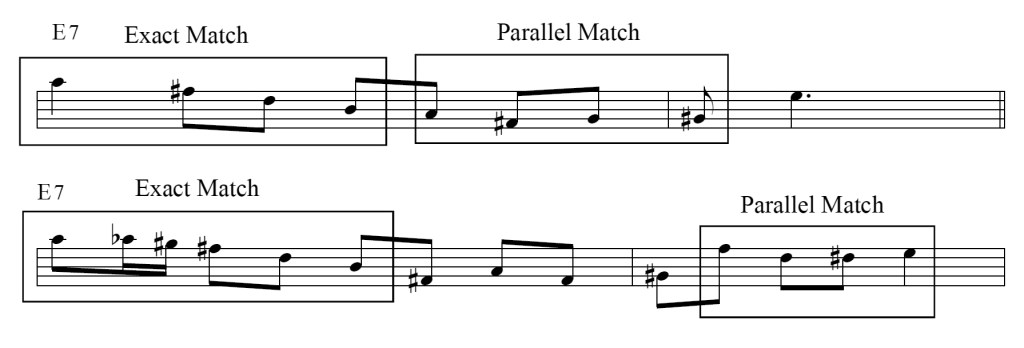
The parallel match is a four note cell that became a lynchpin in Bird’s vocabulary. Buster uses it to outline 4, 2, b3, 3 on the E7. Bird often uses it that way, too, but here he uses it to outline b9, b7, 7, 8 on the E7.
One example does not an argument make, but last time I presented a clip of an uncanny, three-note match that’s persuasive in its own right. Through a twist of fate, Buster and Bird both recorded “Moten Swing” in 1940, Buster on November 11 in New York City, and Bird on December 2, in Wichita, Kansas. Here’s the match, Buster first, then Bird:
This is as much of a smoking gun as anyone can reasonably ask for, and the fact that (barring extraordinary circumstances) Bird couldn’t have heard Buster’s recording makes it all the more striking. He must have remembered Buster playing it on the bandstand.
Two examples are better than one, but I wouldn’t try resting my case here, in part because of a troublesome fact: We can’t be sure it’s actually Buster playing the “Moten Swing” solo in question. Let’s say for the sake of argument, though, that it is Buster. Would that be enough to prove he influenced Bird? Maybe not, but it still advances the argument to the point where other pieces of evidence, inconclusive on their own, might begin to have a cumulative effect.
And there’s a gang of those.
***************************************************
Here are the full tracks for “Squabblin’,” “Baby Look at You,” “Jump for Joy,” and “Cherry Red” in that order:
“Squabblin’”
Walter Page and His Blue Devils Kansas City: November 10, 1929
Hot Lips Page, James Simpson, James LuGrand, trumpets;
Druie Bess, trombone; Buster Smith, Theodore Manning,
Reuben Roddy, saxes; Charlie Washington, piano; Reuben
Lynch, guitar; Walter Page, baritone-sax, tuba, bass; Alvin
Burroughs, drums. Jimmy Rushing, vocal.
“Baby, Look at You,” “Jump for Joy,” “Cherry Red”
Pete Johnson’s Boogie Woogie Boys New York: June 30, 1939
Hot Lips Page, trumpet; Buster Smith, alto; Pete Johnson,
piano; Lawrence Lucie, guitar; Abe Bolar, bass; Eddie
Dougherty, drums. Joe Turner, vocals.

